|
|
|
| Sun revolves around Earth, say 56% |
|
Slartibartfast
Member #8,789
June 2007
 |
Quote: It's by definition.
I think that's what really irks atheists about religious people. That the religious approach tends more towards "we are right by definition" rather than actually explaining things. ---- |
|
Evert
Member #794
November 2000
 |
Quote: The big bang isn't observable, as it (if it did happen at all) happened years ago and has not reoccurred since.
False. Does that mean the big bang model is right? No, but it means that it is consistent with observations and that predictions from the model are confirmed. That's a strong hint. Although the universe was optically thick to photons, it was not so for neutrinos - one of the reasons people are building neutrino detectors: to see what happened before recombination and test the model further. |
|
relpatseht
Member #5,034
September 2004
 |
I've never really understood how looking into the past by viewing the distant universe could possibly allow one to view to any time period even close to The Big Bang. Wouldn't any light concerning that event have started out moving faster than our galaxy (therefore making it further ahead and unobservable)? Along the same lines, wouldn't we have been passed by light from, say, about half of the lifespan of the known universe as well (I may be being generous or stingy, I don't want to look up any numbers)? I'm probably missing something here, but how is that possible? Anyway, on the whole subject, I usually say that I simply am not arrogant enough to believe I could ever know exactly what happened fifty years ago, let alone a few billion. That isn't to say anyone is wrong, just that I don't care how much evidence they have for whatever idea they are pushing as it takes far too much faith to believe it.
|
|
23yrold3yrold
Member #1,134
March 2001
 |
BTW, just got around to watching the video in the OP; funny stuff. The comments made it out to possibly be a fake though. Almost looks like a bad dub job with the lips not quite lining up with the speaking, but then I'm not French so what would I know of it? -- |
|
Evert
Member #794
November 2000
|
Quote: I've never really understood how looking into the past by viewing the distant universe could possibly allow one to view to any time period even close to The Big Bang. Wouldn't any light concerning that event have started out moving faster than our galaxy (therefore making it further ahead and unobservable)? Along the same lines, wouldn't we have been passed by light from, say, about half of the lifespan of the known universe as well (I may be being generous or stingy, I don't want to look up any numbers)? I'm probably missing something here, but how is that possible?
Current determinations of the age of the universe suggest it is 13.7Gyr old. Light that has travelled a distance of 13.7Gyr has been in transit since the universe began. In other words, looking at events that are 13.7 billion lightyears distant means you are looking at events that took place at the time the big bang was created. |
|
Neil Black
Member #7,867
October 2006
 |
Yeah, but wouldn't that light have already passed by Earth?
|
|
BAF
Member #2,981
December 2002
 |
Quote: that there is a God who created us by design, giving us free will to do what we want. That is my belief as a Christian too. Quote: Yeah, but wouldn't that light have already passed by Earth? No. That's the point. If we are looking at stuff that is 13.7 billion light years away, we're looking at what happend 13.7 billion years ago. Now, that is about the extent of my understanding of the space time stuff. I understand the idea behind it, but it is mind boggling to think of space as 4d space/time. Also, I thought Big Bang happened and was long over, without taking into account if it is still going on or not, and without remembering the whole space/time aspect. Is the big bang "still going on?" By that, I mean can we still look billions of light years out and see the universe expanding? |
|
Rampage
Member #3,035
December 2002
 |
Quote: Also, I thought Big Bang happened and was long over, without taking into account if it is still going on or not, and without remembering the whole space/time aspect. Is the big bang "still going on?" By that, I mean can we still look billions of light years out and see the universe expanding? The universe is still expanding as a consequence of the Big Bang, that's how it was detected. The big bang is not quite like a bomb exploding; it's more like inflating a balloon. -R |
|
relpatseht
Member #5,034
September 2004
|
Evert said: that the big bang did not occur at a specific location in space (in other words, it didn't happen 'here' or 'there', it happened everywhere). That is where I'm lost. I really don't see how all matter could be condensed into an infinitely dense point and still have that point be everywhere. It fits with the theory that one could view back to the origin of time, but not with common sense.
|
|
Rampage
Member #3,035
December 2002
|
Quote: That is where I'm lost. I really don't see how all matter could be condensed into an infinitely dense point and still have that point be everywhere. The point was everything, time and space were both in it. When the point expanded, it became the universe. Maybe your common sense tries to imagine a point in the space, but there was no space to be "at". -R |
|
relpatseht
Member #5,034
September 2004
|
It still doesn't seem to fit at all. Well, I suppose if I could make sense out of it then there would be no incentive at all to finish my time machine.
|
|
Rampage
Member #3,035
December 2002
|
Common sense is often wrong. If you were to guide yourself only by it, you'd claim the the sun does orbit around Earth. -R |
|
relpatseht
Member #5,034
September 2004
|
Very true, but this seems to be one of the things I just can't wrap my head around. Not that it matters.
|
|
Don Freeman
Member #5,110
October 2004
 |
-- |
|
23yrold3yrold
Member #1,134
March 2001
|
Quote: Maybe your common sense tries to imagine a point in the space, but there was no space to be "at". So what is the universe expanding into? And where is it expanding from? Quote: What you're missing is that light always moves at the speed of light, independent of the observer and that the big bang did not occur at a specific location in space (in other words, it didn't happen 'here' or 'there', it happened everywhere). The former is a given, so I don't see how anyone's "missing" it. And I'm baffled as to how The Big Bang did not happen at a more-or-less specific location. If it happened everywhere, it didn't bang. I thought the point was that the universe originated from an extremely dense and hot state. "Dense" implies to me it occupied a (relatively) small location. Want to elaborate? -- |
|
Don Freeman
Member #5,110
October 2004
|
23yrold3yrold said: So what is the universe expanding into? And where is it expanding from? Exactly! It is ALL relative to the person/thing viewing it. Space is relative, time is relative, etc. There are strange things we are just beginning to learn about in quantum physics such as particles that are seemingly not connected together, but when one is made to rotate clockwise the other rotates counterclockwise...with NO known forces at work...from great distances away! Incredible! Not only that, but I saw, on one of the science channels awhile back, particles that simple seem to not exist if seen! They are just gone as soon as they are "looked at". Imagine the possibilities for this in secured messaging. You could send data at regular intervals. If the "packet(s)" are gone, then someone has intercepted the "packet". If these "crazy" new things are just now being discovered, I would love to see what is still awaiting us to find out! -- |
|
Evert
Member #794
November 2000
|
Quote: I really don't see how all matter could be condensed into an infinitely dense point and still have that point be everywhere. That's because we are inside it, rather than looking at the explosion from the outside. Everywhere was the single point. Well, maybe. The laws of physics we know are very likely to break down when you get close to a singularity. Quote: So what is the universe expanding into? And where is it expanding from? Not to say those aren't intreaguing questions, but they're metaphysical questions rather than physical. Physically, the universe is not expanding "into" anything and not "from" anything - there is nothing outside the universe, or rather, if there was, it would make no difference since there is no way to communicate with what the universe would be expanding into if it were expanding into it (because you could only do that by transferring information faster than light, which you cannot). Quote: I don't see how anyone's "missing" it. Missing as in "not taking into consideration" in the line of reasoning. Quote: And I'm baffled as to how The Big Bang did not happen at a more-or-less specific location.
Well, I suppose it depends on wether you believe that we occupy a special location in space time. From our perspective, the universe is expanding away from us in all directions. That either means we're exactly at the centre of the universe, or (if you beleive the universe looks more or less the same wherever you are), every point in space is moving away from every other point. Quote: If it happened everywhere, it didn't bang. Not in the sense of the type of explosion you'd see on Earth, no. The name "big bang" is catchy and captures the imagination, but it's an analogy, not an accurate description of what happened. Quote: I thought the point was that the universe originated from an extremely dense and hot state. "Dense" implies to me it occupied a (relatively) small location. Want to elaborate?
The intuitive picture is not easy; the mathematical one in a sense is easier. |
|
Neil Black
Member #7,867
October 2006
|
Don Freeman, why did you have #include <Intelligence.h>? I've seen no evidence of it's use.
|
|
23yrold3yrold
Member #1,134
March 2001
|
Quote: That's because we are inside it, rather than looking at the explosion from the outside. Was this not a given? It sounds like semantics at this point. It was at a single location. Now it's big and spread out. Sure, "Everywhere was the single point", but it was still a single fuggin' point and you're not going to see the "singularity" in the present unless you're on the edge of the mess, even given your raisin-bread analogy. Quote: Missing as in "not taking into consideration" in the line of reasoning. I understand the word. I don't understand how anyone's missing it. I still want to know what's outside of "space". -- |
|
Kibiz0r
Member #6,203
September 2005
 |
What's before time? --- |
|
relpatseht
Member #5,034
September 2004
|
I can understand that the universe is just a scaled up version of what it was when it occupied a single point, but that still doesn't make any clearer how a picture of this single point could possibly be viewed. Unless the speed of light were scaled as well, I entirely fail to see how light from 13.7 billion light years ago which originated at much the same point as we could possibly still be behind us (relatively speaking, of course) considering that light should not (to the best of my knowledge) apply to the scale. Kibiz0r said: What's before time?
|
|
Rampage
Member #3,035
December 2002
|
Quote: I still want to know what's outside of "space". It's impossible to know, since we can't detect or communicate with anything outside our space (at the present time). Who knows? Maybe there are other Universes outside our own. -R |
|
X-G
Member #856
December 2000
 |
I'll steal an analogy from Hawking and say: Asking what's "outside of space" or "before time" (or for that matter, before the Big Bang) is like asking what's north of the North Pole. -- |
|
bamccaig
Member #7,536
July 2006
 |
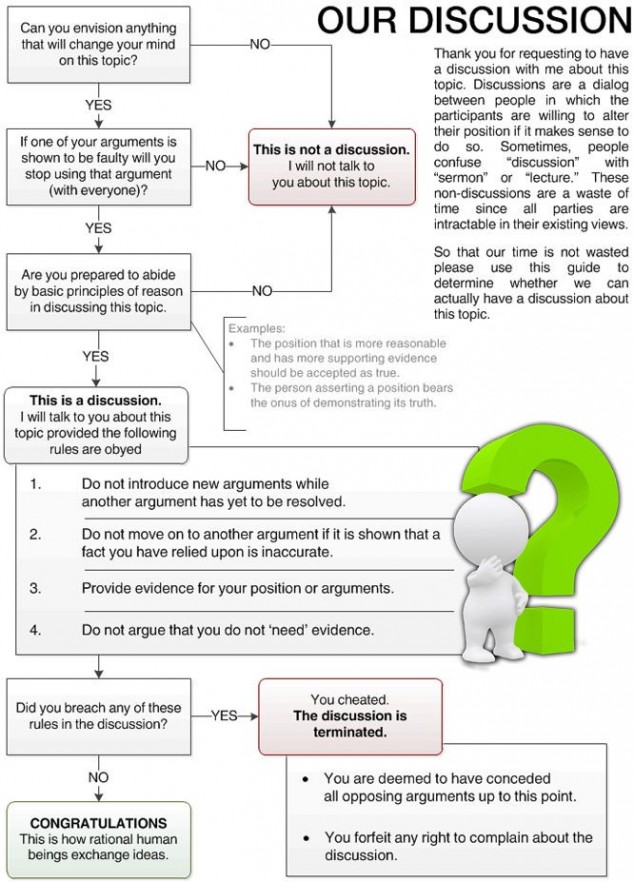
@The Big Bang IMO, time never began and the 'universe' was never created. Until we know otherwise I imagine space and time to be infinite. Space never changes so if you applied a coordinate to a particular spot in 3-dimensional space that spot would always be the same. However, matter and energy move throughout that space. Without studying the theory thoroughly, I believe the Big Bang did happen at a particular place (because IIRC scientists can trace the galaxies' movements back to an origin point). In other words, the universe always was and the matter that we now know to be galaxies and the like were somehow formed during the Big Bang. As I recall, matter, light, everything, is really just energy and I believe that energy just always was. Perhaps over time the energy that makes up our galaxies, etc., will be released back into pure energy, eventually collapsing in on itself and resulting in another Big Bang. All this talk of space and time being created by the Big Bang are IMO just as silly as God. I've never seen or heard of any indication that space nor time actually begin or end. @Viewing The Past I agree that it's probably not feasible to see the Big Bang or the like. That light would have moved past us long ago and/or have been altered by matter and energy collisions. I don't see it as a feasible expectation to really ever see the Big Bang event that brought us our galaxies. It might be feasible to recreate it in the distant future or perhaps model it with computers, though that's also somewhat far fetched. -- acc.js | al4anim - Allegro 4 Animation library | Allegro 5 VS/NuGet Guide | Allegro.cc Mockup | Allegro.cc <code> Tag | Allegro 4 Timer Example (w/ Semaphores) | Allegro 5 "Winpkg" (MSVC readme) | Bambot | Blog | C++ STL Container Flowchart | Castopulence Software | Check Return Values | Derail? | Is This A Discussion? Flow Chart | Filesystem Hierarchy Standard | Clean Code Talks - Global State and Singletons | How To Use Header Files | GNU/Linux (Debian, Fedora, Gentoo) | rot (rot13, rot47, rotN) | Streaming |
|
Rampage
Member #3,035
December 2002
|
Quote: IMO, time never began and the 'universe' was never created. Until we know otherwise I imagine space and time to be infinite. Quote: Space never changes -R |
|
|
|


 Still funny.


 Maybe that is how you can just "feel" when someone is looking at you!