Holy crap, anyone else watching the news right now?! There is a tsunami too, with house floating away, and they're on fire!
I hope they're better prepared for it than we were. Luckily(?) though, with their record of quakes, they should be.
HOLY SHIT... 8.8, it's been a long time since we have seen such a powerful one 
I'm not a believer, so may they be lucky. Mother nature was harsh on that one.
The Wall Street Journal news alert reported the EQ was 7.9. Sad I didn't sell Nikkei 225 immediately..
I'm hearing 8.9, 8.4 in Tokyo, aftershocks as high as 7.1, Fukushika hit with 7ft tsunami wave.
Hawaii will be hit by estimated 2 meter high tsunami in about 3 and a half hours.
Sad I didn't sell Nikkei 225 immediately..
Its sad that that's what you find sad.
Its sad that that's what you find sad.
Indeed it is. I'm sorry for your personal loss. However I'm quite ignorant about disasters in general, too used to hear about them. Also if I can't do anything about it, why would I even care.. ?
Yet on the other hand, it is very likely I lost a good chunk of my morality during the latest couple of months due to a series of unpleasant events.

Now check out the massive wave of debris at ~0:28:

Scary shit.
Wow, I'm glad my wife was back in the USA when that happened... she was just over Japan that day.
That is... I don't know what to say. It could have been a lot worse I bet. They've been working on quake proofing for decades. Lets hope everything goes ok.
Now this is interesting. Or I've been hanging around radiation physicists for too long.
Lets hope they can get the reaction cool. Wouldn't want it to go critical or anything.
Now this [edition.cnn.com] is interesting.
No, this is potentially the most sad thing in the whole story. Perhaps after me not selling Nikkei 
Lets hope they can get the reaction cool. Wouldn't want it to go critical or anything.
The reactor has been shut down, so it's no longer critical. The cooling is for the residual decay heat - still a problem, but much more manageable. But remember this: even if they completely fail to cool it, that doesn't mean a release of radioactivity.
And everything I've read points to the evacuation being purely precautionary.
even if they completely fail to cool it, that doesn't mean a release of radioactivity.
Good. I was hoping there wasn't a way for a reactor to fail even after the shutdown was started.
WoW! This is not the kind of news I like to wake up in the morning. First of all, I'm rather impressed with the engineering and how they can sustain an 8.9. Unfortunately, it appears the ocean is unstoppable.
Oh, the reactor can still fail. It's just that even if worst comes to pass and it melts, that doesn't necessarily mean that any radioactivity will leave the building. 
Containment buildings are built to absolutely ridiculous standards.
I hope they're better prepared for it than we were. Luckily(?) though, with their record of quakes, they should be.
Seismologists say the quake was 160 times more powerful than the one that devastated Christchurch last month.
The quake was the largest to hit Japan, the fifth strongest tremor worldwide since 1900 and the seventh strongest in history, according to the US Geological Survey and Japanese seismologists.
http://www.abc.net.au/news/stories/2011/03/11/3162153.htm
It took me a minute to realize the barely visible bits of "debris" in gnolam's videos were actually cars, and the larger pieces were buildings.
How close is Japan to New Zealand? I wonder if the tsunamis will reach, or affect them.
I'm frankly amazed at the low death toll. Japanese building codes must be something special.
Indeed, apparently they were even sort of expecting it to happen.
I think they've been waiting for this to happen since the last big one. I know it doesn't make me smart, but I've seen a bunch of those documentaries on buildings, and Japan's codes are some of the strictest. And rightly so since they sit directly on at least one major very active fault line. AFAIK there are several mild earthquakes per year.
Now, I'm not sure if this is accurate, but some people have been theorizing that earthquakes can and will cause more earthquakes along nearby faults. One of the ideas is that fault likes can act a bit like a zypper. When one point of friction lets go, the energy and force stored there, "unzips" to the next point which causes that one to pop, and the next... etc. And another idea is that the movement caused by one earthquake can cause another to go. Similar idea, but different semantics.
Given the large earthquakes in the region the past year, it doesn't seem all that far-fetched to me any more. China, New Zealand, and now Japan. Crazyness.
IANAG.
Now, I'm not sure if this is accurate, but some people have been theorizing that earthquakes can and will cause more earthquakes along nearby faults.
Aftershocks.
Aftershocks.
Not the same thing as a quake happening in a different location shortly after another quake.
Ok, it's a far-off, delayed aftershock... 
I heard about this, and I immediately hopped on Facebook to contact my friend in Japan. Thankfully, she was all right.

That video really brings home just how destructive a tsunami is - it's not the height of the waves, it's that there's nothing that stops them. There's just too much water and too much momentum. 
Nuclear reactor dangers stay.
The nuclear power plant risks have been greatly exaggerated by the media. Even now, radiation levels outside the plant are perfectly safe -- they're even safe inside the plant. Several times of nothing is still nothing. Nuclear power plants come with a shitload of safety measures.
Nuclear power plants come with a shitload of safety measures.
True indeed, and you're probably right about the exaggerations. Chernobyl did take place though.
Sigh. Not this shit again. Chernobyl was badly designed, badly built, badly maintained, old as balls, and the operators fucked up big time. Chernobyl is nothing like this incident.
You sound confident. I believe you.
The Japanese plants are badly designed, too! The plants themselves can stand earthquakes, but the power supply system to the plants obviously can't. And that is causing the problem now.
• Explosion reported at nuclear plant in northeastern Japan
• Blast happened while workers tried to cool nuclear rods
• Japan's nuclear agency says radioactive cesium is detected in the air near one plant
• There is a strong possibility that the melting of a fuel rod caused the leak, the agency says

[EDIT]
I'd just like to point out how awful the news reporting around this is.
The one technical detail I could find before the boom was in New Scientist's twitter feed:
"1050 mSv radiation around Fukushima nuclear plant not life-threatening but exceeds national safety level", which was later corrected to "that's 1050 microSieverts of radiation detected at Fukushima , not milliSv".
... which is complete nonsense. A sievert is a unit of absorbed equivalent dose - saying that there are "x µSv of radiation" somewhere makes no sense whatsoever. Now, dose rate - dose per unit of time (e.g. µSv/h) - would be a perfectly fine way of expressing the level of radiation. But without that unit of time it makes about as much sense as saying that something "draws 200 joules of power".
And the only news channel I've found that actually has an expert instead of just a talking head is the BBC - and even they make inane "who'da thunk it" statements. What, it "might be steam or hydrogen" exploding instead of the core itself? Really. You don't say.
Two scenarios may have lead to that explosion visible in that link. Both scenarios include fuel rods melting.
Not necessarily. The two possible causes are either a hydrogen gas explosion or a steam explosion. All you need for either of them is plenty of heat. Enough heat and you get a meltdown, yes, but all a meltdown means is that... well... the fuel melts. It's an orthogonal issue to explosions.
But at this point, I'd be surprised if it didn't start melting soon, if it hasn't already...
The questions now are a) what caused the explosion, and b) how much damage did the explosion cause?
Whatever's happened, there's now been an uncontrolled release of radioactivity. What's unsure is how much: was it just the surrounding concrete structure that went kablooey, or has the reactor vessel itself been pierced? If the former, the release will be limited to mildly radioactive steam. If the latter, then the explosion and smoke could contain any of the nasty stuff that's in the core.
I don't post here often in recent years. Just posting to say that I'm alive and well. The quakes are hitting up at the North, but still clearly felt here (Izu peninsula). I'm worrying about the Fukishima plant, but also about the quakes that still continue for more than three days already. This may trigger quaking in the other areas along the plate boundary. In our area tsunami was only about 3 meters high, so no damage. However I don't go near shore. Of course up north it's a disaster. I'm glad I was not in Tokyo yesterday, or I'd be stuck there. Also we are expecting blackouts due to many power plants shutting down.
Map of the recent quakes (almost realtime)
Wish us luck.
Best of luck in overcoming the disaster.
Kirr: good to hear!
And now: Mmm, humanity...

I thought everyone got over Pearl Harbor, right around the same time they got over the nukes we dropped in retalliation. 
People are idiots. That is all, let's move back to the sad news now.
I also love how the news channels, as usual, are spreading nuclear FUD. They're whining and crying how the US was finally going to start building nuke plants, electric vehicles, etc., because people were starting to feel that nuclear power was safe, and now people will be rethinking that. Instead of, you know, pointing out that these are 40 year old nuclear plants, that nothing majorly bad as happened yet, and that newer plants are safer.
Kirr, I'm glad you're ok! I hope Japan is able to get things sorted asap.
I also love how the news channels, as usual, are spreading nuclear FUD.
Yeah, the timing sucks, but to be honest, this is actually a rather decent result. It could have been a hell of a lot worse, and it wasn't. If all you have to do is make sure there's enough reserve power to handle the cool down during a natural disaster, then I really don't think theres any problem with nuclear power. Especially up here in Canada. About the only thing we have to worry about up here is another ice age (excepting Vancouver who actually sit on/near a fault line).
He's probably trying to get banned, just to see what happens. (See this for context.)
If all you have to do is make sure there's enough reserve power to handle the cool down during a natural disaster, then I really don't think theres any problem with nuclear power.
Yeah, as long as you can make sure of that. They had several backup sources in this case in Japan, battery backup, generators, etc., but the tsunami screwed that up. From what I've been able to gather, they ran off batteries until they were depleted, and then were stuck because the backup generators were flooded and the power grid was down so they couldn't pull from that. I'm not sure why they couldn't fly in backup generators - I heard at one point that Japanese military was working on bring some in via ground and the US Air Force was attempting to fly them in. Kind of ironic, in a sick and twisted way, that a power plant would have total loss of electricity.
At any rate, aren't the newer designs self regulating to an extent? I think they're all pretty much "walk-away safe," meaning that they're able to regulate their own temperature and such.
At any rate, aren't the newer designs self regulating to an extent? I think they're all pretty much "walk-away safe," meaning that they're able to regulate their own temperature and such.
I bet they are, as long as they've power..
I checked out CNN after reading that the media over blowing it in this thread. That channel is so creepy sometimes. The "newscaster" (it was "the situation room", that doesn't sound like news) was speaking about an unnamed, untitled guy "from inside the reactor" that "was quoted as saying" there may be the "possibility" of a meltdown. She said it three times in different ways, stressing "possibility" each time, and then it went on to the next concern.
I didn't watch long enough to want the gold and antidepressants. 
More sensations more profits..
Good luck, Kirr! I was wondering before if something may have happened to you, glad you're ok ...
I bet they are, as long as they've power..
If they require external power/influence, then that means they aren't self regulating...
At any rate, this blog post seems to have actual information and explinations from people who actually know what is going on and what happened, rather than sensationalist OMG MELTDOWN bullshit. Though I do have to question that they couldn't hook up the backup generators "because the plugs didn't fit." I would expect a power plant to have engineers who could make it work; electricity is electricity, and non-matching plugs should only be a brief setback; so there must be more to the story yet that isn't being told.
If they require external power/influence, then that means they aren't self regulating...
They had some other power generators(diesel I bet), which failed..
I'm not talking about the Japanese reactors; they're fairly old. I'm talking about newer designs.
At any rate, this blog post [morgsatlarge.wordpress.com] seems to have actual information and explinations from people who actually know what is going on and what happened
It gets so many facts wrong.
Like calling control rods "moderator rods"[1], or describing them as only being used to stop the reaction completely[2], or implying that the uranium is what's dangerous if released, rather than the way way nastier 137Cs (a strong gamma emitter) for example. Or this one:
The intermediate radioactive materials (Cesium and Iodine) are also almost gone at this stage, because the Uranium decay was stopped a long time ago.
The half-lives of 131I and 137Cs are 8 days and 30 years, respectively, and the uranium decay hasn't stopped - the uranium fissioning has been stopped.
References
- The water is the moderator. Slowing down neutrons != absorbing neutrons.
- They're used under normal operations to regulate power output.
Here are some before-and-after photos of selected areas.
http://www.abc.net.au/news/events/japan-quake-2011/beforeafter.htm
Pretty saddened by this. Having increased my contact with Japanese culture in the last years (still haven't traveled there, but now I am founder and editor of a fansubbing group), this was a terrible shock, as many of our cappers/translators are in Japan (including one who was actually in Sendai when this all happened).
And now the nuclear problems. It is an absolute tragedy.
Oh hey, and now there's a volcano acting up. Cut this country a break ... geez.
And now the nuclear problems
They are not as bad as TN claims them to be  actually, it's a testament of Japanese building skills that the nuclear plant survived a quake that was 7 times stronger than it was designed for. In any case, I share the feeling though, I hope that they can find some of the missing people!
it's a testament of Japanese building skills that the nuclear plant survived a quake that was 7 times stronger than it was designed for
But that's only a partial truth. The quake caused the tsunami. The plant is at the shore. Either the tsunami or the quake caused the power failure, which made the cooling system fail. Things are not as they should be at the plant. That said, I do believe they will fix the problems and the world will see that they handled the situation well.
Just posting to say that I'm alive and well.
Keep it like that !
Hope you'll overcome that with not that much problems, Good luck man !

I wasn't even aware of the quake until I saw the news. In Osaka, we got shaken up a little, but nothing major. Even then, I was out of the city at the time.
I'm more than a little concerned, as I have friends in the affected area.
And goodbye reactor building #3.

No doubt about it being hydrogen this time...
They pumped sea water either into the reactor vessel or the containment (it's not clear yet). Either way that's pretty bad, because that's basically the last resort when you have nothing else left to remove the residual heat from the reactor. It also means those reactors won't be running ever again. Not much will go into the environment though, that's nonsense exaggerated by the media...
By the way, those explosions are nothing to be worried about really...
They pumped sea water either into the reactor vessel or the containment (it's not clear yet).
Sea water/boric acid mix into the reactor vessel itself.
It also means those reactors won't be running ever again.
Better because of the cooling meassures taken than by a meltdown. If I'm not mistaken meltdown of the reactor fuel can threaten the integrity of the vessel itself, am I right? (Correct me if I'm wrong, please).
Sea water/boric acid mix into the reactor vessel itself.
Ah, so my sources weren't up to date. I'm reading the latest official report right now: http://www.jaif.or.jp/english/news/2011/110314fukushima_event-status-1.pdf
Better because of the cooling meassures taken than by a meltdown. If I'm not mistaken meltdown of the reactor fuel can threaten the integrity of the vessel itself, am I right? (Correct me if I'm wrong, please).
Yes, because it would be virtually impossible to clean up the whole system. Just think of all the dead fish in there
Aha, nice summaries. I've been following TEPCO's press releases instead.
That link doesn't work for me.
But that's only a partial truth. The quake caused the tsunami. The plant is at the shore. Either the tsunami or the quake caused the power failure, which made the cooling system fail. Things are not as they should be at the plant.
True, but take into account that the power plant's design is very old by today's standards since it is a Mark I reactor (in fact, reactor I was scheduled to be retired soon) and at the time BWRs required active cooling. Supposedly newer designs have passive cooling which would eliminate / mitigate these kinds of problems (not sure if there are any in operation though).
I think that something we should be able to agree upon is that we shouldn't build nuclear power plants so close to a sea shore susceptible to tsunamis.
Am I the only one who really knows whats going on here....?
GODZILLA!
That link doesn't work for me.
Eh, now it works, but very slowly.
The explosion took place Monday morning at the No. 3 reactor of the Fukushima Daiichi nuclear complex, the same place where a failure to cool overheated fuel rods at the No. 1 reactor resulted in a similar blast on Saturday. That explosion also damaged a pump used to bring in sea water for added cooling, the government's Nuclear and Industrial Safety Agency said at a briefing Monday evening. The agency said the fuel rods at the No. 3 reactor are now fused together.
Could anyone explain what does that mean?
I think that something we should be able to agree upon is that we shouldn't build nuclear power plants so close to a sea shore susceptible to tsunamis.
The reason you build plants close to the sea is so you can run the last heat exchange on seawater in an open cycle, and thus don't have to build large, expensive cooling towers.
Could anyone explain what does that mean?
Partial melting of the fuel rods.
So it's far beyond control. I suppose the reactor design shouldn't let too much of it out, but.. It's likely reactors are permanently unusable, right?
Append:
And no, I don't plan to sell Nikkei anymore 
The reason you build plants close to the sea is so you can run the last heat exchange on seawater in an open cycle
Good point. They should upgrade the plants to have a backup passive cooling system then.
I just came across this. Words fail me.
23, you're late.
Really? Sorry; I didn't see it here (still don't). Just had a friend link it on Facebook and thought the ignorance was amusing.
EDIT: NM, I see it now. Er ... post++!
The reason you build plants close to the sea is so you can run the last heat exchange on seawater in an open cycle, and thus don't have to build large, expensive cooling towers.
Are you sure? Because It is probably the first time in the industry's 57-year history that seawater has been used in this way, a sign of how close Japan is to facing a major nuclear disaster following the massive earthquake and tsunami on Friday, according to the scientists.[1]
There is a very nice video in the NHK showing the three cooling stages: the electrical one that is usually used, the diesel one, and the condensation one. The sea water was a last try that had never been planned. In fact analysts in the same article admit that Japan has already sacrificed those reactors, as they will likely become completely damaged by using this seawater to cool them down.
References
Are you sure?
They (normally) use it to cool the cooling water, afaik. Instead of cooling it in cooling towers.
Are you sure? Because It is probably the first time in the industry's 57-year history that seawater has been used in this way, a sign of how close Japan is to facing a major nuclear disaster following the massive earthquake and tsunami on Friday, according to the scientists.
Yes. What they're doing now, which has apparently never been done before (because, as miran pointed out, it's tantamount to junking the reactor), is injecting the seawater directly into the reactor.
The reason you build plants close to the sea is so you can run the last heat exchange on seawater in an open cycle
(Emphasis added)
The reactor coolant loop is always completely closed (both because you want the coolant to be as pure as possible, and because it will become slightly radioactive) - in a boiling water reactor, the coolant water goes through the reactor core, boils into steam, goes through a turbine to produce electricity, and then goes back in after condensing back to liquid water. The seawater never goes anywhere near the reactor. Rather, the seawater is used to cool the steam in the condenser (basically, a big heat exchanger - so the two never mix).
Oh hey, Wikipedia has a diagram:
{"name":"740px-Schema_reacteur_eau_bouillante.svg.png","src":"\/\/djungxnpq2nug.cloudfront.net\/image\/cache\/3\/3\/3370bce98934e9d432ee725cc2875dbf.png","w":740,"h":431,"tn":"\/\/djungxnpq2nug.cloudfront.net\/image\/cache\/3\/3\/3370bce98934e9d432ee725cc2875dbf"}
The condenser is #12.
If you draw the condenser's coolant from the sea (or a nearby river or lake), then you can run it on an open cycle: pump as much as you need to run it through once (the Swedish plants require 20-40 m3/s), and then just dump it back out somewhere. If you can't do that, then you have to reuse it - and that means cooling it yourself. Which in turn means huge cooling ponds or cooling towers.
This isn't unique to nuclear plants, BTW - any thermal power plant (coal, oil, gas...) has the same problem.
Aha, gotcha, thanks for the explanation.
... and it looks like #2 just went up as well.
From the BBC's feed:
2308: An explosion is heard at Fukushima's second reactor, the Kyodo news agency reports.
2311: The news agency said the blast was heard at 0610 local time on Tuesday (2110 GMT Monday). No other details were immediately announced.
2316: Kyodo now says that the suppression pool may have been damaged at the second reactor.
...
2333: More details on the reported blast at Fukushima's reactor 2. The explosion is feared to have damaged the reactor's pressure-suppression system, Kyodo says. It adds that "radiation tops legal limit" after the explosion.
2340: Tokyo Electric officials are now holding a news briefing. They say the blast at reactor 2 happened "near the pressure vessel". They also confirm that some staff at the nuclear power plant are being evacuated.
From Kyodo News:
08:28: Higher radiation levels measured in Ibaraki -- south of Fukushima
08:33: Radioactive materials feared to be leaking
09:41: Fukushima's No. 2 reactor container damaged, radiation leak feared
11:14 Fire occurs at Fukushima plant's No. 4 reactor
... WTF? #4 wasn't even active when the quake hit.
Hydrogen explosion occurs at Fukushima No. 4 reactor
... I think I'm going to give up updating this now.
[EDIT]
Feed updates.
http://www.jaif.or.jp/english/news_images/pdf/ENGNEWS01_1300157986P.pdf
It looks very very very bad. Cores in reactors #1 and #3 are severely damaged (possibly melting), but that's not really much of a problem, that's still under control, but #2 is in serious trouble. It seems the reactor vessel has been damaged which means that when they vent the containment to reduce the pressure (which is necessary, otherwise the containment would be destroyed), they also let a lot of radioactive material escape into the environment. Radioactivity at the site border has increased by several thousand times since the explosion at #2.
allegro.cc is delivering better info than the news! Not that that's really hard to do, I guess, seeing that I get American news.
I'm a bit confused about how it works.. If it is overheating, why then can't the heat be used to generate power to remove the heat.. ?(oh well, or send energy to network giving it to those need it)
If it is overheating, why then can't the heat be used to generate power to remove the heat..
You want to go in and install a steam turbine unit personally?
Latest update: http://www.jaif.or.jp/english/news_images/pdf/ENGNEWS01_1300168169P.pdf
There's also trouble at unit #4 which was down for maintenance at the time of the quake, but the problem occured with the spent fuel pit. Spent fuel still gives off significant amounts of heat years after it's taken out of use, so it needs to be cooled down (spent fuel is usually stored on site for decades after it has been used). With the cooling systems offline the temperature in the spent fuel pit went way up, hydrogen formed, it accumulated in the building, then there was an explosion and now there's a fire. I think the same thing could easily happen at units #5 and #6.
Radiation at the site is getting quite significant. People within 20km of the site are being evacuated and pepole within 30km are asked to stay inside. There's always some background radiation (from the earth, the sun, etc.) with the worldwide average being about 0.27μSv/h (here at our site we measure about 0.07μSv/h, I don't know what it is in Japan because it varies locally). The current rates are 38.5μSv/h at Fukushima 2 (that's about 150x background) and 8217μSv/h at Fukushima 1 (about 30.000x background).
Btw, it's interesting how only Fukushima 1 is having problems while Fukushima 2 which is located only about 10km away is relatively OK.
You want to go in and install a steam turbine unit personally?
Guess some other time. Although the Japanese have robots
But anyways.. Nuclear power plant is hell of a costly project.. And cooling isn't planned to run.. "this way"?
Or was it planned, but got damaged?
Or was it planned, but got damaged?
Gnolam posted a good diagram that shows how cooling is done.
When the reactor shuts down, the residual heat is initially only about 2 or 3% of total reactor power and quickly goes down. This isn't nearly enough power to make sense to design the plant in a way to use this residual heat to generate electricity after the core is shut down. It's still a significant amount of heat though and needs to be removed somehow otherwise pressure would build up until the reactor vessel exploded. In normal operation when the reactor is shut down for refueling, residual heat in BWR type reactors is removed by pumping primary coolant through the primary loop and cooling that in the secondary loop with whatever cooling system is installed (cooling towers, river, lake, sea). The primary loop is completely sealed and the heat is transfered to the secondary loop with a heat exchanger and then that is transfered to the secondary coolant in a large condenser. All this normally takes a few days to complete. The pumps that pump the water in both loops are powered by an external power source (i.e. the national power grid or a dedicated backup power plant). In case the power grid is obliterated in some sort of freak natural disaster (e.g. a tsunami), on-site diesel generators are used to provide power (every plant stores enough diesel fuel to cool down the reactor just with the diesels). In case the diesels too are destroyed (tsunami), there are also backup accus to provide power for the most essential systems, but they last just about 8 hours, which by design should be enough time to bring external power or diesels online. In the case of Fukishima it took them longer than that, so for several hours the reactors were left without cooling. This resulted in increased pressure in the reactor vessel where steam formed and that had to be vented out quickly before the fuel melted. This meant that a lot of primary coolant was lost and the only way to replace it quickly was to inject sea water into the reactor as soon as power was available.
This isn't nearly enough power to make sense to design the plant in a way to use this residual heat to generate electricity after the core is shut down. It's still a significant amount of heat though and needs to be removed somehow otherwise pressure would build up until the reactor vessel exploded.
When there's pressure you can use it to generate power.
Append:
The primary loop is completely sealed and the heat is transfered to the secondary loop with a heat exchanger and then that is transfered to the secondary coolant in a large condenser. All this normally takes a few days to complete.
What "all this"?
Append1:
Erm. Okay. But I still don't understand why not power the pumps with the actual heat.. Furthermore, the inner cycle isn't pumped, as I understand all the idea of a power station is to use the pressure of the inner cycle to generate power...
When there's pressure you can use it to generate power.
Not nearly enough to make sense.
But actually 2nd generation BWRs are designed in such a way that they can use steam from residual heat to power a small turbine to power a pump that provides at least a little bit of cooling in case everything else fails. Unit #1 is 1st generation and doesn't have that system, that's why it was the first to go.
What "all this"?
Cooling down of the core to a manageable temperature and pressure.
Furthermore, the inner cycle isn't pumped, as I understand all the idea of a power station is to use the pressure of the inner cycle to generate power...
No, the primary coolant has to be forcefully pumped through the reactor core. Well, the primary loop is actually designed so that there is some natural recirculation (same effect as a chimney) but for the cooling to be really efficient, the coolant (water) has to be pumped through.
Hopefully I've gotten some basic understanding of the state of things. Thank you.
Allegro.cc, where to be a member, you must be able to check off at least 20 of these items:
[ ] Allegro expert
[ ] Biblical expert
[ ] Child-rearing expert
[ ] Dog training expert
[ ] Expert expert
[ ] Fitness expert
[ ] Gun control expert
[ ] Hacker expert
[ ] Investment expert
[ ] Japanese expert
[ ] Kitten loving expert
[ ] Language expert
[ ] Medical expert
[ ] Nuclear power expert
[ ] Ophthalmologist expert
[ ] Psychological expert
[ ] Quality control expert
[ ] Relationship expert
[ ] Sex expert
[ ] Trolling expert
[ ] Urologist expert
[ ] Video game expert
[ ] Women expert
[ ] Xenophobia expert
[ ] Yoga expert
[ ] Zen expert
You left out Pepsi(TM) expert!
@Matthew: Is there anything wrong about being an expert in something? 
That's was self pleasure. 
Ninja edit:
The crisis is going mad, number 3 and 4 are hit
And now (10h38) two breach of 8 meters are appearing on the number 4 !!
Now what are your estimations of the risk of melting ?
They're at level 6 of 7. Tcherno was the level 7... It's going bad my friends
And naturally, the knee-jerk mouth breathers are out in full force.
EU energy chief Günther Oettinger has said Europe should consider whether it can meet its energy needs without nuclear power, Reuters reports.
Let me think about that for a minute... hmm...
NO
No no no no, big fat NO.
Building 100 coal plants is not an option.
Let's hope that guy doesn't get put in charge of transport. Then we'll have to stop flying after the first plane crashes.
And naturally, the knee-jerk mouth breathers are out in full force.
The Japanese are scamming us! I just checked Japan on Google Streetview and everything was fine!"
Building 100 coal plants is not an option.
The choice doesn't have to between coal and nuclear.
For starters:
building a wind park (or even a single generator) in the Netherlands requires about 100 official permissions, and for every single one, there is at least one interest group that can file a complaint and delay the procedure
although it is possible to build energy neutral homes (that is, homes that produce as much energy as they consume under normal use) at lower total cost of ownership than conventional homes, even in the Netherlands, the overwhelming majority of homes built today is not energy neutral
Also, three more arguments against nuclear (fission) power, apart from the fact that it's pretty damn stupid to build a nuclear reactor on a tectonic plate fault, and disregarding the general safety controversy (which basically boils down to "nuclear energy is safe" - "no it's not" - "is too" - "is not" ...):
fissionable materials are scarce, even more so than fossile fuels; if we were to use nuclear power for all our energy needs, we'd probably run out of fissionables long before fossile resources are depleted
fissionable materials are found in politically questionable countries; it's bad enough to depend on the oil nations, but depending on Russia and corrupt African leaders is not a nice thing
even if we used all the available production capacity for building nuclear plants, we could maybe double the capacity over the next 30 years - but since we're now at about 5% nuclear (unless I remember wrong), that would get us to 10%, still leaving the other 90% unaccounted for.
The choice doesn't have to between coal and nuclear.
It pretty much is.
You mention wind power. The world's largest wind farm (Roscoe) produces 781.5 MW (and I can't even find if that's average or peak, so I'm going to be a cynic and assume the latter) and covers 400 km2. 782 MW is less than a single reactor.
Hydro? Already at capacity.
Photovoltaic just isn't an option for large-scale power generation. You mentioned the scarcity of fissile materials? That's nothing compared to the scarcity of the exotic (and, BTW, usually incredibly toxic) elements PV cells rely on. We're running out of those right now.
Solar thermal, OTOH, is a real option - if you're at a low enough latitude.
Biofuels? Again, not an option for large-scale power generation. You just can't produce enough (and, aside from when you're just using waste products, it's actually worse for the environment than burning fossil fuels).
And most of these suffer from the usual problem with renewables: huge fluctuations in output coupled with the inability to adjust production according to demand.
So basically, all our options have incredible flaws. What exactly does this mean?
That there are a couple of billion too many of us.
It's the top 20% that cause the problem. How about we get rid of them... us... oh dammit...
Bye guys ...
push the red button
So basically, all our options have incredible flaws. What exactly does this mean?
The tragedy will come.
That there are a couple of billion too many of us.
All governments should adopt that 1-child-max policy China is said to have had at one point. Within 100 years or so we should manage to have only about 1 billion people left (at which point the policy could be changed to allow 2 children again). Probably 100 million would be a more sane number than 1 billion given the size of the planet but can think about that then. It would solve virtually all environmental and energy problems and nobody needs to be killed along the way...
All governments should adopt that 1-child-max policy China is said to have had at one point. Within 100 years or so we should manage to have only about 1 billion people left (at which point the policy could be changed to allow 2 children again). Probably 100 million would be a more sane number than 1 billion given the size of the planet but can think about that then. It would solve virtually all environmental and energy problems and nobody needs to be killed along the way...
Russia wouldn't agree. Although it's what it virtually has anyways. Countries who's ambitions don't match their population will be "offended", we're yet to mature up to be able to take these decisions.
And most of these suffer from the usual problem with renewables: huge fluctuations in output coupled with the inability to adjust production according to demand.
Shouldn't it be possible to store energy from the peak production in giant flywheels (or something), to even it out and have a "reserve"? (assuming you have a surplus on average).
And naturally, the knee-jerk mouth breathers are out in full force.
Please stop using that term. It makes you look incredibly stupid.
Let's hope that guy doesn't get put in charge of transport. Then we'll have to stop flying after the first plane crashes.
You were faster than me. By the way Austrian greeners (or how to call them) are getting quite nervous and from what I've heard they want some kind of testing on all plants. I guess we together with Germans are going to be their first target Anyway I don't think they'll be able to find an non-nuclear option for the Europe for upcoming, let's say, 30 years, so I wouldn't be worried that much. On the other hand, we're talking about bureaucrats from Bruxells...
fissionable materials are found in politically questionable countries; it's bad enough to depend on the oil nations, but depending on Russia and corrupt African leaders is not a nice thing
If I'm not terribly mistaken we still have uranium deposits. In the past it has been mined and transported into then Soviet Union for refinement. All it needs is to persuade the government and people[1] to renew mining operations.
References
- And probably get rid of a green party, which in my opinion does more harm than good
Shouldn't it be possible to store energy from the peak production in giant fly-wheels (or something), to even it out and have a "reserve"? (assuming you have a surplus on average).
Already being done, though not through this exact mechanism. What you need is a mountain and two lakes at different altitudes. You build a pipe that connects them, and a power plant that can act both as a generator and a pump. When there's excess energy in the network, it pumps water from the lower lake into the upper lake, acting as an electrical pump. When the energy is needed again, the flow is reversed, and the pump now acts as a turbine and the motor as a generator. This is, to my knowledge, the most efficient way to store large quantities of energy; the best part is that it doesn't matter how long you store it - the water levels won't change much by themselves, unlike other storage mechanisms which generally lose energy over time. The downside is that it's pretty hard to find suitable locations for such a thing.
All governments should adopt that 1-child-max policy China is said to have had at one point. Within 100 years or so we should manage to have only about 1 billion people left (at which point the policy could be changed to allow 2 children again). Probably 100 million would be a more sane number than 1 billion given the size of the planet but can think about that then. It would solve virtually all environmental and energy problems and nobody needs to be killed along the way...
This would lead to negative population growth, and the fact that we keep getting older, combined with the way our economy works, is a recipe for disaster. Best case, overall population goes down worldwide, negative population growth is compensated for in the rich countries through immigration and gets worse in the poor countries; we end up with the same number of people that now is the top 20%, still consuming 80% of the planet's resources, while the rest (now 80%) is reduced in numbers, but this never solves more than 20% of the problem. Worst case, the compensation does not happen, economies collapse under the weight of retired people and the lack of young adults to fill the gaps, anarchy, chaos, apocalypse etc.
Shouldn't it be possible to store energy from the peak production in giant flywheels (or something), to even it out and have a "reserve"? (assuming you have a surplus on average).
It's a problem of scale: you'll need to store several MWh. AFAIK, the only tried and tested really large-scale energy storage method is pumped-storage hydro. Which has the same problems regular hydro power has...
[EDIT] Which is what Tobias described.
By the way Austrian greeners (or how to call them) are getting quite nervous and from what I've heard they want some kind of testing on all plants.
That I can actually get behind, as it's rational. By all means: inspect the plants. Correct technical flaws. Heck, replace a bunch of the plants altogether - there have been a lot of safety and efficiency developments since the '60s, which is when a vast percentage of them were designed or even built.
Going "ZOMG!!!ONE we have to shut down all nuclear power plants and give up the technology for good!", OTOH, is idiotic.
On the other hand, we're talking about bureaucrats from Bruxells.
It wouldn't surprise me to see them first outlaw nuclear power altogether, and then outlaw atoms. The EU just can't surprise me in bureaucracy, corruption or stupidity anymore.
Are there any political parties in Europe that are pro nuclear power?
The murder-and-puppy-kicking party.
That I can actually get behind, as it's rational. By all means: inspect the plants. Correct technical flaws. Heck, replace a bunch of the plants altogether - there have been a lot of safety and efficiency developments since the '60s, which is when a vast percentage of them were designed or even built.
Going "ZOMG!!!ONE we have to shut down all nuclear power plants and give up the technology for good!", OTOH, is idiotic.
Well yes, it's rational. I for one am for inspections, but judging from the past attitudes towards our two nuclear power plants from the Austrians, I bet they are just looking for whatever reasons to increase their lobby for shutting them down.
By the way, I've just heard that Germans have shutted down all 7 of their oldest plants (well, ok some of them are really old and should be replaced), the sad part is that they are currently revisiting again their nuclear strategy.
Are there any political parties in Europe that are pro nuclear power?
You mention wind power. The world's largest wind farm (Roscoe) produces 781.5 MW (and I can't even find if that's average or peak, so I'm going to be a cynic and assume the latter) and covers 400 km2. 782 MW is less than a single reactor.
Is there any reason it should be centralised like that? Who needs 1000+ MW at one place anyway?
The problem is that the energy that is produced by wind/solar power is actually not used most of the time. Because the nuclear and coal plants are very slow to shut down / power up, instead of using wind power when there's wind and shutting down the coal/nuclear plant, the wind power remains unused in a lot of cases.
So a combination of nuclear/coal power and wind/solar energy is not a good idea. The best option would be to combine wind/solar energy with Combined Cycle Plants using natural gas, which are highly efficient AND are quick in powering up / shutting down.
Wind and solar power can only be expanded reasonably when there are less nuclear and coal plants.
That there are a couple of billion too many of us.
Only if implying our current lifestyle, which is horribly inefficient in terms of energy. Only think of all the megawatts wasted for devices in stand by mode...
Still, what to do with the nuclear waste?
Let's send it to SouthAfrica !
Still, what to do with the nuclear waste?
Is there any reason it should be centralised like that? Who needs 1000+ MW at one place anyway?
Is there any reason why 1000MW should cover so insanely large areas. Not to mention zero output when there's no wind or light? I prefer to have electricity up all day. Not only on windy/sunny days
Is there any reason why 1000MW should cover so insanely large areas. Not to mention zero output when there's no wind or light? I prefer to have electricity up all day. Not only on windy/sunny days
Of course, when you combine larger areas, there's probably enough electricity on average most of the time. And for the case there isn't, I already mentioned Combined Cycle Plants using natural gas.
Wind is highly predictable, which facilitates distribution/regulation.
As to advantages:
Zero pollution? Zero CO²? No risk of potentially rendering quite some square miles of land uninhabitable for centuries?
It's not like all the land that windmill farms use is wasted. Around here they are built on corn fields; the yield doesn't drop significantly.
Is there any reason it should be centralised like that? Who needs 1000+ MW at one place anyway?
You can't place them just anywhere (wind conditions, environmental concerns, human health concerns, etc). My main point was to point out just how awful wind power is in terms of W/m2.
(It's fairly dubious in other aspects as well, such as cost, reliability and even CO2 break-even point)
Because the nuclear and coal plants are very slow to shut down / power up, instead of using wind power when there's wind and shutting down the coal/nuclear plant, the wind power remains unused in a lot of cases.
... what? Adjusting the power output according to demand is where (non-solar) thermal plants excel!
Yes, if you shut down a plant completely, it'll take ages to get it back up. But if you can shut it down... then you have so much excess capacity that it's irrelevant for the discussion.
Still, what to do with the nuclear waste?
Mine it. Breed it. Then burn it.
(BTW, for some reason, people nevery worry about the tons of toxic ash that coal plants produce...)
(BTW, for some reason, people nevery worry about the tons of toxic ash that coal plants produce...)
All any other toxic waste that comes from photovoltaic panel production. Even the panels themselves create serious hazard for the environment when they'll be about to be disposed.
Not to mention energy saving light bulbs. EU has forbid mercury based thermometer sales, but energy saving light bulbs are ok, eventhough they contain mercury and about a dozen other toxic materials...
Are there any political parties in Europe that are pro nuclear power?
A whole bunch of them. If they call themselves "liberal", then they are likely pro-nuclear. If they call themselves "christ-something" or "conservative", then chances are they're also pro-nuclear, but more likely to bend with the current public opinion.
(BTW, for some reason, people nevery worry about the tons of toxic ash that coal plants produce...)
Roads?
However, nuclear waste isn't of a decent problem too.. Well it's somewhat costly, but doesn't imply a serious problem for us, except for the expenditures. AFAIK: The idea is that due to the decay, even after graving all the wastes we would produce during the duration of them becoming no longer radioactive- we won't occupy any significant square on the planetary scale.
From the BBC again:
2152: AFP is reporting a new fire at the number four reactor at the Fukushima Daiichi nuclear plant.
2153: Flames are rising from the reactor, AP reports.
... not good.
I find the energy debate hilarious. Where I'm from we have air conditioners. People drive their dinosaur juice machines to the corner store. Buildings leave their lights on 24/7 by law. We smother our entire country in street lights. It is so obvious what needs to happen. We need to choose who is allowed to use energy and who is not, and unfortunately the only option is to raise prices to levels that cannot be afforded.. and that's much better than doing nothing about it. These things are luxuries. They're modern, but they are still luxuries.
The problem isn't that we're not capable of generating enough energy. The problem is that we live in a competitive society where people disagree because it's the most enjoyable thing to do with their time. People are so incredibly wasteful with the energy they do produce. I mean, get real. Most of them sit and watch TV stuffing their face with garbage food, drive everywhere... It's disgusting. There isn't an energy problem, there's a society problem.
Gnolam's absolutely right. Billions of humans need to stop existing. Start with the fattest ones... government problems everywhere.
Gnolam's absolutely right. Billions of humans need to stop existing. Start with the fattest ones.
I thought we were starting with the Japanese.
The earthquake was an act of the omnipotent god. He hates Japanese people.
I thought we were starting with the Japanese.
Well, I was thinking more along the lines of prohibiting the sale of fast food. Then they would just starve to death... or maybe lose enough weight to get rid of their air conditioners. You eat an elephant (Or.. a dinosaur) one bite at a time.
From the BBC again: [www.bbc.co.uk]
Quote:
2152: AFP is reporting a new fire at the number four reactor at the Fukushima Daiichi nuclear plant.
2153: Flames are rising from the reactor, AP reports.
... not good.
Why do you keep following BBC (and/or other media)? Flames rising from the reactor? WTF does that mean? Do they even know what a reactor is?
Anyway, the second fire in unit #4 was caused by an oil leak on a pump that was pumping sea water into the spent fuel pit of unit #4. The fire was burning for 140 minutes, then went out by itself. It's not clear if the pump in question still works or not though, but I would guess not.
There's also more trouble at unit #3. White smoke is rising from the reactor building which indicates the containment vessel is probably damaged. This means both #2 and #3 containments are damaged. The reactor vessels are still OK of course.
You seem to know what you talk about, Miran, (as opposed to me ^^) so what is really going on there ?
Is there really a chance of melting ? And if so, what would be the consequences ? As big as Tchernobyl ?
Chernobyl*
It's supposed to not let the radiation out, even in case of melting. But we already see it doesn't look like the case.. Perhaps they're still able to seal it to prevent further contamination, but I am somehow getting doubts regarding it.
So, the real fear are only radioactive clouds that could be generated by the melting of a reactor ?
Is there really a chance of melting?
Yes. Maybe some of the cores partially melted. The latest report said the water level in rector #2 was 1.7m below the top of fuel elements before they pumped sea water in. This means over a third of the fuel in reactor #2 was without cooling for some time which means it's possible it melted. But we probably won't know for sure for quite a long time. When the last similar accident happened in America in 1979 (TMI), they didn't know the core melted until 4 or 5 years later when they were first able to visually inspect the reactor.
And if so, what would be the consequences? As big as Tchernobil?
No. The consequences will be bigger than TMI though.
It's supposed to not let the radiation out, even in case of melting.
That's not true. It's supposed to not let the melted fuel out, but some radiation still gets out through steam that needs to be vented to reduce pressure. There are special valves just for this purpose. And because the fuel elements have been damaged, the steam is contaminated with radioactive fission products, thus radiation gets out. Also it seems that #2 and #3 containments have been damaged so the contaminated steam is escaping into the environment uncontrollably from units 2 and 3.
Did the fuel get out in Chernobyl?
Did the fuel get out in Chernobyl?
It did, but because of the steam explosion that took away top part of the reactor vessel and blasted a hole into the reactor building. Mind you there was no containment around that particular RBMK.
Three Miles Island, as Miran was referring to, was a different architecture - PWR. Fukushima I has similar design called BWR, both are build with a containment building and such explosion that occurred in Chernobyl is virtually impossible.
The only problem could be possible reactor vessel breach due to the core meltdown, because apparently the containments have taken some damage from the hydrogen explosions.
Which brings me to a question for miran: shouldn't there be hydrogen-oxygen recombinators to prevent such event?
Alright, no Chernobyl even in perspective is somewhat good.
Thanks.
Why do you keep following BBC (and/or other media)? Flames rising from the reactor? WTF does that mean? Do they even know what a reactor is?
Because I know that they're journalists who get every technical detail wrong, and I can usually figure out what they really mean. 
(The alternative is "no news")
Which brings me to a question for miran: shouldn't there be hydrogen-oxygen recombinators to prevent such event?
Yes, but they can't handle such huge amounts of hydrogen at once, so it had to be vented out.
The alternative is "no news".
That and official reports: http://www.jaif.or.jp/english/index.php
Oh hey, you can watch NHK online as well: http://www3.nhk.or.jp/nhkworld/index.html
Yes, but they can't handle such huge amounts of hydrogen at once, so it had to be vented out.
I wouldn't call deflagration "a venting out", though I understand that the pressure needs to be lowered. So I assume there was much more hydrogen than the recombinator systems could handle and that lead to the explosions.
Why do you keep following BBC
... also, for the hilarious typos:
The pant has suffered several explosions, triggering radiation leaks.
Maybe it wasn't a typo.
Wired seems to have an uncharacteristically informative article about the danger of radiation leaks and their causes.
If by "informative" you mean "full of errors". The worst of which is this one:
Without water things can heat up quickly — both the temperature and the rate of fission within the reactor core
The latter decreases without water.
[EDIT]
... but yeah, Miran has a point. This article is apparently aiming for a new world record in unfounded speculation:
Or, did technicians at some point take water from the pond for use in reactor 4's cooling system?
Sure... they could have done that. Because it's so necessary to cool an empty reactor. It hasn't had any fuel in it since 2010-11-30!
Unit 4 was shut down for a routine, planned maintenance outage on 30 November 2010. After the outage, all fuel from the reactor was transferred to the spent fuel pool.
Japanese police said the death toll increased to 4,164 from the massive earthquake and tsunami that shortly followed and the number of missing rose to 7,843 as of Wednesday 0900 GMT.
First report I saw was 36..
It's supposed to not let the radiation out, even in case of melting. But we already see it doesn't look like the case.. Perhaps they're still able to seal it to prevent further contamination, but I am somehow getting doubts regarding it.
They're purposely venting it. Sealing the thing shut would be a recipe for disaster.
Sure... they could have done that. Because it's so necessary to cool an empty reactor. It hasn't had any fuel in it since 2010-11-30!
Yes, but that fuel is now in the spent fuel pool, generating heat, where it needs to be cooled. The pools need quite a bit of water in them, mainly to keep air away from the depleted fuel and to buffer the radiation.
So they took water from the pool to... fill the pool? Yeah, that makes way more sense.
We were granted access again today to the area of the CBD where our apartment is. The amount of destruction is very sobering when you see it for yourself rather than on camera. I can barely imagine what the areas wiped out by the tsunami are like.
It's looking almost certain now that they're going to demolish our building. They had thought it could be saved, but the estimate to fix it so far is at 10 million dollars, and the engineers haven't been to most of the upstairs areas yet. If the cost rises over 14 million, which it looks certain to do now, they're going to demolish.
{"name":"603649","src":"\/\/djungxnpq2nug.cloudfront.net\/image\/cache\/7\/b\/7b9116e572d41d89c74c0b344ea7c5fa.jpg","w":1063,"h":595,"tn":"\/\/djungxnpq2nug.cloudfront.net\/image\/cache\/7\/b\/7b9116e572d41d89c74c0b344ea7c5fa"}
Lenny: this was the building where your previous apartment was located. The new one you've posted about was in the same building?
Lenny: this was the building where your previous apartment was located. The new one you've posted about was in the same building?
Yup. We moved from the apartment in the base of the left turret to the apartment at the very end of the left side of that photo.
What you can't tell from that image is that the building is L shaped, and there's a courtyard on the other side. The new apartment had an entrance on to the courtyard, with it's own smaller private court-yard, unlike the old one, which just had an interior entrance. The new apartment was a lot larger as well, and the lounge area was north facing, so got the sun. The old apartment was south-east facing, and only got sun for about an hour in the morning.
The apartment we're going to move to in Melbourne will probably be about half the size of the original apartment we had in that building, and cost nearly twice as much.
Yup. We moved from the apartment in the base of the left turret to the apartment at the very end of the left side of that photo.
Ah well, I haven't remembered this fact. It's a pitty because the building looked so sweet.
The apartment we're going to move to in Melbourne will probably be about half the size of the original apartment we had in that building, and cost nearly twice as much.
Do I have this right?
There are spent fuel rods outside the reactor containment vessel. These rods lie in pools of temperature regulated water. The temperature in these pools has risen, and water has evaporated to expose some of these rods. Due to increasing temperatures in the rods, some may already be damaged.
They have to take out the used up (spent) reactor rods out of the containment vessel to make room for fresh reactor rods in the containment vessel. They're not so used up that they're not generating any heat though.
The latter decreases without water.
Light water doubles as a coolant and moderator in BWR (and PWR) reactors. The word "moderator" means that is it used to slow down fission. In technical terms it means it adds negative reactivity (though much more negative reactivity is provided by boric acid in PWR reactors and even more by control rods). Without a moderator fission would go out of control. In normal operation the moderator is used to keep the fuel in a state of equilibrium called "criticallity". If there's too much moderator (i.e. control rods are inserted) the reaction becomes subctirical and eventually dies out and if you remove the moderator, the reaction becomes overcritical and the rate of fission increases. As I said the main source of negative reactivity is not the water itself, but it does provide some. The explanation is this: when a water molecule is hit by a neutron, it breaks up into hydrogen and oxygen, the oxygen receives this extra neutron and becomes a radioactive isotope of nitrogen with half-age of about 7 seconds. The nitrogen then decays (beta decay) into oxygen which then recombines with the hydrogen to make water again. This is actually a very lucky coincidence that makes it possible to use ordinary water as a moderator and coolant.
By the way, ordinary light water is a relatively good absorber of neutrons which means that in order to maintain criticallity, the fuel must contain a high enough concentration of U235 (uranium with higher than natural concentration of U235 is called enriched uranium). Some reactor designs (e.g. CANDU) actually use natural uranium (about 0.7% of U235) or only slightly enriched uranium (0.9-1.0% of U235), but in order to be able to do that, the moderator has to be heavy water. Heavy water already has an extra neutron and so can't absorb any more.
And all this talk is irrelevant when it comes to the current events at Fukushima because the reactors were shut down the moment the earthquake struck and there is now absolutely no fission whatsoever taking place.
There are spent fuel rods outside the reactor containment vessel. These rods lie in pools of temperature regulated water. The temperature in these pools has risen, and water has evaporated to expose some of these rods. Due to increasing temperatures in the rods, some may already be damaged.
The fuel that has been spent can't be used in the reactor anymore (because it has been spent), so it has to be removed to make way for fresh fuel. This is typically done once every 12-18 months and the whole process is called refueling. The spent fuel still generates significant amounts of heat, so it needs to be artificially cooled. The spent fuel is put into a deep pool of water (3m of water above and below), the heated water is pumped through a heat exchanger where it is cooled and then pumped back into the pool. Typically the temperature in the SFP is around 30°C and is pumped at around 300m3/h. In Fukushima they lost electrical power so the pumps stopped pumping, the temperature of the water in the SFP went up to 100°C and eventually boiled away. The spent fuel was left in the dry and consequently melted (most probably).
I thought all reactors used control rods. Are they really dependent on water to shut down the reaction? That sounds horrible.
I thought all reactors used control rods. Are they really dependent on water to shut down the reaction? That sounds horrible.
Maybe I didn't express myself properly. Yes, all reactors use control rods of some kind. They're the principal means of providing negative reactivity for the reactor. The water is only used to provide some more negative reactivity (especially with some additives). I don't know what is used in BWRs but in PWRs we use boric acid (boron is a very good absorber of neutrons). This is used for very fine adjustments of reactivity inside the reactor during normal operation. Maintaining criticallity is actualy a very fine balancing act. The reactor tends to want to shut down as the fuel "burns" and its reactivity goes down, so operators need to constantly adjust the control rods and the concentration of boric acid to put in exactly the right amount of negative reactivity. In case of emergency all control rods are quickly inserted and the reactor shuts down within seconds.
But again, the problem at Fukushima isn't in shutting down the reaction. The problem is in cooling down the reactor. In normal circumstances it takes about 5 days to cool down the reactor with very intensive cooling, but if that fails as it has at Fukushima the reactor still generates so much heat that it would take several years to cool down on its own (as it did at TMI). Again, there is no fission or uranium going on at Fukushima anymore. This was stopped the minute the quake struck.
Without a moderator fission would go out of control.
I thought that uranium used in nuclear power plants was insufficiently refined (or dense, perhaps an alloy that dilutes it) to produce uncontrolled fission (a nuclear bomb). Or do you mean unrestrained energy production without the runaway domino effect?
I thought that uranium used in nuclear power plants was insufficiently refined (or dense, perhaps an alloy that dilutes it) to produce uncontrolled fission (a nuclear bomb). Or do you mean unrestrained energy production without the runaway domino effect?
The uranium in nuclear power plant fuel is enriched to 3-5% of U235 (refined and dense aren't the proper terms, the right word is "enriched"). This is easily enough for the reaction to go out of control. At TMI (in 1979) the power output of the reactor went up about 1000x nominal power before it was shut down. It couldn't have exploded though, because the automatic security system dropped the control rods before that could happen.
A nuclear bomb is actually nothing but an air tight container inside which fission is allowed to quickly go out of control, the pressure inside the container very quickly increases to an insane level and the container explodes to spread all of its contents over a large area.
I was under the impression that a nuclear bomb had it's contents very slightly under the enrichment level required for a nuclear blast, then the conventional explosives crushed it (or sent it down a gun barrel, ala Little Boy) to compress it to the level needed. Airtight isn't required. You could simply shovel enough enriched uranium into a pile to achieve a nuclear blast (assuming you were impervious to the insane radiation levels just before explosion) but since the addition by shovel is so slow, you'd achieve the bare minimum explosion no matter how much you had on hand.
[EDIT]
OTOH, upon further reflection, shovelfuls would be too much, maybe a couple of grapefruit sized chunks would suffice. Regardless, you'd only get the parts facing each other to explode, driving the rest out of the critical zone.
[EDIT2]
Airtight is required for conventional explosives to detonate, as the high pressure of the initial reaction speeds the detonation. Except maybe nitroglycerin and other extremely high explosives, where the inertia holds it in place well enough for the shock wave to detonate the remainder.
[EDIT4]
The reason the nuclear material in bombs is held below the "explode upon contact" level is to ensure that the bomb won't explode under any conditions other than the perfectly executed crushing of the conventional explosives. Assuming the conventional explosives could be set off by a hit from the side by a howitzer shell or similar, then it would be a dirty bomb, but not a nuclear bomb.
Ok, well, I'm not an expert on nuclear weapons...
I'm not an expert on nuclear weapons either, but I doubt nuclear material from a power plant could do anything more than become an extremely radioactive lava, possibly with some vaporization of the material directly. The Chernobyl blast was steam, spreading the radioactive junk by dragging it along.
I'm not an expert on nuclear weapons either, but I doubt nuclear material from a power plant could do anything more than become an extremely radioactive lava, possibly with some vaporization of the material directly.
Yup, that's right. Even if the reaction inside the reactor got out of control the fuel would just melt and eventually become subcritical again, though releasing large amounts of radiation in the process.
To create a nuclear explosion the criticality must be achieved really fast. For uranium based weapons this is done via a gun assembly as you've mentioned. Basically you have two pieces of highly enriched uranium in subcritical amounts and quickly smash them together to form a critical mass (this was the case of the Little Boy bomb).
Other possible way is using sphere of plutonium and applying enough pressure to change its density so it becomes critical via a shaped charge (principle used in the Fat Man bomb). But getting close two pieces of enriched uranium to achieve criticality by hand would end up with you dead by radiation poisoning and two molten pieces of uranium together.[1]
References
- Though I'm not an expert in nuclear weapons either
Aha, something like that. here.
Even if the reaction inside the reactor got out of control the fuel would just melt and eventually become subcritical again, though releasing large amounts of radiation in the process.
Releasing large amounts of radiation could be temporarily bad. But releasing some amounts of radioactive stuff is much worse. The radiating chunk itself is of course dangerous. If you get exposed to the radiation, it will do you bad. It would be ok, if the chunk just could be isolated. But problems arise, when radioactive stuff vaporizes, explodes or whatever to get all over the environment and the atmosphere. And when this stuff gets into your body, you are really screwed. It stays there and continuously radiates your fresh tissues, eventually causing malicious mutations to your DNA.
Re type568's link:
"The shift supervisor then deceived the radiation control supervisor and entered the room of the incident and possibly attempted to pour the solution down a floor drain, causing a large nuclear reaction that irradiated the shift supervisor with a fatal dose of radiation."
-- Homer Simpson -- The Early Years
Johan: yes, that's why aforementioned Chernobyl was that bad. Hopefully nothing more than slightly contaminated steam won't get out of the Fukushima plant.
Actually the link I gave wasn't exactly that came in to my mind, on that wiki page I found link to this one. I didn't remember its name, thought it's either a Death Sphere or a Ball of Death. Meh, quite close.
{"name":"4772524_600x400.jpg","src":"\/\/djungxnpq2nug.cloudfront.net\/image\/cache\/9\/0\/905b430f5c2454b6d9a005026e3f7324.jpg","w":599,"h":400,"tn":"\/\/djungxnpq2nug.cloudfront.net\/image\/cache\/9\/0\/905b430f5c2454b6d9a005026e3f7324"}
Light water doubles as a coolant and moderator in BWR (and PWR) reactors.
Yes. And as you say further down, it also acts as a neutron absorber, but in a Fukushima-style reactor, the moderation effect dominates.
(In a Chernobyl-style RBMK reactor, the absorption effect dominates since you use graphite as the principal moderator)
The word "moderator" means that is it used to slow down fission.
No. What it means is that it slows down ("thermalizes") neutrons[1], so they can be readily absorbed by the target 235U nuclei and induce fission.[2]
Without a moderator fission would go out of control.
No.[3]
In normal operation the moderator is used to keep the fuel in a state of equilibrium called "criticallity".
Yes.
If there's too much moderator (i.e. control rods are inserted)
Control rods are neutron absorbers[4], not neutron moderators[3].
I thought that uranium used in nuclear power plants was insufficiently refined (or dense, perhaps an alloy that dilutes it) to produce uncontrolled fission (a nuclear bomb).
Correct. Well, the fission can still technically be uncontrolled, but it can't explode like a nuclear bomb.
,molanG are you a nuclear physicist?
Oh yeah, I got that wrong. But then again, I'm only a programmer and don't really need to know that stuff.
Miran is from Slovenia, where every guy already heat his house with a nuclear plant in the ground.
Gnolam is just eating with his nuclear knife.
Anyway allegro.cc have the best informations on the subject, that community is incredible: we always have a tech ^^
molanG are you a nuclear physicist
He learnt everything from Wikipedia.
Nope, miran is working in a Slovenian NPP and gnolam has something to do with nuclear physicists.
Oh yeah, I got that wrong. But then again, I'm only a programmer and don't really need to know that stuff.
I guess Chernobyl power plant was programmed by guys thinking your way -.-'
Before/after pictures in a very interesting presentation:
http://www.abc.net.au/news/events/japan-quake-2011/beforeafter.htm
I'm just an ordinary renaissance man.
HardTranceFan: "While nuclear causes calamities when it goes wrong, coal causes calamities when it goes right, and coal goes right a lot more often than nuclear goes wrong."
Maybe Gnolam is researching this stuff for his next game!
HardTranceFan: "While nuclear causes calamities when it goes wrong, coal causes calamities when it goes right, and coal goes right a lot more often than nuclear goes wrong."
Yaaaawn.
As I have pointed out before, the choice is NOT only between nuclear and coal. You can discontinue to spread this idea of perilous dilemma, although you may personally like the sinister feeling of it. 
Again:
Wind energy yields enough electricity on average, if combined over large areas. The point is to adapt power networks to be able to cope with fluctuating supply, which is facilitated by the fact that wind forecasts are highly reliable
as Matthew saw it, windmills can be placed on farmlands etc., there's no need for centralisation, so there is little wasted space
In case there shouldn't be enough wind/sun at all, combined cycle gas turbine (CCGT) plants can be used as backup. They are small, more efficient (nearly 60%) than coal plants (about 31-38%) (and nuclear: 30-40%), therefore emit less CO² per kWh and, as I may presume, also less radioactivity. Furthermore, they're comparatively cheap, able to start/shut down completely (meaning from 0% to 100%) in short time (unlike coal/nuclear), which makes them attractive as backup-power. Even when there should not be any natural gas left, they can then be powered with biogas, which should be the long term focus anyway. The main component of biogas, the actual fuel, is methane. The effect of methane as greenhouse gas is 20-30times worse than CO². So it's a very good idea to burn it to get CO² and water... Consequently, in long term perspective, the gas networks should be adapted to be able to receive biogas decentrally.
solar cells can be made of different materials, not all of which are short of supply; they are also recyclable up to about 90%
these roads taken and measures applied, we should need considerably less nuclear and/or coal; when combined with measures to reduce power consumption (a lot of power is wasted anyway -> stand-by mode of devices for example), it should be possible to get rid of them completely
Reasons for shutting down/not building coal plants:
CO²
radioactive emissions
Reasons for shutting down/not building nuclear plants:
plants are damn expensive (and take a long time to build)
the residual risk will never be zero, especially because it's men operating them and corporations, formed by men, needing to make necessary investments to increase security (which was not done, by the way, in Fukushima, as Toshiba-engineer Masashi Goto testifies)
if something goes wrong, there's the still the possibility it goes wrong in a way words can hardly describe
attempts to attack plants by plane are often not taken into account by security measures (around here, the allegedly highly effective counter-measure is spreading ...fog!
)earthquakes/tsunamis are highly unpredictable; reliable records of earthquakes and their intensity have existed for about 100-150 years, whereas earthquakes certainly do exist much longer.
So, the phrase "We've taken all known data into account, it's safe!" is, as Fukushima proves, highly insufficient and not even rational.uranium mining is quite ugly, to say the least
Okay, that's all what comes to my mind at the moment...
attempts to attack plants by plane are often not taken into account by security measures
So maybe you should take example from Iran?
Reasons for shutting down/not building nuclear plants:
* plants are damn expensive (and take a long time to build)
* the residual risk will never be zero, especially because it's men operating them and corporations, formed by men, needing to make necessary investments to increase security (which was not done, by the way, in Fukushima, as Toshiba-engineer Masashi Goto testifies)
* if something goes wrong, there's the still the possibility it goes wrong in a way words can hardly describe
The same could be said about any mission critical / advanced systems (e.g. airplanes, space travel, the Internet, particle accelerators like the LHC)... We may as well go back to the stone age if we want to feel "safe".
* attempts to attack plants by plane are often not taken into account by security measures (around here, the allegedly highly effective counter-measure is spreading ...fog!)
The same could be said for all types of power plants. And it's more of a human issue than a technology issue (see 9/11).
earthquakes/tsunamis are highly unpredictable; reliable records of earthquakes and their intensity have existed for about 100-150 years, whereas earthquakes certainly do exist much longer. So, the phrase "We've taken all known data into account, it's safe!" is, as Fukushima proves, highly insufficient and not even rational.
And what is a more rational argument? and again, not exclusive to nuclear power plants. For instance, after the quake, the Fukushima dam also broke down, flooding the city. By the same token we should not also build big buildings (e.g. skyscrapers).
My point here is that one can never be 100% safe, even when you take all the known precautions.
EDIT: Also, another fact not to build Coal Plants is that they pollute quite a lot (much more than other kinds of plants).
My point here is that one can never be 100% safe, even when you take all the known precautions.
Exactly my point!
While a plane crash, a burst of a dam etc. can be recovered from within one generation or two, a severe nuclear accident contaminates not only the environment our grand-grand-..............-grand-children will have to live in, but also severly endangers human DNA itself. You can't say this applies to an ordinary plane crash (not crashing into a nuclear plant, of course...).
Your line of argument would be: Nothing is safe, let's jump out of the window then, because that isn't safe either... Perfectly right
a severe nuclear accident contaminates not only the environment our grand-grand-..............-grand-children will have to live in, but also severly endangers human DNA itself
Agreed on that.
Your line of argument would be: Nothing is safe, let's jump out of the window then, because that isn't safe either...
Not really, I think it's better to accept that life is not without risks.
Not really, I think it's better to accept that life is not without risks.
Quite right, so why build additional giga-risks?
Quite right, so why build additional giga-risks?
You're clearly biased... Modern Nuclear plants aren't "giga-risks".
CO²
Remember that pet peeve thread? This is one of mine. It's Cee-Oh-Subscript-Two. CO2. Not Cee-Oh-Two (CO2), and definitely not Cee-Oh-Squared (CO²).
Not knowing how to do a subscript is excusable in certain situation, but deliberately using superscript instead is just wrong. And if you're afraid of getting it wrong, you can always spell it out.
It's 'Carbon dioxide', one part carbon with two ("di-") parts oxygen ("oxide").
Sorry for getting the CO2 wrong. I promise, I will never do it again.
You're clearly biased... Modern Nuclear plants aren't "giga-risks".
He who is without bias shall throw the first...
This 'giga-risk' was only a short, laconic reply, out of context. You know that, too. But: interesting strategy of argumentation.
The problem is not how the plant itself looks on paper/in theory (there are, however, as I've pointed out, problems with 'earthquake data'). The problem is constant operation by humans over long time, humans deciding whether to upgrade security or not etc. There are various reasons for suboptimal behavior by humans (cost/profit, corruption, stupidity, ...). That does not even necessarily concern the engineers.
You will never have a plant without all that.
But I feel I shouldn't try to argue with you anyway, because... you don't argue at all and ... well, I guess you seem to be quite biased.
Death toll so far from the earthquake and tsunami: 5000 and rising.
Number of which have been radiation-related in any way: 0.
Your line of argument would be: Nothing is safe, let's jump out of the window then, because that isn't safe either... Perfectly right
The straw man is strong in this one...
Death toll so far from the earthquake and tsunami: 5000 and rising.
Number of which have been radiation-related in any way: 0.
Yes, if more people understood that, there'd be less of a problem with media-scare.
However, radiation can also contaminate the environment for a long time which is worse (in some aspects) than landscape altering natural disasters. But, obviously (I hope), the property damage caused by the natural disasters will exceed the damaged caused by radiation, at least in terms of total area and money.
(I hope), the property damage caused by the natural disasters will exceed the damaged caused by radiation
The way you put it doesn't sound exactly compassionate.
The way you put it doesn't sound exactly compassionate.
Eh, what? We already know what the property damage is. If the radiation is worse than that, then well, Japan is doomed.

It still sounds kind of bad. Out of context, it could be mistaken for you saying you want more property damage (especially with the way the threat of radiation is being played up by the media. It would have been better to hope that the radiation damage is less than the property damage.
Not that you should really care. We all know what you meant, and no one else will ever read it. And you also shouldn't have to tailor your words so stupid people won't misunderstand and hate you.
And you also shouldn't have to tailor your words so stupid people won't misunderstand and hate you.
Quite the opposite really. I typically try and tailor my words to be highly offensive to anyone who even slightly misunderstands what I'm saying.
It would have been better to hope that the radiation damage is less than the property damage.
So you are suggesting you hope that the property damage has no upper bound and that the radiation damage is close to that.
Yes.
So, what's the worst-case scenario on the radiation/nuclear plants situation? My roommate is convinced its another Chernobyl.
Miran commented about that on page 2.
I commented about his friends three years ago.
With this one, I'll agree with you Matthew. He's one of those people who's like, "I talked to someone who seemed authoritative, therefore I know more than everyone."
Is this the same guy you had the "out of pizza" debate with?
Nope.
I only complain about friends when they're being particularly stupid. Keep that bias in mind.
I kind of like JP's opinions, even though they seem to have gotten a bit muddled since his brain tumor.
http://www.jerrypournelle.com/view/2011/Q1/view666.html#Thursday
Animated plot of the quakes between 2011-03-09 and 2011-03-14:

So what we've learned so far is that if external power supply is lost and diesels are rendered unusable, there can be quite some difficulties in maintaining control of nuclear plants, right? Is it really that unlikely that those conditions are met? (I can imagine: attack, heavy snow+low temperature, and, of course, tsunamis)
As far as I am informed, there are plants where backup-batteries are not available, and anyway, as we've seen, they don't last long enough to cool the whole thing.
That's not what I'd call safe.
It's been said several times that these are an older reactor design...
Animated plot of the quakes between 2011-03-09 and 2011-03-14:
Thanks. Nice..
I wonder though, could these pre- 8.9EQ small EQs be used as a warning sign. I'm sure they could hint, but.. This has to be somewhat reliable..
So what we've learned so far is that if external power supply is lost and diesels are rendered unusable, there can be quite some difficulties in maintaining control of nuclear plants, right?
Right.
Is it really that unlikely that those conditions are met? (I can imagine: attack, heavy snow+low temperature, and, of course, tsunamis)
Yes, it's that unlikely. One other scenarion I can imagine is a commercial size airplane crashing right into the switchyard and then proceedning to take out not just one, but both tanks that hold diesel fuel. Extremely unlikely.
That's not what I'd call safe.
I'm not 100% sure, but I think in the entire history of the nuclear industry this was the first time diesel generators were actually needed. Yes, in retrospect it seems very unsafe to only have backups that can be destroyed by a mere 10m tsunami that was caused by a little 8.9 tremmor in the ground, but then again, it was a 10m tsunami!
I wonder though, could these pre- 8.9EQ small EQs be used as a warning sign. I'm sure they could hint, but.. This has to be somewhat reliable..
I wondered the same, but then again this might be the base level of earthquakes in that region. In this video you don't see what it looks like on any normal day.
In 2007, a 6.8 earthquake in Japan created a problem in one of the reactors in the Kasiouwasaki station, the biggest nuclear plant with 7 nuclear reactors. The company tried to downplay the problem the first 24 hours, but afterwards they were forced to admit that the reactors were not designed to withstand such an earthquake.
Japan took a lot of shortcuts with their nuclear reactors, and now they are paying the price.
Is it really that unlikely that those conditions are met? (I can imagine: attack, heavy snow+low temperature, and, of course, tsunamis)
Yes.
These were exceptional circumstances: an absolutely massive 9.0 magnitude earthquake (it got upgraded from 8.9, making it either the fourth or fifth strongest quake in the history of seismology) that first devastated the country, followed by a tsunami that simply razed everything hundreds of meters in from the shoreline in the affected areas.
Under normal circumstances, no matter what had happened at the plant, the plant operators could just request whatever they needed and get it there ASAP - personnel, external power, new generators, more fuel, more boric acid, special vehicles, or whatever.
But imagine trying to get help in the situation they were in, with bridges collapsed, power lines washed away, other power plants shut down, roads destroyed and blocked, thousands of people killed, injured and trapped, emergency services overwhelmed...
And even after all that consider that the plant itself hasn't had a complete melt down, or anything even really approaching a serious radiation emergency. Especially since its an older model plant.
That to me says nuclear power is rather safe.
Latest reports say they've been using dihydrogen monoxide on the radioactive stuff! Some of it's reputed to be impure, as well!
These were exceptional circumstances: an absolutely massive 9.0 magnitude earthquake (it got upgraded from 8.9, making it either the fourth or fifth strongest quake in the history of seismology).
"Exceptional" and "history of seismology" don't fit together well. Earthquakes predate seismology quite significantly, precise data is only available since c. 1900, afaik. You can't really argue anything being "exceptional" from that, only because it didn't happen the last 100 years or so.
The point is: what might appear exceptional to seismology, given its short history, is totally natural to the earth.
I wonder though, could these pre- 8.9EQ small EQs be used as a warning sign. I'm sure they could hint, but.. This has to be somewhat reliable..
Wikipedia said:
Despite considerable research efforts by seismologists, scientifically reproducible predictions cannot yet be made to a specific day or month. However, for well-understood faults seismic hazard assessment maps can estimate the probability that an earthquake of a given size will affect a given location over a certain number of years. The overall ability to predict earthquakes either on an individual basis or on a statistical basis remains remote.
Once an earthquake has already begun, early warning devices can provide a few seconds' warning before major shaking arrives at a given location.
The precision of prediction is: years. You only get precise info a few seconds before the major shaking.
"Exceptional" and "history of seismology" don't fit together well. Earthquakes predate seismology quite significantly, precise data is only available since c. 1900, afaik. You can't really argue anything being "exceptional" from that, only because it didn't happen the last 100 years or so.
Luckily, there's this thing called history, where stuff like "enormous, destructive earthquakes" or "tsunamis" tends to get recorded...
And while we can't reconstruct the actual seismometer data, we can estimate the magnitude from descriptions of the event and the damage done. And that tells us that, yes, this is indeed exceptional.
Also, a hundred years of data is pretty darned good for most types of risk assessments.
Also, a hundred years of data is pretty darned good for most types of risk assessments.
It's considered to be good due to lack of alternatives. It really doesn't cut the point though.
While the period of about 4000 years of written history is considerably longer than 100 years, it is still quite a short period of time compared to 4+ billions of years of earth's history, isn't it?
Still, there is no precise data for more than 100 years, and I doubt there is any data for anything before 1500. Cave-paintings don't count.
Also, a hundred years of data is pretty darned good for most types of risk assessments.
Now don't mislead by saying "a hundred years of data". The type of data is quite important. That's just nonsense in this context.
Considering the severe risks of nuclear plants' accidents with possible effects on generations to come, I wouldn't judge those among those "most risks".
Yawn.
Chile is known for big earthquakes. Do we have a record predating 1500s?
That's beside the point.
Japan is also "known for big earthquakes".
The point is, whether it is pointless to judge an earthquake "exceptional" or not, building highly critical buildings on the basis of such a judgement.
But all this discussion is futile, I hope they will be able to avoid further spread of this stuff
I like how the assertion that "there is no data to prove it is exceptional!", while ignorant and false in and of itself, is somehow implied to also mean "therefore it is extremely common!".
Get educated. Modern nuclear power is more than safe enough (although more science is always better!), and the alternatives are not good enough to satisfy our energy needs. The "giga-risks" you are talking about do not exist.
nm
I like how the assertion that "there is no data to prove it is exceptional!", while ignorant and false in and of itself, is somehow implied to also mean "therefore it is extremely common!".
No. Not common for us. But maybe normal for the earth, though at large intervals.
The basic principle of downplaying, which is not right, seems to be: "Ah, come on, it is unlikely!" before and "Oh, it was exceptional!" afterwards.
"8.2 is surely enough. Everything beyond is exceptional."
Get educated. Modern nuclear power is more than safe enough (although more science is always better!), and the alternatives are not good enough to satisfy our energy needs. The "giga-risks" you are talking about do not exist.
The keyword here is "modern". I'd guess that half of the plants in operation today (and often not to be shut down permanently very soon) predate 1980 and that a quarter or so will predate 1975.
Of course "modern nuclear power" is safer, but it's not reality. And it won't be for quite some time, because there aren't enough plants planned now to replace older ones. The consequence is that older plants are granted a longer lifespan. So, in reality, there's not that much "modernity" there...
So, you may repeat your phrase of "modern - no risk" until the next accident. I will probably agree with you then, when you will state: "Oh, it was not modern."
Or you might stop your mantra and inform yourself about alternatives which do exist.
And it won't be for quite some time, because there aren't enough plants planned now to replace older ones.
Gee, I wonder why that is. It could be because of ignorant enviro-scaremongers like you who and other lobbyists who are preventing new plants from being built.
Alternatives? There are no viable alternatives that work to scale. Get real.
Nuclear energy is only around 14 % of the global generated energy.
Nuclear energy is only around 14 % of the global generated energy.
And most of the rest is coal and oil (well over 60%) as well as natural gas (some 25%). I have a feeling the enviro-scaremongers aren't actually proposing we do more of any of those, either (nor should they -- they are really bad for the environment). Which doesn't leave a hell of a lot. Nuclear really is the greenest and safest alternative that can still provide us with the energy we need.
Nuclear energy is only around 14 % of the global generated energy.
The trend is up..
And most of the rest is coal and oil (well over 60%) as well as natural gas (some 25%).
Ours is predominantly hydro, with a fair number of windfarms popping up around the country.
After the Japan disaster, nuclear shouldn't be an option here given that we're straddling a fault line, regardless of how safe the nuclear advocates claim it to be.
Following the earthquake a month ago, someone is now predicting another significant earthquake "soon".
After the Japan disaster, living near the coast shouldn't be an option anymore.
Following the earthquake a month ago, someone is now predicting another significant earthquake "soon".
That guy is a public menace who should be buried in a very deep hole somewhere.
If nuclear plants were built deep in the ground, then would not they be safer in case of a problem? let's say 300 meters below the surface. 300 meters of ground would not let the radiation leak, would it?
I'd like to point out that when it comes to things like nuclear plants, there is no such thing as exceptional circumstances. Nuclear plants must be built to withstand earthquakes that have never happened before and that will never happen. Otherwise, it is a call for disaster.
The "unsinkable" Titanic didn't give us a lesson, as I can see. I am all for nuclear power, provided that it is as safe as it can possibly be.
@ramlixa
The only nuclear disaster so far with Chernobyl, due to ill experimenting(it didn't happen during regular operation, but rather during an experiment), and a array of facts not known to the people there..
All of the other "disasters" are rather jokes, including our currently pending one. I really like the thing molang point out: 5k dead to tsunami & EQ itself, and no single casualty to the nuke plant. And I don't think there will be any, but since people are afraid of radiation the "danger" will be spammed out as long as the ads are being transmitted.
The Titanic point is a good one, nevertheless. You can't really over-plan for safety when it comes to stuff like this. Or would you rather wait for a disaster that isn't a joke first?
Ounce of maintenance, pound of cure ...
At one point, a rock crashed into the Earth with such energy that it turned the whole planet into a giant ball of magma. That rock then bounced off and started orbiting the Earth!
I'm not saying that this is a common event, I'm just implying that it could occur again, at any time. Nuclear safety protocols probably don't cover that eventuality, so nuclear energy can't possibly be safe.
At one point an entire universe exploded out of nothing. Now, there's very little evidence that this could happen again, but there's also very little evidence that it won't happen five minutes from now. Current safety standards for chairs don't account for this, therefore chairs are horrendously unsafe and we should not allow people to build them.
^This
superstar4410:
... and apparently, fixing the power grid is even harder than it should be: http://www.itworld.com/business/140626/legacy-1800s-leaves-tokyo-facing-blackouts
From Superstar's linked video.
{"name":"603687","src":"\/\/djungxnpq2nug.cloudfront.net\/image\/cache\/3\/d\/3d64d3f8bbf4daa0053dc28aea5e95e7.png","w":644,"h":394,"tn":"\/\/djungxnpq2nug.cloudfront.net\/image\/cache\/3\/d\/3d64d3f8bbf4daa0053dc28aea5e95e7"}
{"name":"603688","src":"\/\/djungxnpq2nug.cloudfront.net\/image\/cache\/6\/0\/602505856bfe9ffd7ef518d2a39de66d.png","w":641,"h":400,"tn":"\/\/djungxnpq2nug.cloudfront.net\/image\/cache\/6\/0\/602505856bfe9ffd7ef518d2a39de66d"}
After the Japan disaster, living near the coast shouldn't be an option anymore.
I wish someone would clue in these rich North Carolina people about this, rebuilding multiple times right on the very edge of the beach after each hurricane and expecting the govt. to help pick up the tab. Same for the mud-slide people in California.
All over the world people are trusting the ocean as if nothing has happened:
{"name":"603690","src":"\/\/djungxnpq2nug.cloudfront.net\/image\/cache\/b\/0\/b07f6471ef8ac928e5f8c51d2b315dba.jpg","w":800,"h":528,"tn":"\/\/djungxnpq2nug.cloudfront.net\/image\/cache\/b\/0\/b07f6471ef8ac928e5f8c51d2b315dba"}
Burj Al Arab
Japan's chief government spokesman said Saturday that higher-than-normal levels of radiation were detected in milk produced in Fukushima prefecture and spinach from neighboring Ibaraki
prefecture, raising concerns over possible contamination from the
stricken Fukushima Daiichi nuclear plant.
The disclosure could put new scrutiny on Japanese food exports, which have already subject to additional testing in some areas since Japan's nuclear crisis began last week.
Why do I think it is nonsense?
Append:
Now that is sweet, although getting a poor habit during the latest ~70 years.
I don't think it's nonsense. It's quite possible that produce around Fukushima could have been contaminated by the various ventings (why the heck didn't that plant have scrubbers? ) and explosions.
And had proper food screening been put in place in the Soviet Union immediately after Chernobyl, much tragedy could have been avoided...
I lived in Fukushima for 2 1/2 years. I was in Koriyama and Sukagawa to be exact. I've visited Fukushima's eastern coast a countless number of times.
From the data set page I linked to earlier (but I don't recall this link being there before):
Japan Radiation Levels Dashboard
So there are raised values, but not at all dangerous.
The highest prefecture value right now is at Ibaraki with ~0.4 µGy/h. That's just roughly twice the average background in these here parts (for example, the background gamma in my apartment right now is 0.18 µSv/h).
(for example, the background gamma in my apartment right now is 0.18 µSv/h).
Gnolam... do you have a Geiger counter in your apartment?
If so, that's badass.
Gnolam... do you have a Geiger counter in your apartment?
What? Are you saying that you don't?
Gnolam... do you have a Geiger counter in your apartment?
If so, that's badass.
Doesn't everyone?
{"name":"603694","src":"\/\/djungxnpq2nug.cloudfront.net\/image\/cache\/a\/a\/aa1e64c146a87b580cec9a30587d1f64.jpg","w":640,"h":560,"tn":"\/\/djungxnpq2nug.cloudfront.net\/image\/cache\/a\/a\/aa1e64c146a87b580cec9a30587d1f64"}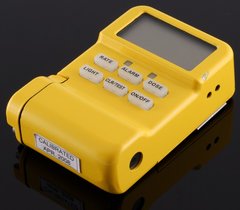
(That's my good one, on loan from REDACTED for this project)
All over the world people are trusting the ocean as if nothing has happened:
{"name":"b07f6471ef8ac928e5f8c51d2b315dba.jpg","src":"\/\/djungxnpq2nug.cloudfront.net\/image\/cache\/b\/0\/b07f6471ef8ac928e5f8c51d2b315dba.jpg","w":800,"h":528,"tn":"\/\/djungxnpq2nug.cloudfront.net\/image\/cache\/b\/0\/b07f6471ef8ac928e5f8c51d2b315dba"}
http://seasteading.org/
{"name":"1.jpg","src":"\/\/djungxnpq2nug.cloudfront.net\/image\/cache\/e\/8\/e8b7fc1a0236ee7ce6a32f746752105a.jpg","w":995,"h":355,"tn":"\/\/djungxnpq2nug.cloudfront.net\/image\/cache\/e\/8\/e8b7fc1a0236ee7ce6a32f746752105a"}
Yeah, because an earthquake and tsunami that just happened has something to do with a hotel built years ago.
Western media in race against time; hysterical nuclear bullshit nearing critical meltdown, yet millions are still uncontaminated.
Also, XKCD:
{"name":"radiation.png","src":"\/\/djungxnpq2nug.cloudfront.net\/image\/cache\/8\/6\/8671639c966208fcb524ce52b5eaf836.png","w":1134,"h":1333,"tn":"\/\/djungxnpq2nug.cloudfront.net\/image\/cache\/8\/6\/8671639c966208fcb524ce52b5eaf836"}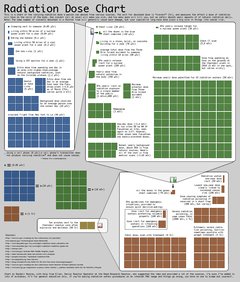
[EDIT]
Hah. The allegro.cc image cache reencodes that PNG to JPG, leading to not just a general quality loss, but also an 850 KiB bloat.
Thanks molang, quite interesting.. Really.
I agree with pyte856, that graph is quote informative.
Why the fuck is everyone typing names backwards?
Hush now FABio.
Another visualization: http://www.targetmap.com/viewer.aspx?reportId=4870
Why the fuck is everyone typing names backwards?
They weren't. As everyone can see, gnolam backwards is malong, not molang as type568 wrote and Vanneto also did't write 865epyt but pyte856. So none of that was either name backwards. Dog forgive me, I have sinneD.
Dog forgive me
I'm K.O.ed.. That's far beyond a lol
append:
Forgive me believers..
Append1:
These numbers in nGy/h don't really tell me much, since all my understanding of these dozes is from your previous chart which used another unit
Thomas Fjellstrom : "tsunami that just happened"
That wasn't the first tsunami.
The Boston Globe has done several "Big Picture" features on the disaster:
Massive earthquake hits Japan
Japan: earthquake aftermath
Japan: Vast devastation
Japan: New fears as the tragedy deepens
Japan: Continuing crisis
Japan: Hopes fade for finding more survivors
Japan: One week later
ehT doG sah esnes fo romuh..
{"name":"bp36.jpg","src":"\/\/djungxnpq2nug.cloudfront.net\/image\/cache\/b\/4\/b40a79143b456ae91356527b0a4e36cd.jpg","w":990,"h":655,"tn":"\/\/djungxnpq2nug.cloudfront.net\/image\/cache\/b\/4\/b40a79143b456ae91356527b0a4e36cd"}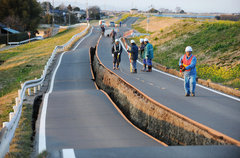
{"name":"bp2.jpg","src":"\/\/djungxnpq2nug.cloudfront.net\/image\/cache\/9\/6\/96fd17cfc60934fe7d6c8e09655fd4ae.jpg","w":990,"h":866,"tn":"\/\/djungxnpq2nug.cloudfront.net\/image\/cache\/9\/6\/96fd17cfc60934fe7d6c8e09655fd4ae"}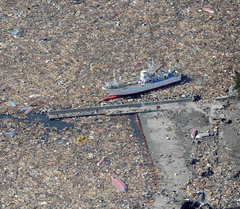
& thanks again..
That was pretty awesome that the road was split right where the yellow line is hahaha!
These numbers in nGy/h don't really tell me much, since all my understanding of these dozes is from your previous chart which used another unit
The sievert (Sv) is just a weighted version of the gray (Gy), which in turn is just shorthand for J/kg (absorbed dose). You multiply the absorbed dose with a quality factor for the type of radiation (for the same absorbed energy, alpha is much more damaging than gamma, for example) and another factor for the type of tissue it has been absorbed by (not relevant here) to get an equivalent dose, that takes the radiation's biological effects into account. So for gamma and beta radiation, they're the same (quality factor of 1).
[EDIT]
Whether it's just shifting winds or related to the smoke from reactor building #3, radiation levels have spiked in Ibaraki again.
{"name":"603721","src":"\/\/djungxnpq2nug.cloudfront.net\/image\/cache\/1\/3\/130502fd22e16423784ffddfcf10cb42.png","w":347,"h":383,"tn":"\/\/djungxnpq2nug.cloudfront.net\/image\/cache\/1\/3\/130502fd22e16423784ffddfcf10cb42"}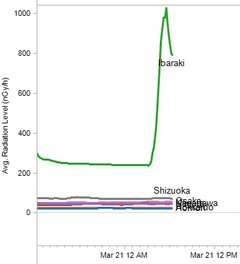
for example, the background gamma in my apartment right now is 0.18 µSv/h
The radiation here is 0.07µSv/h right now and I sit less than 100m from a working reactor. If I lean back in my chair I can see the reactor building from my window.
While the general radiation level might not be a problem I think there is one if you eat/drink/inhale radioactive isotopes, which remain in your body, because they are being treated like other substances.
Villagers living near the plant have been told not to drink tap water due to higher levels of radioactive iodine.
I've never heard that long flights and most other things on your chart caused such problems...
I've never heard that long flights and most other things on your chart caused such problems...
Of course they do. You are less protected by the atmosphere.
Of course they do. You are less protected by the atmosphere.
Oh, nice.. So I guess flying during the night means it is "safer"?
Furthermore.. Poor cosmonauts..
So I guess flying during the night means it is "safer"?
I would guess not by much if at all.
Furthermore.. Poor cosmonauts..
Exactly. That's one of the main non-political reasons no one has been to Mars yet.
And poor pilots. And flight attendants.
Oh, nice.. So I guess flying during the night means it is "safer"?
Probably yes, because you don't get direct Sun radiation. But then again all other cosmic rays are incoming from all directions.
While the general radiation level might not be a problem I think there is one if you eat/drink/inhale radioactive isotopes, which remain in your body, because they are being treated like other substances.
Yes.
Internal radiation (radiation that originats from within the body) is always worse than external radiation. One reason is simply the penetration capability - alpha radiation is stopped by the skin, so it's considered harmless (well, it can damage the corneas) unless the emitter actually enters the body. Beta can be effectively shielded against just through thick clothing.
Another reason is, as you say, that they can remain in the body. Some elements are flushed right out, but others can be taken up by various tissues. Iodine, for example, is taken up by the thyroid[1], cesium by soft tissues, and strontium by bone.
(For this reason, data sheets for radionuclides usually contain cumulative equivalent doses for inhalation and ingestion (separately), expressed in Sv/Bq. This takes into account all the relevant factors - quality factor, tissue weighting factor (as determined for where in the body it ends up), biological half-life, etc)
I've never heard that long flights and most other things on your chart caused such problems...
Cosmic radiation increases with altitude. After miners (who inhale a lot of radon), airplane personnel receive the highest average dose of any profession in this country.
For more info, see for example http://www.hps.org/publicinformation/ate/faqs/commercialflights.html (USian site, so naturally they're using archaic units, but just divide all the mrem figures by 100 to get them in mSv)
Oh, nice.. So I guess flying during the night means it is "safer"?
Nah. The cosmic rays in question are extrasolar.
References
- This is why potassium iodide is being distributed - by flooding the body with stable iodine (127I), you stop the thyroid from taking up the radioactive 131I.
That was pretty awesome that the road was split right where the yellow line is hahaha!
That happened with quite a few of the roads here too. There is even a bridge where one side collapsed and fell into the river, while the other was fine. It was right down the lane line as well.
Wiki about cosmic particles says vast vast majority are alpha, and you say it's absorbed by the skin.. Furthermore, something tells me the fuselage would have some stopping effect. There's some beta too, but almost no gamma as I understand, so.. What is harmful there? Do the crews keep track of it?
If I'm not mistaken x-rays are there too. Essentially any photon with high enough frequency is ionizing radiation. Not to mention neutrons.
Didn't all of you know that the yellow lines are long pieces of tape that hold the road together?
Didn't all of you know that the yellow lines are long pieces of tape that hold the road together?
Wow! I didn't know half this stuff!
Wiki about cosmic particles says vast vast majority are alpha
It's mostly protons, actually.
What is harmful there?
First off, cosmic rays have vastly greater energies than particles produced through simple radioactive decay. The helium nuclei produced by alpha decay typically have energies in the order of 5 MeV or so. Cosmic ray helium nuclei OTOH can have energies up to the order of TeV...
Anyway. The answer is "various kinds of secondary radiation: mostly neutrons" (at cruising altitude, neutrons make up more than 50% of the equivalent dose[1]). AFAIK, the neutrons are mostly produced through a process called spallation, when high energy cosmic rays strike nuclei in the atmosphere.
[EDIT]
Kyodo News: All 6 Fukushima reactors reconnected to external power
References
- IARC Monographs on the Evaluation of Carcinogenic Risks to Humans: Neutron Exposure (Yay, I finally found a publically accessible source! )
Kyodo News: All 6 Fukushima reactors reconnected to external power [english.kyodonews.jp]
Afaik they have been able to switch on the lights in the control room of no 3. Great!
So far, there is no information on the cooling systems, however...
edit:
Austrian meteorology office said:
First emission estimates
[...]
Regarding Iodine-131, the picture is relatively homogeneous. A source term of 1017 Bq per day would explain the measurements in Takasaki as well as Sacramento. The total 4-day emission of 4 1017 Bq is on the order of 20% of the total emissions of Iodine-131 that occurred during the Chernobyl accident. Regarding Cesium-137, the situation is a bit different. In the cloud eventually propagating to the United States, the ratio of Iodine-131 to Cesium-137 was about 30. This is similar to the Chernobyl accident. In Takasaki, however, this ratio was four. This would indicate a much larger Cesium-137 release in the second two-day period after the accident. Taking this together, the source terms would be about 3 1015 Bq during the first two days, and 3 1016 during the second two-day period. In sum, this could amount to about 50% of the Chernobyl source term of Cesium-137.
Source: here
The official death toll has risen to 10000, with 17000 still missing, and 240000 still living in temporary shelters.
Also, three workers at Fukushima aiming for a Darwin Award have suffered radiation burns.
The two men were not wearing rubber boots as they stood in water that contained radioactive materials 10,000 times the normal level, plant operator Tokyo Electric Power Co. said.
[...]
''Because of this, the workers are believed to have continued working even after the alarm on their dosimeter went off, assuming there was a problem with the device,'' a TEPCO official said.
So death pool being about 30 000.. Eh, considering the scale of the disaster I'd say very well done.
Though the world has lost 25% of it's silicon chip manufacturing abilities
What I've learned from this is we need to do a better job building nuclear plants.
That is correct! I believe a nuclear power plant must be able to survive a direct nuclear warhead hit without releasing a Bq of radiation itself!
...a TEPCO official said.
Oh, there are really so many reasons to trust them, including this:
(Wikipedia:)
The utility "eventually admitted to two hundred occasions over more than two decades between 1977 and 2002, involving the submission of false technical data to authorities" [...]
In 2007, however, the company announced to the public that an internal investigation had revealed a large number of unreported incidents. These included an unexpected unit criticality in 1978 and additional systematic false reporting, which had not been uncovered during the 2002 inquiry
Business as usual
There was this interesting report about TEPCO having been hiring unskilled workers for years, firing them after their radiation dose was reached... Unfortunately, I can't find it in English.
What I've learned from this is we need to do a better job building nuclear plants.
At some point, they'll become too expensive...
I forgot to mention: No insurance-company has ever covered nuclear accidents at power plants. I guess they know why, AFAIK they're pretty good at estimating risks.
I forgot to mention: No insurance-company has ever covered nuclear accidents at power plants.
Question: Why aren't nuclear reactors built underground?
Question: Why aren't nuclear reactors built underground?
Why should they?
No, it would not prevent nuclear leaks in case of a meltdown: the pressure would push the dirt out in either case.
Patently false. [www.amnucins.com]
Interesting. I admit I didn't word my claim carefully enough. ^^
At any rate, that's no regular insurance company doing business. It's a construct of/encouraged by the government and it can only exist because it is backed by tax-money. There's no private insurance company which will insure nuclear plants up to a reasonable amount insured.
BTW, risk estimates are roughly at 1 "beyond design basis accident" every 30 years with about 400 reactors in the world. So, it is actually a bit too early.
Oh, there are really so many reasons to trust them,
At the marriage counselor:
Husband: "My wife is unfaithful."
Wife: "That's not all true. I can mention lots of occasions when I have been faithful."
What people conveniently do not mention is that even though a nuclear disaster of epic proportions was eventually avoided at Fukushima, it was a pretty damn close call. And the reactor itself is pretty much the cleanest and safest part of the whole chain.
Another thing that bothers me to no end is that people conveniently suggest that the amount of required energy is a given - it's not.
{"name":"117322.strip.gif","src":"\/\/djungxnpq2nug.cloudfront.net\/image\/cache\/2\/d\/2d54072eddc0533acba76a22874a9569.gif","w":640,"h":199,"tn":"\/\/djungxnpq2nug.cloudfront.net\/image\/cache\/2\/d\/2d54072eddc0533acba76a22874a9569"}
Another thing that bothers me to no end is that people conveniently suggest that the amount of required energy is a given - it's not.
You're right. The energy demand will only grow further.
But what about daylight savings time? And abandoning light bulbs? Clearly a lot is being done to reduce energy consumption.
But what about daylight savings[sic] time?
Irrelevant. Even the few modern studies that show any kind of power savings from daylight saving time show absolutely insignificant savings.
And abandoning light bulbs?
Also irrelevant. Put it like this: Earth Hour was indistinguishable from noise in the power companies' usage charts.
Also, the goddamn EUSSR-mandated CFLs are shite. They give shitty discrete-spectrum light, they don't save nearly as much energy as they claim (the lumen values and light bulb equivalence values are grossly inflated), they have to be kept on for long periods of time (as they take several minutes to warm up), and they're horrible for the environment (yay, mercury and worse).
Just think of the uproar that would ensue if the 10,000 deaths were due to unclear energy instead of a natural cause.
That would end the unclear energy usage
Also irrelevant.
You can order a new sarcasm detector from me. I have three left in stock.
the lumen values and light bulb equivalence values are grossly inflated
They seem quite right to me. I use 13W bulbs. Maybe you crazy Europeans use 1W bulbs.
as they take several minutes to warm up
Mine light up instantly. USA really is #1.
Yeah, even my old ass CFL bulbs only take a second to turn on. Now, that's a bit different if you're using one outside, and its -20c or so. Then it can take a few minutes for a normal CFL bulb to warm up.
Some of them aren't even capable of shining outside at temperatures below 0°C. Sure, newer ones are able to start nearly as fast as normal light bulb, but they still don't produce good light spectrum.
And still there are plenty of places where using CFL bulb is infeasible, yet the bureaucrats in Bruxells decided to outlaw lightbulbs.
I think you can get a full spectrum CFL. Not entirely sure though. I bought myself a couple full spectrum incandescent bulbs recently. They are nice.
If everybody used CFL bulbs, we wouldn't need any of this unclear energy that Arthur speaks of.
If they have so many earthquakes over there, why don't they develop and engineer an earthquake driven power plant? It must be possible to catch, convert, store and use all that energy. Some genius just has to invent it.
If they have so many earthquakes over there, why don't they develop and engineer an earthquake driven power plant?
Absolute nonsense, but awesome!
Perhaps I'm being a worry-wart, especially since the article I'm linking even says it's not a big deal, I'm still curious about the safety of my pregnant wife and the child. She drinks a lot of milk. A lot. Anyway, should I be observing closely what's happening to the radiation levels in milk (or when should I get concerned)?
IIRC from 30+ years ago, dairy products from the state of Michigan had to be destroyed in the '60's due to fallout from A-bomb tests contaminating the grass the dairy cattle ate with cobalt-90, which substitutes for calcium quite nicely, and you'll have this radioactive element in your bones for a lifetime, but not so slowly that it's harmless. It seems to me that a reactor core that melted its way to a concrete floor isn't nearly so dangerous as a 20 mile wide mushroom cloud thousands of miles closer.
[EDIT]
Quite a few 20 mile wide mushroom clouds.
Perhaps I'm being a worry-wart, especially since the article I'm linking even says it's not a big deal, I'm still curious about the safety of my pregnant wife and the child. She drinks a lot of milk.
Do you live next to the reactors in japan that are damaged? Or in an area that gets its milk from farmers around the reactors[1]? If your answer to those questions is false, then don't worry. Theres no way your milk will be affected.
References
- but then, farmers in the area have already been dumping that milk, so its unlikely it'll be sold anywhere, even if it is safe
Gotcha, cool beans. I'm cautious because she seems to flirt with Death every time she gets near anybody somewhat sick. What a whore.
What Thomas said.
The thing is that radionuclides are detectable in extremely minute quantities. So pretty much whenever radioactive material is released into the atmosphere, it will eventually be picked up by monitoring agencies all over the world (this is a big part of enforcing nuclear weapons testing ban treaties, BTW).
Remember this: you're surrounded by radiation every second of every day of your life. The world is a radioactive place. Everything you eat is, to a certain degree, radioactive. You are even quite radioactive yourself.
I remember when I was in the 8th (?) grade or so, we had a Geiger counter to play with, and it said my left knee was considerably more radioactive than the rest of me. I was a bit worried at the time.
OK, light bulbs:
In cold areas, using low-energy bulbs is pretty much pointless. The energy you save on light also reduces the heating side effect of the bulb, which means you spend less on lighting and more on heating.
CFL bulbs these days light up instantly, but it still takes them a whole friggin' time to reach their full brightness (at least every single one I've seen so far has this problem)
CFL bulbs, even the full-spectrum ones, don't produce a continuous spectrum, but one or more sharp lines. In most cases, we don't see this, but combining them with other non-continuous-spectrum devices (such as LED or LED-backlit LCD screens) sometimes yields disgusting results
Specifying the light output in the Wattage of an equivalent conventional bulb is silly, but it seems to be the only way to get consumers to buy that stuff. I've even seen things like "13 W = 60 W" printed on the box.
In cold areas, using low-energy bulbs is pretty much pointless. The energy you save on light also reduces the heating side effect of the bulb, which means you spend less on lighting and more on heating.
I'm willing to bet that their efficiency is far less than the average furnace or space heater though, so really, its just wasting most of the heat.
Now how a simple heater can be of varying efficiency?
The energy you save on light also reduces the heating side effect of the bulb, which means you spend less on lighting and more on heating.
If this point were valid, then you should use lightbulbs (or electricity) as your only source of heat.
but it still takes them a whole friggin' time to reach their full brightness
The bulbs here in the great USA apparently are superior.
You can order a new sarcasm detector from me. I have three left in stock.
Keep them isolated from your posts. Otherwise the warranty is void.
In cold areas, using low-energy bulbs is pretty much pointless. The energy you save on light also reduces the heating side effect of the bulb, which means you spend less on lighting and more on heating.
I'm betting the money you save on electricity far outweighs the money you spend on the extra heating.
For a house using electrical resistance heating, bulbs would be just as efficient, except for disrupting the actual temperatures of particular rooms because of thermostat location. A house with a heat pump would see a rise in electrical usage due to the increased efficiency of heat pumps. For petroleum heated houses, no contest, bulbs are a terrible heating strategy.
I'm willing to bet that their efficiency is far less than the average furnace or space heater though, so really, its just wasting most of the heat.
It's been a long time since thermodynamics, but wouldn't that inefficiency result in heat dissipated (ie: the intended goal)?
Yes, but the point is that electrical resistance heating is far more expensive than alternatives.
Now how a simple heater can be of varying efficiency?
Efficiency is basically the ratio of input to output in any given system. My forced air furnace, even though its 20+ years old, and probably running at 60% efficiency[1] is probably more efficient than the two 100W light bulbs I use to brighten up my living-room. At the very least, heating with gas here in alberta is far cheaper than using electricity, even with a proper electric heater.
Short story, when my furnace died a couple months ago, I used my oven temporarily a couple times to bring the temperature up to a liveable level before the repair guy came. Turns out it cost me $20-40 for the few hours I had been using it for heat. It managed to slightly warm up my living room, which was nice, but wasn't worth $40. Especially since my furnace can do the same job with $1-4 in fuel.
It's been a long time since thermodynamics, but wouldn't that inefficiency result in heat dissipated (ie: the intended goal)?
How long would it take a 100w lightbulb to heat my livingroom? And how much energy would it take as compared to my forced air natural gas powered furnace?
Note that most light bulbs don't include a circulating mechanism, so its also going to take a long time for the heat to distribute itself in the room.
References
- 60% of the energy going in, is actually being turned into useful heat
I remember back in 1998, I lived in a house heated by electrical resistance, and left my computer on all the time. This is how the conversation went (in February)
Him: "You're leaving the computer on all the time! You're wasting electricity!"
Me: "The 'wasted energy' is just helping heat the house."
Him: "But it's wasting electricity!"
Me: "The heat helps warm this room, which has the thermostat in it. Therefore, leaving the computer running will cause the thermostat to turn off the heat faster and turn it on slower. The only effect is that the other rooms will be a bit cooler because the computer heat isn't blown into those rooms like the heating ducts do."
Him: "But you're wasting electricity!"
[EDIT]
I suppose the extremely slight amount of electromagnetic radiations emanating from this computer could be considered to be wasted energy. I kept the case on though, and the resultant trapping of the electrical waves would just make the case warmer.
@Thomas: Your old heater was 60% effective? And where did the other 40% go?
It was given off as waste heat, obviously.
Waste heat? How did the heat get wasted? Was not the heater inside your house? How did it get out?
I should have used the sarcasm smiley.
Sorry. "Lost sense of humor is a sign of strong emotional involvement."
...or just a sign of serious need in a sleep, and reconsideration of drinking amount standards
Waste heat? How did the heat get wasted? Was not the heater inside your house? How did it get out?
For some reason, it seems like this same question was already answered recently.
Have you forgotten what a chimney or vent is for? Do you want your house filling up with exhaust gas? Higher efficiency with a gas furnace involves making sure as little heat escapes in that process as possible.
OTOH, nuclear power plants don't produce stove oil or natural gas .
@Thomas: Your old heater was 60% effective? And where did the other 40% go?
What they said. Much of the heat is being wasted, either going up the chimney, or at least not being used effectively. Also the gas is probably not being burned completely, so a lot of the energy is also flowing up the chimney.
Furnaces get less efficient over time, due to various reasons. And old ones started less efficient than current models.
OTOH, nuclear power plants don't produce stove oil or natural gas .
They produce the electricity required to power the fan and electronics.
Anyway, it's going to be a sucky summer in Japan regarding electricity. But that's how it will eventually be everywhere: electricity only being available during a few hours every day.
Can I change my screen name to Mad Max?
@Arthur if you're using a gas heater, the question is off. But wasn't it electrical.. ?
You have either reached a page that is unavailable for viewing or reached your viewing limit for this book.
[EDIT]
And now they've been struck by a 7.1 quake.
I noticed someone mentioning light-bulbs in here. I used the old incandescent style, then I switched all my light-bulbs to the supposedly energy efficient bulbs... until one of them blew, it stunk to high heaven of burning rubber and the bulb was so hot you couldn't hold it, I have never felt a light-bulb that hot in my life. I done some research online and there have been several people reporting these things catching FIRE when they blow. There was a lady that had to pay our $3000 for cleanup when one blew due to it cracking and she had to hire people to do mercury cleanup (hazardous cleanup, whatever). Although newer versions no long have mercury that I know of, the fire hazard was enough for me, I switched back to the old style, and to be honest, my energy bill didn't change one penny even though I had the entire place changed over and back, in fact this month my electric bill was cheaper than expected so... I have to wonder how accurate the information is we get.
What worries me is they were talking about outlawing the older style bulbs (incandescent) in Ontario, which is nuts considering the fire hazard of the newer ones. Plus the fact that man made Global Warming is false anyhow and the worry over greenhouse gas is unwarranted... in my opinion anyhow.
I read plenty of reports online that say they're not a fire hazard, but I have also read reports that they HAD caught on fire, the people reporting they had aren't lieing, they merely reported their experiences and I know how hot mine got. I'm paranoid over fire so... I'll pass until forced to use them by law, at which time hopefully they would have improved them.
Fire hazzard? Most of my bulbs have been CFLs for over 5 years now. I haven't had to replace a single light bulb since I moved in, and none of them have had any kind of failure.
I think you were just unlucky to buy a defective or broken bulb. Shit happens. No reason to get all paranoid about it.
They do last a long time, but wait until one blows, and one WILL blow, you'll see what I mean. The stink is unreal, like strong burnt rubber, and so hot you'll literally burn your hands. Do some reading, they say that them getting REALLY hot that way is normal, and they can tolerate those high temperatures and the fire hazard thing is a myth, but there have been reports of them catching fire when they burn out, so it is NOT a myth, I've read the reports myself.
It wasn't a bad bulb, this is how they normally blow. Getting red hot isn't debated, this is a known thing from what I read. As for "energy savings", I debate that as well, I never saved one penny the several years I had my entire house changed over, now that I have all incandescent bulbs back in, I see no difference and my electric bill is still cheap as always. I honestly think the public's being lied to about these bulbs.
This is the first time I've heard of one blowing. I think you just got a bad bulb. if ALL of them failed like that they wouldn't even be allowed on the market.
I see no difference and my electric bill is still cheap as always.
It's literally pennies per bulb with normal use, so it'd be hard to see a difference, unless you leave a lot of 100W lights on 24/7. a 60W bulb on 24/7 would cost like 25-50 cents a month.
Although newer versions no long have mercury that I know of
No, they all still do - and plenty of it (around 4 mg).
Plus the fact that man made Global Warming is false anyhow and the worry over greenhouse gas is unwarranted
It's literally pennies per bulb with normal use, so it'd be hard to see a difference, unless you leave a lot of 100W lights on 24/7. a 60W bulb on 24/7 would cost like 25-50 cents a month.
IIRC, we get charged $0.16 per kilowatt/hour. Times 24x30 that comes out to $115.20 for a 1000 watt device left on for a month straight. A 60W bulb takes 60/1000th's of that, so that works out to $6.91. Subtract the 15W (?) of an equivalent CFL bulb to come up with 3/4 of that to get $5.18. Supposing the bulb lasts 5 years, that $5.18 gets multiplied by 12x5 so that's $311.04 over the lifetime of the bulb. You can buy a low end computer for that much.
Based on the current electricty prices here (or at least last month's prices):
(60 watts) * (1 month) * (0.08 (Canadian dollars / kWh)) = 3.50632511 Canadian dollars
For a month of running a 60W incandescent bulb 24/7. So I guess its a bit more than 50 cents but I think thats what you end up spending on any given light if you only leave it on for a few hours total a day.
I guess if you have children and a large house it may be a good bet. I have a habit of flicking lights off as I leave the room, I don't have to think about it, it's just natural so there's never a light on 24/7 in my home unless I am in the room for that long. That's probably why I never see a difference on my bill.
I don't think it's as big a deal as I hear it made out to be though. I may plug a few CFLs back in, if only because I get tired of changing normal bulbs, but... CFLs just freak me out too much when they blow. I like a good old fashioned bright light + pop sound that makes me jump that incandescent bulbs give me, without the smoke, heat and burnt rubber smell of CFLs.
Why is it when I talk about CFLs I get the urge to play football?
EDIT:
Here's a good thread with some people talking about these things failing, with a fairly nasty looking picture.
CFL Ballast Fire
Here's one user's post as an example: "It's happened to me before, we had a light blow up in use in a theater, and it burned happily for about a minute until the nice fire extinguisher put it to rest."
Nothing like a toxic mercury fire to brighten your day. We bought into the whole CFL bulb craze, but they're not worth it. The supposedly last years longer than incandescent bulbs, but the ones in the garage happily burnt out after only a couple years of infrequent use. Back to incandescent bulbs for me.
he supposedly last years longer than incandescent bulbs, but the ones in the garage happily burnt out after only a couple years of infrequent use.
Yeah, the older ones definitely don't like the outside, or the cold. They weren't made for that. Next time you try, get ones that were made for that.
Back to incandescent bulbs for me.
Except the fact that they'll not be still available down here. They already retired 100W and 75W and 60W ones.
August will mark the end of the 40W ones and December 2012 will mark the end of 25W ones.
All these production stops will lead us to have no more incandescent bulbs to sell at the end of 2012.
Halogen spotlights, baby!
All these production stops will lead us to have no more incandescent bulbs to sell at the end of 2012.
Yeah, but by then the world will have ended, so it doesn't matter.

The maximum radiation in that clip was 112 uSiv/hr at 11:36. Wikipedia claims that up to 0.25 uSiv/day fails to produce symptoms. So, while ignoring the body's ability to repair itself during lengthy exposures, they could have stayed there 93 days before feeling ill.
uSiv/hr
µSv/h, dammit.
Wikipedia claims that up to 0.25 uSiv/day fails to produce symptoms.
It bloody well should, since that's in the order of a tenth of normal background.
Whoopsy! I should have said 0.25Sv
So now they admitted it was INES 7.
Oh dear, it's always the same. No reason to trust any of these people.
edit:
One official from Tepco said that radiation leaks had not stopped completely and could eventually exceed those at Chernobyl, Reuters news agency reported.
If Tepco says "could" in this context, that translates to "will".
So now they admitted it was INES 7.
Oh dear, it's always the same. No reason to trust any of these people.
The INES rating is a) fairly useless (it has no effect whatsoever on the response to the incident) and b) upgraded or downgraded according to new information and how the incident unfolds.
Well, while I agree on a), the point with b) is that information was available before. They just officially stopped to assess each reactor/spent fuel rod separately by now, which was nonsense anyway: I'm sure the people who live/d in the area do not care where exactly their new long-term cohabitants Caesium and Strontium came from.
The estimated the fallout volume about 10% of Chernobyl..
important words missing: so far
BTW, there were other, larger estimates weeks ago.
BTW, there were other, larger estimates weeks ago.
By people like fox, who were over reacting to blown up reports
It would be nice to get a accurate report from someone.
No, not just Fox.
The Austrian meteorology office already said on 24th March:
The three day emissions from Fukushima of Iodine-131 would be about 20% of the total Chernobyl emissions, while those of Cesium-137 would be between 20 and 60%
Note they're taking into consideration the first three days only.
Source here.
As they're neither Greenpeace, nor affiliated with the nuclear industry, I'd give them some credibility.
Since they estimated emissions that high for the first three days, the Japanese are a late with their INES 7 rating, because, obviously, it was already in that scale quite early. Emissions have declined since then.
Wow, the austrians? I assume they are some kind of authority on japanese reactors?
It's not about the reactors. It's about emissions carried away by the wind. There's no knowledge needed about the reactors whatsoever.
So they were there and taking measurements? I doubt it
Of course they weren't, they took the Japanese and US and international measurements and calculated using them.
It's not about the reactors. It's about emissions carried away by the wind. There's no knowledge needed about the reactors whatsoever.
Their estimate is based on measurements from Takasaki and the US Pacific coast, which leads to absolutely enormous error bars, since it relies on long-distance, long-timescale meteorological models. Which are notoriously fickle.
I'll take the official sources, thankyouverymuch.
Wow, the austrians? I assume they are some kind of authority on japanese reactors?
Mind you, they are still a bit envious, because of their world's most expensive museum of atomic energy - finished nuclear powerplant that never ran a fission reaction.
That buidling surely is a beast. Seems like I have another place to visit and shoot on my camera
Their estimate is based on measurements from Takasaki and the US Pacific coast, which leads to absolutely enormous error bars, since it relies on long-distance, long-timescale meteorological models. Which are notoriously fickle.
I'll take the official sources, thankyouverymuch.
Did the "officials" sit beside the reactors and actually count the isotopes? No wait, they'd have to sit on a boat a bit to the east... Do they have measuring devices there, on the sea? I doubt it...
Did the "officials" sit beside the reactors and actually count the isotopes?
Pretty much, actually - they're doing continuous air, soil and seawater sampling around the plant.