EDIT:
Per Onewing's request, here are some of the important links for this thread:
Monday[1][2] can be found on SVN at http://svn.miquelfire.com/monday/ (thanks, MiquelFire[1][2][3] for the repo!).
Two project pages used to keep track of Monday's progress and design ideas are:
Allegro Wiki: wiki.allegro.cc
Mark Oates' page[1]: www.zeoxdesign.com
Monday will use the Lua[1] scripting language (current version: 5.1.4).
[center]=== ROLES AND ASSIGNMENTS ===[/center]
Matt Smith is our Evil Producer.
23yrold3yrold is our Team Leader.
Thomas Fjellstrom is the official Cat Herder.
Trezker is our Lead Programmer.
bamccaig has started to work on a developer console that may be incorporated into the Monday project to allow in-game edits.
alethiophile is Programmer #12.
Thomas Harte has offered support for "drawing TrueType fonts with OpenGL geometry".
decepto has offered support for sound design.
Pedro Avelar Gontijo has offered support for music (is this different from decepto's sound?).
relpatseht has offered even more manpower.
Paul Pridham has offered some sort of speech support. Cool.
To discuss this in an IRC channel, CGamesPlay has suggested using mibbit.com if you don't have a dedicated IRC program. Join us on the Freenode server in the #allegro channel. The #allegro-monday channel is often used as well for intense Monday-related discussions so as to not derail #allegro too badly.
Oh, and 23yrold3yrold says we haven't yet beaten the longest-running thread record yet...
...there may be more... I keep losing internet connection and want to get this posted.
I finished an internship at a game development company. Then I came back to the a.cc forums. I saw the TINS competition going on, and all the other projects that are actually getting done.
I think I've learned that, unless someone is keeping me motivated and giving me stuff to work on, I get overwhelmed and never finish a project.
So I'm wondering if there is a "group project"-style competition similar to TINS or SpeedHack?
The project may last about a week, and we'd post our game (as far as it's gotten) next Monday~ish (or a week from whenever the "group" gets organized). Work is totally "on your own schedule", and someone would be a project manager who ensures everything gets integrated and basically pieces together all the different parts of the game into the final version.
Any takers?
That sounds interesting, actually. I think there are enough people around here these days who have enough programming and game design experience to do that.
It's just a matter of how many people you can get involved. Well count me in.
Alright. First thing to do is determine the game type.
I've ALWAYS been a fan of RPGs, but I'm flexible.
Ideas anyone for this game? Moreover, GAME NAME ideas anyone?
I'm in.
Should try to make it more than your random TINS entry (though some were quite impressive!), since we have a week or however long to do it in, and more people. And it's hard to come up with a game name if we haven't decided on a genre/setting yet. I propose, however, that it be set in space.
Surely if it's a competition or event, there is no single game name?
I'd be willing to take part, schedule allowing. Obviously team arranging on forums such as this is usually folly, but if it's explicitly a one week competition-type thing then I reckon it could work out.
Would we have a magic computer match us up into teams? If so, presumably it would do so through application of a matching algorithm based on our preferred development libraries and possibly environments?
I would help with a group thing. I've learned that nothing of real note gets done solo, at least IMO. As long as I know the rest of the team is on the job; I think KQ has mostly hit the rocks. 
Nice idea. As long as it's not gonna be in the next month or so, count me in! (And as long as we won't run into problems like "no one to do the graphics", which is a project-killer. Unless the project doesn't have graphics of course  )
)
It's never going to work. And it's Monday.
Most probably, but it doesn't hurt to try
First of all, how do we set up coordinating our efforts? Say we have 4 programmers. Do we have someone here who knows how to set up a part-time, short-term repository that we can check in/out our changes? Or do we need to start PM'ing and emailing all ideas to "the head programmer" and let that person integrate everything?
Setup an SVN repo on some server? That makes the most sense, I think.
It's never going to work. And it's Monday.
The fun question is, who's being sarcastic, and will the people who aren't figure it out? 
It's never going to work. And it's Monday.
Believe in hope Matthew! Believe in hope!
So I've got these takers so far:
OnlineCop (me),
Mark Oates,
alethiophile,
Thomas Harte,
23yrold3yrold,
CursedTyrant
I have absolutely no idea how to set up any sort of SVN or CVS repo at all. Does someone here know how, and where we can host it for the next week (maybe a week-and-a-half for a long estimate)?
I don't really care if all of this code is 100% original, or if it's only 80% original (like reusing old and very efficient timer routines that's out on the wiki already, or whatever), so we can get started as soon as we come up with a depot for all of our code and graphics. Once the repo is setup, we can hammer out game ideas.
People reading this forum are welcome to submit suggestions! (Or would it be better to come up with the "this is the type of game we're making... NOW who's interested in being part of the group?" approach and choose candidates from people interested in the game?)
I know how to do an SVN repo, and AFAIK that's better than CVS. (I don't have any experience with CVS, just SVN.) As for where to host it, Tuxfamily (Google it) provides free hosting for projects under OSS licenses, but it's uncertain whether they would accept something like a game licensed OSS--there's some wording about "relating to the free software philosophy". I'm unsure about other services providing SVN hosting--I know there are others, but they all cost money. If it's only for a week, then it's barely possible that we could host it on one person's PC that isn't ever turned off. That's a problem, though, because most users' ISP contracts forbid them from running servers on their machines.
Everyone who's interested in this project, rank your top 3 game genre preferences.
Mine are:
1) RPGs
2) Puzzle (like Zep's Dreamland)
3) Action-Adventure (like Zelda, Chrono Trigger, Secret of Mana)
With this, we'll narrow down what we'll work on as a group and get started (with or without a repository, if necessary for a few days).
See I'm thinking that we have several teams. 
I think that instead of the group deciding what to make. Spin the Speedhack rule-o-matic.
RPG is a likely-to-fail, Puzzle is too easy. Make it a platformer or adventure game or something.
First of all, how do we set up coordinating our efforts?
That's for each individual team to decide.
RPG is a likely-to-fail, Puzzle is too easy. Make it a platformer or adventure game or something.
This should be for each team to decide.
"Each" team? It's Monday; one team is optimistic. Let's not get silly here; start small.
We did a team competition once with four teams. It was moderately successful, so it is possible.
"Each" team? It's Monday; one team is optimistic. Let's not get silly here; start small.
Well I'm really only interested in a proper event, and therefore in planning for an event. I have no faith whatsoever in the idea of us all just deciding we're going to be a team for a week and then actually doing it.
I'm aware that the event may not happen, but I thought that was the nature of the thing we are discussing.
Re: teams in general, the only time I've ever really been part of a "successful" team (i.e. one that completed a project) was doing the Allegro Skater demo game. I did the main game code alone for a concentrated period, the menuing system and script for creating the level with Blender were done by others; I just followed instructions to use the menuing system and provided a documentation of the ASCII-based level file format. So I guess the key, during the event, will be properly defining the boundaries between roles and how the different parts should slot together.
If anyone ends up on my team, I'm going to push for adoption of my event-based game framework*, which sits on SDL, SDL_mixer, SDL_image, FreeType and OpenGL (but obviously I won't go home and cry if it's rejected); can we have ChristmasHack-style rules that don't stipulate Allegro?
as used, in various states, in everything I've done since 2005.
It's already failing! 
The only group decision should be to elect a team leader. Don't you see that any detail left to a group will never get decided? Letting the group pick the genre means five angry kids deciding to do their own thing since the group went against their desires to build a 3D Japanese cartoon porn puzzle soccer game.
The reason group projects work in the real world is because everybody is getting paid to listen to his or her employer.
3D Japanese cartoon porn puzzle soccer game.
I think we have a genre!
Well, if this gets off the ground (Key word, if), I can provide SVN repository for whatever. If it's only meant to be for a short time. For long terms projects, use SF or any SF clones (like the one OpenLayer is hosted on)
Don't you see that any detail left to a group will never get decided?
Exactly why there needs to be a team leader.
The only group decision should be to elect a team leader.
Who here would be interested in being a Team Leader?
I'm in.
I figure that if the team leader calls all the shots, the entire "this game is fun (or not)" rests on that person's shoulders. In the gaming industry, some games just plain suck, and I blame the project manager for that. Although the game publisher checks in often and suggests areas of improvement, it's the manager that calls the shots, makes the final decisions, cuts some aspects and emphasizes others.
So if the project is doomed to fail, at least the next time there's a group competition, you know who you DON'T want for your team leader... 
Exactly why there needs to be a team leader.
Yup, but too bad electing a team leader is a group decision, which can only end in failure.
Team leaders work in the real world because they are paid to be the leaders and you are paid to be the monkey. Out here, in the Internet, we all think our ideas are the best and will argue non-stop in circles until we get our way the thread is closed.
For a group project to be successful on the Internet, somebody needs to step forward and write a bunch of code and get it all working to build up interest. Now he is the leader because he has proven to have what it takes to get stuff done. He doesn't have cash to offer like in the real world, but he does have a substantial code base to build upon. People like to be part of something successful.
All that said, I do think that a team competition like amarillion mentioned can work if it is a very small project with a short deadline. But of course, such projects don't really need multiple people...
The reason group projects work in the real world...
What do you mean group projects work in the real world?  The failure rate is extremely high, even in the corporate world. The main reason for this, however, is poor planning and lack of organization. Somebody needs to nail down the ideas before a code repository is even on the drawing board. Figure out what you're making first. Then pull ideas in to work out the details. The code, graphics, and sound come last. And don't set a deadline until you know what you're developing. That's a recipe for failure.
I'd be interested in participating, but I'm not sure what help I would be. Especially without knowing what exactly will be developed.
I view myself in a position where I would be of no help, other than setting up a SVN repo or two as that's a few minutes out of my day, unlike the hours (most likely as it's a game project) other work would need.
I nominate 23 as our team leader.
I'll second 23.
23 gets my vote, or my support, however we decide this. Also, this may seem obvious, but I've seen group projects that died because they didn't get this: Team leader is arbitrator and final decider, not sole input to the decision.
I'm down with that.
I think everyone here knows that.
[nvmd]
I'm in, and I'll also throw in my support for 23 as team leader.
We did a team competition [amarillion.bafsoft.net] once with four teams. It was moderately successful, so it is possible.
No doubt, but I wish you had some screenshots there so we could see at a glance if there were any similarities in theme of gameplay. See what a group finds easier than an individual. Maybe they're all "endless" games, like Tetris.
Flattered by the "nomination". Okay, let's pretend I'm leading this; I'll throw out a "vision" and we'll see what the comments are. I'm partial to the quarter view adventure style game (think Link to the Past). I don't feel like doing a platformer since I'm still working on The Mighty Stoopid and I'd just be recycling code. Keeping within a realistic goal, there should be, say, three dungeons and then a final dungeon. Lots to do in between; like most adventure games, some mini-quests to actually get to the dungeons. Short game but we can try to pack a fair amount of interaction and an intriguing plot in there. So what do we need:
- setting
- plot and characters
- rough map
- ideas for flow of game/quests
- dungeon design
- enemy design
- player interaction, weapons, items, etc.
- graphics and sound (low priority for now)
I don't know how teams usually delegate code duties, but we need the usual; tilemap engine, collision detection, NPCs to converse with, objects to interact with, a way to track quest points, handling death/zoning/saving/options, in-game cut scene, all that jazz. Plus name some stuff I missed. Anyone want to grab one of those and start brainstorming?
Top-down sounds awesome.
I like the idea, though I think it needs to be scaled back a bit. For example, 3 dungeons, an overworld, and final dungeon would be enough to work on and manage, so how about we scrap the side quests and keep NPCs to a bare minimum, like a 1 window popup when you walk within radius?
Basically just simplify for the sake of "get 'er done".
The next question in my mind is the map format?:
1. equally spaced tiles
Or
2. A list of objects arbitrarily placed with rectangular bboxes.
Or
3. A mix of the two, background graphics are tile-based but physical objects, blocks, stones, are arbitrarily placed.
Or
4. Something else
I vote for #3.
3 would be wise. Maybe. Normally I would just make everything tile based though. Maybe some things will need to be separate objects by design, but that will be dictated by gameplay requirements. Clearly tilemap-everything would be easiest, so we'll do it if we can. That's a page 8 topic though.
For example, 3 dungeons, an overworld, and final dungeon would be enough to work on and manage, so how about we scrap the side quests and keep NPCs to a bare minimum, like a 1 window popup when you walk within radius?
Once a system is implements to handle NPCs and quest chains, implementing new quests is trivial (kill this monster, find this herb, talk to that guy, bring me materials to make this thing, find key for door, etc.) so there's nothing keeping us from making a relatively interactive world. I'm all for "get 'er done" but let's not be lazy.
Ok. I've never done NPCs, quest chains, and scripting so that all sounds like the complicated stuff to me. Everything else looks very doable on my end, but those three in particular intimidate me.
Here's mah plot proposal, I'll just throw this out here:
Title: Z-Strand
Premise: The overworld is a space station (think ds9 but more federation) where there are shops, people, places to go, etc. Your mission is to go to some teleport rooms on the station, each room ultimately takes you to the dungeons, where you have to do the level and locate... a strand of bacteria... once you locate all three (the three bars of the "Z", I guess N-Strand would work to, that would be in your map/item screen... anyway) then you open the super whatever and it takes you to the last level. Each dungeon can be completely different... maybe the teleports take you to different time periods for example.
The reason I like a space station is because it'll take us out of the days of yore which is typical for an adventure game, and I think that would be refreshing. Plus we could do cool effects like teleports and lasers and stuff like that.
Yeah, I was thinking futuristic setting too. No time travel though; there's lots of time to jump a shark later.
Okay, space station/colony for main setting. We could have a main colony and an overworld with smaller colonies. Dungeons could be satellites, caverns, power plants, hidden bad guy base on an asteroid, alien craft/ruins, etc. Lots of variety. Travel can be on foot or with a shuttle, maybe a teleporter can be opened up end game. Any one of these locations can be in space, on a planet, on a moon, or it can all stay "local". We could have a military man investigating some mutiny in secret (colonies don't get disrupted too much by that), we could have some lower officer who ends up saving (most of) the colony from an alien invasion, we could have something more personal to the main character.
This is going to give us a lot of freedom as far as weapons, obstacles, enemies, etc. go too.
Anyone want to have at a general plot outline? Should we make it a bit "cartoony" (like Link to the past was) or go for something more serious in tone and graphics?
Dungeons could be satellites, caverns, power plants, hidden bad guy base on an asteroid, alien craft/ruins, etc. Lots of variety. Travel can be on foot or with a shuttle, maybe a teleporter can be opened up end game. Any one of these locations can be in space, on a planet, on a moon, or it can all stay "local".
I like that.
I'm thinking cartoony but serious, like color and tone from Titan A.E. (some attached screenshots) but rounder and more bubbly characters like windwaker - Of course the variety would saturate the color palette here and there.
I think everybody else is asleep
Yeah, I'm putting this to bed until tomorrow. Kinda defeats the "team effort" idea if it's just you and me.
What? Two people is not a team?
I think everyone else is so much in awe of your excellent ideas that they feel ashamed to post their own crappy ideas.
The main thing is not feeling ashamed of crappy idea, it's feeling ashamed because you are not able to translate them to working code.
Motivate people, join them !
PS:
I would have joined with pleasure, but some few week ago I decided to continue my abandoned project, so I set up a new project and I am cannibalizing my old old code, creating a to-do list, ect...
Well, I won't be throwing any ideas at you today, since I have to study for tomorrow's exam, but so far everything seems fine.
As for the tilemap, I'd go with #3.
I'm liking it so far. One question I'd like to throw out there:
Turn-based combat(Final Fantasy style) or real-time(Zelda style)?
I vote for real time, because it's more fun.
I'm in. I would have posted earlier, but my internet's been up and down all day yesterday.
I vote for real-time so you can see the enemies and choose to avoid them (if possible).
I'm trying to make some preliminary engine code that we can start and build up on. It's not done yet, but if someone else has an engine, or some code, that they're writing for this, we can let 23 decide on which to use.
Yes, real-time. That's why I drew parallels to Zelda and not Final Fantasy. Just now you'll be using a gun and not a sword.
I'm not too worried about code just yet; we're still in design phase. I would like to use C++ for it personally, but if the people most willing to contribute code prefer C, we're probably stuck with that.
First thing I'd like to be hearing is story ideas. We need something that follows the game flow through 3 dungeons to a final dungeon, and gives you some objectives in between out in the overworld. Is it just 3 arbitrary levels before the final level? Do we go the Zelda route of "collect three things from these dungeons to open the final dungeon" right from the outset? That would make for one simple story. After that we should hammer some details like what items or upgrades you get along the way, and then start mapping this out to various locales and get an idea how all the quest points link up. Once we know what we need to do all that, we'll have both the direction and hopefully the motivation to get the code flowing.
Dungeon #1: Ruins of a civilization that's gone on some planet. Find the first piece of the puzzle, maybe along with some documents telling you what this thing that's now in three pieces is for. Ruins would be a good setting for low level opponents, scavengers, animals etc... You could also put in some areas with high level opponents so you can return here later, but that's bonus stuff.
Dungeon #2: ?
Dungeon #3: Infiltrate enemy base. Make up some story on how you get into the base and provide an extraction point. But you'll have all the time in the world to sneak around in the base and find the final piece.
Dungeon #4: Profit...
I put the ? in the wrong place now...
I'm iffy on the infiltration idea. On the one hand, it can be really fun to sneak around an enemy base right under their noses. But on the other hand, it can detract from a game if you spend half of it blasting your way through every obstacle and suddenly you have to sneak around and move slow. I think it would work best if being caught didn't throw you back to the beginning of the area, but instead the guard tries to set off an alarm and you have to try to stop him before he does or else you have to fight off a large group of enemies.
So then are we spaceships, little men INSIDE of space ships, aliens/astronauts with space-packs?
Are we going to be in an inside setting, or outside? Like, will it be a Halo-style indoor setting as we run around our own (or others') ships, killing baddies with all the effects of gravity, or something like Asteroids and Arcanoid where monsters come to ram our "hurdling aimlessly" persons into black holes?
Heh, I wonder if it would be a good idea to make ruins outdoors on planet, infiltration indoors and third "dungeon" in asteroid field flying around in a scout ship.
If one where to make such diverse environments you can't make a level grind I think since you require completely different skills in each place. "You've leveled up your stamina a lot in the ruins so we're gonna give you a faster spaceship"
As for the sneak vs fight on infiltration I imagine a GTA approach would be nice. You start a fight, guards chase you, fight more means more and more guards. Reset to anonymous by entering a repaint shop... Well, you get a new disguise.
Sounds interesting, define top-down, are we talking zelda, crimesonland or isometric style?
In anyway, I'm definitly in if there are any positions open.
I keep seeing Zelda perspective in my mind...
Opinions on some questions that have been asked: I prefer C to C++, and a Zelda-type, square-grid, top-down view sounds good (easier to move around in than a platformer). Also, if there is an "infiltration"-type level, than an alarm going off shouldn't just automatically lose you the level, but should bring more guards to the area--like it's handled in Lugaru, if anyone's played that game.
So are we all agreeing on the gametype/gameplay? Do we know who's in the group(s) yet?
If not, here's just another game idea to throw into the ether:
You have a grid of colored blocks on a playing field:
http://www.allegro.cc/files/attachment/596282
The Tetris shapes on the right are the ones you can play with. You are shown their shape as well as the "after I have placed this on the grid" spin direction.
You must align 3 of the same color in a straight line, or 4 of the same color in a 2x2 grid, in order to clear the pieces. When they clear, they leave a hole that the pieces on top of them fall into. New random pieces fill up at the top.
After you drop the Tetris piece onto the grid (within the lighter-gray 4x7 grid), all the blocks under that piece are rotated in the specified direction. The reason for the outer dark-gray grid is so you can see what colors would be circulated into the play field if you drop the Tetris piece near the edge.
It's probably not as fun or exciting as the idea everyone's coming up with right now, but if there comes to be two groups instead of one, someone could always use this idea...
no no no... we're doing the zelda thing, that's pretty much decided. Lets keep focused
Are we going to be in an inside setting, or outside? Like, will it be a Halo-style indoor setting as we run around our own (or others') ships, killing baddies with all the effects of gravity, or something like Asteroids and Arcanoid where monsters come to ram our "hurdling aimlessly" persons into black holes?
Think Metroid from a Zelda playstyle and perspective and you won't be far off.
I'm iffy on the infiltration idea. On the one hand, it can be really fun to sneak around an enemy base right under their noses. But on the other hand, it can detract from a game if you spend half of it blasting your way through every obstacle and suddenly you have to sneak around and move slow. I think it would work best if being caught didn't throw you back to the beginning of the area, but instead the guard tries to set off an alarm and you have to try to stop him before he does or else you have to fight off a large group of enemies.
Seriously, we need to get on the story. I'll write one myself given a few days, but again, it defeats the "team" idea. Half these dungeon ideas may end up so much fodder if they don't fit with the plot we come up with so let's do that first ....
I'll write one myself given a few days, but again, it defeats the "team" idea.
Not really. You need to start somewhere. if the entire team is in on it from the start, you'll never get anywhere.
If you plan to do everything together you are all better off splitting up into 3 teams of 2 or 2 teams of 3, better chance of agreeing on things, and thus actually starting. Or just agree on a general outline, then let the leader go off and put things together in a format you can all then work on together.
Yeah, I'll probably end up writing the story in the end, but my point stands that half the stuff being suggested at this point would be scrapped if it doesn't fit the plot. Either brainstorm on that or leave it to me and I'll use it to start a new thread ...
Puzzle games isn't teamwork projects :/.
Anyway, I really hope something takes off, I was to sick to program during tins and now I really need to program.
Question: Is this vision somewhat right:
Zelda style game in futuristic space, where the player shoots stuff (probably aliens).
If this is right, Might i suggest multiplayer? sound like a typical coop-fun kind of game. I might be thinking larger than I should but I think at least hotseat should be included.
I think what we need answers to right now is, how does the game end and how does it start? Just so we know where the box is.
Why do you think 23 is trying to get the plot (at the very least, the outline) done first?
Stab at an incomplete intro story:
A year ago one of our allies abandoned their home planet. For reasons unknown to us they suddenly made a huge effort to evacuate their whole world. We don't even know where they went. They were very aggressive against any attempt to track them.
None of their colonies or even their second home planet followed in this exodus. Whatever happened was local. Our investigations have not produced any answers to his mystery. However, with the permission of the new government they organized, we were given access to the home world to search for clues. In this search we found one machine which purpose we could not find, all documents about it was very cryptic.
Over the last year we have made some progress in figuring out how the machine operates but we do not have the means to make it run. It is missing three components.[insert stuff here]
So, who can come up with the answer to the mystery and what exactly those three components are?
The only backstories I can think of for a game like this are either the character is trying to do something heroic (ie rescue the princess, prevent the bad guy from taking over the world, etc.) or because he/she is taking revenge for something in the past.
I had an idea not too long ago: Its an RTS and not a RPG or Platformer though (fairly obvious)
Your world has just suffered through a self inflicted Global Warming cycle, and are now on your way to a severe ice age. livable areas were already limited, now the previously cooler (though much warmer than normal) north and south regions are cooling down FAST. There is currently not enough room on your world for all the souls living on it, let alone after the livable area shrinks even further. Your mission is to get as many people off your world as possible before they start a global war for limited space, and even further limited resources!
You have several options, Rockets, Space elevator, reusable spaceships.
You have limited destinations available, orbit, the moon, mars, or generational space ship. What order do you build things? Where do you send people, and how many to which place? Do they all die? Its up to YOU.
I vote for Trezker's story. its... erie...
as an addendum (for the sake of clarity):
Our investigation team is stationed on a large, nearby public space station (now I'm thinking more like the fifth element cruise ship interiors) retrofitted with advanced research equipment and a transport shuttle.
so... each dungeon would then be on the surface, transport there and back by shuttle, and since the world is so large we could plan levels in different environments... even areas that had been inhabited before, so that could give us step quest things like find keycard, open door, defeat monster, flip switch, etc.
I'll go with Trezker and Mark. It's a decent story and better than anything I can come up with. Also, if everyone tries to push their own ideas nothing will ever get done.
Mah proposal for the three dungeons:
1. some basic world surface (grassland, mars-rock, swamp, jungle, ?)
2. underground cave (with some technology lab type stuff)
3. city ruins (Looks like the cruise ship except it also extends outside and is much more dirty, lots of broken sparking type tech stuff.)
for the most part I'm seeing the dungeons as being somewhat disorganized and cluttered (as opposed to the clean decor of the space station)
Aw come'on. There's gotta be at least one hulking space wreck, drifting through the void leaking atmosphere.
dude! idea!
after you find all three of the <whatevers> our protagonist(s) go back to the space station... and... ALARMS! ALARMS! >>BOOM!<<
a hulking space wreck, drifting through the void leaking atmosphere has crashed directly into the space station... why? how?... is it a malicous attempt to prevent our team from discovering the truth about the <whatevers>?!
Station Captain: "We couldn't avoid it. It came right at us like a magnet, no matter what maneuvers we tried."
Lieutenant: "It's a hunk of space wreck. It doesn't have any propulsion systems, no navigational sensors, nothing. Something sucked it right into our ship."
someone will have to go aboard to investigate, and who is more qualified than the investigators brought aboard for the research mission!
Begin level 4.
Me likey! It adds a nice twist. Suddenly the safe and secure base is the most dangerous level seen yet!
Here's an idea about how the wreck crashes into the station and actually causes the game to switch from having the player focus on a spot on the planet to being on the station for the last level, what you're finding are generators and you have to activate/destroy them.
If it's to activate them, maybe because you need power to a central city of sorts to get in, it causes a beam to appear that results in it causing the wreck to hit the station. Why that happened could be figured out while you're trying to save the station from crashing into the planet or blowing up, basically causing you to be stuck on the planet otherwise with no way to get home (along with the survivors of the station)
If it was to destroy them, maybe to remove some force fields, then the last one causes the area you targeted for the whole game to be a launch pad of sorts, and the last shield actually prevented its contents from be shot out into space, maybe causing other planet to require evacuation if it's not stopped. It was lucky (maybe) that it hit the space station and basically put itself in a position to be unable to get to other planets, but if not dealt with, may allow the station to be used as a way to other planets.
Seemed much better in my head... I need to work on that. Oh well, this is just brainstorming right.
I like the story and addenda that have been proposed by Trezker, Mark Oates and Neil Black. Maybe also, there could be a level/area in which you are being attacked by robots (either left there to guard something, or malfunctioning), and you have to reach a computer from which you can reprogram them?
That sounds interesting. Maybe the wrecked spaceship could damage the space station's internal defenses and you have to get to the core processor and reboot it.
Need I bring up the huge team we had formed for Retro Remakes several years back? We ended up with a team leader (possibly it was even 23 back then too), the project went on for a short while, then just kinda dropped dead out of nowhere.
Let's not think about failure, it's fun while it lasts.
(possibly it was even 23 back then too)
Wait; what?
Keep brainstorming, sometime in the next few days I'll try to grab a cohesive plan out of it all and post it. More ideas == better ...
Well, we now have the general game idea and genre down. We have several people willing to work on the game. We have someone with access to a temporary repository.
What we DON'T want for a game is a committee. All of the programmers who will be in this team will have to acknowledge that they may give some game ideas that are flat out rejected by the project leader, and some that are only partially accepted or implemented.
All the game fleshing-out, storyline details, environments, animations, battles, and so on should only be the project group's decisions. Forum input is always welcome, but quickly gets out of hand.
Is there anything else we need to actually start programming now? The whole idea is to get a simple idea "just working enough" to showcase it here on the forums in a short amount of time. It doesn't HAVE to be a blockbuster. Heck, it doesn't even need to be FUN, nor 100% bug-free. Just get something working and "out there" and let others take a look at the group effort, give feedback, etc.
I wanted to do something fun without it becoming tedious.
So let's program!
I know very little about game programming for larger games, but from what I can tell we'll need some engine code that won't change regardless of storyline, especially if we've agreed on the basic game type (top-down shooter). Maybe we should work on that.
I suggest setting up trac. Its wiki and task management is easy to work with and it can be extended with more features if needed.
And no, I don't think we're ready to start coding yet. You can start on your own stuff if the fingers are itching, but we haven't even passed the concept stage yet.
Who will setup the trac server? It requires root access. Well, if it doesn't, then I don't feel like looking too hard right now. (That, and the system I would run on only has Python 2.3... Bleh)
Yeah, I'll probably end up writing the story in the end, but my point stands that half the stuff being suggested at this point would be scrapped if it doesn't fit the plot.
Scripts for dialoque scenes would be useful, but the story can often follow after the map. Instead of a story declaring "He walked a long way" it's a case of "Map #3 looks nice but takes a long time to walk across, so let's explain that in the story".
Major characters need fleshing out first, so they can be drawn, animated and used to devise storylines. This would need to be a fairly detailed biography. Professional authors do it for themselves, and it would be utterly essential in a group project, or else the characters will be children of a single mind. If it's your primary duty Chris, then you'll either have to carry through the "visionary" thing or let go at the start and make sure the character's motivations and emotions are public property.
EDIT: Another plan would be to get volunteers for the voice acting, and let them motivate their own characters. Is there something like skype which lets you multitrack record a conference call?
Somebody needs to specify exactly what the tile size and perspective is, unless you are waiting for an artist to come along and read your mind.
I'd say 16x16 or 32x32 would be a good tile size. 16x16 would be good because the tiles require less time, but 32x32 looks nicer (when done well). As for the perspective, I assumed it would be in the 3/4 top-down style like the early Zeldas.
EDIT:
Another question, would this load room-by-room like the early Zeldas, or be more free-roaming like FF, but with Zelda-like combat?
It would be safe to assume it will load map-by-map. Whether that involves scrolling is not important at this stage, and is platform dependent anyway.
How the combat is done is constrained by the available graphics. If your artist can do 20 frame sword sweep animations in an hour, then do that everywhere. If you are forced to work with scanned concept art then you need a separate combat 'pop up'.
Doing everything as 3d models saves making pixel-size decisions, and needn't take any longer to do. Pixelling can be VERY tedious, after all. You could shave this burden off the total prohect workload if you used Reiner's Tilesets for everything.
Reiner's Tilesets?
http://reinerstileset.4players.de/englisch.html !
He uses an odd 4:3 iso with 64x48 tiles. There's a lot more interesting characters now. The original ones from his RTS would have left you with a main character who mines gold, and in his spare time hunts and chops trees.
Best of all, they are all totally free to use in any game you like.
EDIT: I've just found his Sound Effects That's another 100 man hours saved. http://reinerstileset.4players.de/soundfxE.html
16*16 is too small. I'd much rather see 32*32 tiles.
I've been thinking a little bit about this space station/ship thing. I'm thinking a science vessel carrying a couple hundred people designed for travel around the galaxy. So something along the lines of the Enterprise from Star Trek in size and equipment. Though I suggest making original design, weaponry and propulsion if someone has good starship imagination.
Of course, huge parts of the ship will never be visited in the game, but it's good to get an outside view in the cutscenes and on the box cover.
Another thing. What kind of inhabitants do we want on the ship and in this alliance of planets? (It's been sounding like some people like my intro story) Is it all humans that has spread through the galaxy, splintered into warring factions with different home worlds? Is it lots of different species radically different physiologically? Or should one go the Star Trek way, different races with minor facial features?
What kind of inhabitants do we want on the ship and in this alliance of planets?
Whatever kind the artist gives you. Draw Your Captain!!!
I vote for 32x32. 16x16 is cool, but hey, this is 2008
For perspective, Lets go with zelda, but taller characters. Think Chrono Trigger... actually, yea, Chrono Trigger at 32x32.
http://www.allegro.cc/files/attachment/596294
Is it lots of different species radically different physiologically?
I like this one. It gives some creative fun to the art department, and can make the game style more visually dynamic.
If it's your primary duty Chris, then you'll either have to carry through the "visionary" thing or let go at the start and make sure the character's motivations and emotions are public property.
I'm thinking Chris is more of the bottom line decision-maker. Its our job to spit out a bunch of crap, push around each others ideas, and then Chris sifts through it to make the final decisions.
I'm thinking Chris is more of the bottom line decision-maker. Its our job to spit out a bunch of crap, push around each others ideas, and then Chris sifts through it to make the final decisions.
Strangely enough, thats what a good leader does.
Tile size, I vote for 32x32. For the plot, I think it makes sense if it's humans who spread around the galaxy.
I like the idea of aliens, especially really funky-looking aliens that would have interesting sprites.
I generally prefer the humans spreading around space idea... The aliens humans come up with are generally poorly thought out and irrational, especially when placed in a world designed for human physiology. I find quite often the alien species can detract from a game, TV show, or movie. Of course, this game probably isn't intended to be very realistic so aliens could work just as well here.
Comprimise: Illegal aliens! Now you have humans AND you have aliens!::)
It works for me. Actually I just don't want to make a big issue out of something that is, in the end, not very important.
Who wants to add a Hooloovoo somewhere in the game?
(A Hooloovoo is a superintelligent shade of the colour blue)
Can it be the final boss?
"How the f*** do we kill a superintelligent shade of the color blue?"
"Mix it with a shade of the color orange?"
Here's some backstory I'll suggest to the mix. Also, I vote for a mostly human race the player controls.
Lastly, my additions are to the proposed stories of Trezker and Mark. (note: I tend to go very epic in my storylines)
A year ago one of our allies abandoned their home planet.
I'm going to make them alien, let's call them alien race X for now.
Over the last year we have made some progress in figuring out how the machine operates but we do not have the means to make it run. It is missing three components.[insert stuff here]
I'm going to say the three components are the "brain," "heart" and "network." The in-game names would be something like, respectively, the "Prospect Judgment Processor" (or PJP), "Xeon V Core Drive" (catchy, eh?) and the "Central Datalink Module."
The machine itself I'm calling the "Robot Prophet" (catchier name needed), a combination not too common. Essentially, this is a machine that takes huge amounts of data (which it connects to with the Central Datalink Module) and calculate a predictable future. So you can ask it, what will happen or where something might be.
Good ole alien race X did just that, asking it where something was. Upon receiving their answer, they dismantled the robot and left in hurry, because the Robot Prophet had been hacked and sinister alien race Y was coming to obtain the super toy. Not having much time, they scattered the main parts (not destroying it for some reason) and left, not giving any clues to their allies so they could obtain [whatever] before them (not the friendliest of allies, cue a sequel to the game).
Anyway, it's some thought fodder for inspiration.
At last, a clear sprite request for the Art Dept.

That's pretty good Onewing.
More input, this time per gameplay.
Perhaps we could say that teams are going to pick up the three components. Your team happens to be part of the "cool" team that's just awesome. The other teams meet uncertain disaster upon their missions. So, in the beginning, you get to pick which order you retrieve the three components (as the other teams attempt to go to the other locations). This breaks it up making it less linear. We just need to figure out how to make the six different paths work (e.g. properly balancing monsters, plot, etc.)
I have one question about the additions to my story.
Upon receiving their answer, they dismantled the robot and left in hurry
This doesn't quite seem enough of a reason for the whole population of the homeworld to leave... Do we explain this, or do we change it to government, military and scientists left the world?
I think the story becomes quite a bit less erie when they have a rational reason for leaving. Of course, it's ok if the answer to the mystery isn't erie, but the game should be erie until you find it.
Perhaps the population are infected with some virus to hide the fact that everyone important left. Then we could have zombies and immune people scared shitless on the planet. (enemies and NPC's) Zombies feels a bit old though and robots aren't scary. Maybe replicators, like in Stargate.
I feel my attempt to change the story failed miserably.
No zombies. We've already got a space shooter/rpg/mystery, we don't need to add zombie killing into the genres.
"Robot Prophet"?
It has to be "Deep Thought".
Gotta have a dash of geek pop culture in there.
Deep Thought. Yes. It must happen.
This doesn't quite seem enough of a reason for the whole population of the homeworld to leave... Do we explain this, or do we change it to government, military and scientists left the world?
It's hard to say. I like the idea of the entire race leaving the planet, but in that case, the machine's prophecy must've been something huuge (that's with two u's). It also adds to the erie factor. However, we still need life on the planet for the player to interact with.
I'm with Neil on not wanting zombies in this game on top of everything else.
Of course, it's ok if the answer to the mystery isn't erie, but the game should be erie until you find it.
Agreed. To the player, I think we should portray an erie overtone. However, to us, the developers, as soon as we decide what the mystery is, it won't seem as erie.
Heh, I can imagine playing the game, putting on the final component of the machine only to have it say, "you're all doomed!" calculating the inevitable armageddon. 
Quick comments:
Because of the size and scope of this game, I'm thinking we're going to keep the setting a little lower than "planet" scale. The player will operate out of a central hub, around which will be a basic overworld with the four dungeons, plus a few caves and crashed vessels to explore should the plot require it. The "collect three things and go" plot is a bit unsatisfying to me; firstly, there's not a tremendous amount of logic to the dungeons and bosses that surround these objectives unless we put a little backstory into them, and secondly, it pretty much negates the in-between plot stuff I was thinking of. Bluntly, it's kind of dull and we can do better.
Here's where I was starting out, and maybe we can build on this. I can supply a map in a day's time if this turns out to be agreeable:
The main character will assume the role of a forensic investigator/engineer, or whatever the appropriate title is. This is a young colony he's arriving on, and there have been some mechanical malfunctions he's been called upon to investigate. The game opens with some minor footwork as he moves the backstory forward talking to NPC's, reporting here and there to pick up his weaponry (light personal protection, mainly). I was thinking of a firing range where you have to hit moving targets with limited ammo; no reward for winning, just a simple minigame you can play anytime, get used to new weapons. Eventually he turns in for the night. Nothing you haven't seen in Chrono Trigger or a million other RPG's.
Cut to darkness as he steals out of the colony and heads for dungeon 1 in a deliberately shady manner. Once the dungeon is completed the backstory is fleshed out: he's a military internal affairs investigator and they are suspecting a member of local command of sabotage for some not-yet discovered motive, and he's investigating covertly, James-Bond style. Between dungeons 2 and 3 there's some questioning, and something useful left for the main character by an informant who's identity will be disclosed later. It's an NPC the player's already had interaction with, naturally. We need to keep some plausible mystery, and enough clues to keep the player wondering.
The investigation ultimately leads to Dungeon 2. The plot heats up a bit, perhaps the guilty party is now aware someone's on to him. Whether that party has been revealed to the player, the main character as the prime suspect, both, neither, whatever, depends on the rest of the plot and how we want to play it. Maybe the main player has a near miss with an "accident". Also keep in mind that this whoel time, the main character can gleefully arm himself with whatever he finds and can take without being caught. That inventory is slowly filling, Zelda style ...
Dungeon 3 pretty much ends any real mystery as all the pieces fall into place. Then it's just setup for the final dungeon, protagonist vs. antagonist, as the good guy has the bad guy on the run and backed into a corner. We can tease the half-destruction of the colony or something to explain why the main character runs in alone instead of with military backup, or whatever else the plot can sensibly allow. Throw a supporting cast in there (like the informant), cool weapons and items, flesh out everyone's motivations and personality, figure out the dungeon settings to follow along the plot, and I think we might have a winner.
I don't mean to step on the previous ideas; just throwing out my own brainstorm. I'm open to being outvoted on this, but like I said I have a few reservations about the previous ideas, unless someone has some really good ideas to make them more workable ...
Ah, cool. Some tangible scene-setting. A male human engineer in a young space colony. The young space colony is a neat idea, as it allows you to mix hi-tech and rustic gfx.
There's always the possibility that there was a huge volcanic blast the hurdled these nearly-indestructible high-tech pieces into outer space. They had just enough juice in them before they crash-landed on various planets (or portions of the same planet if you want) to send out a homing beacon so someone knew that they were at least "out there somewhere" and a general location (on the western jungle continent, and on the far end of one of the northern moon craters, etc.)
That would explain why there was no one left, and why it appeared that they all left in a hurry without actually gathering this technology with them for their flight.
Then you could build your story around that premise, and that you need to
... assume the role of a forensic investigator/engineer
and do all the recovery stuff...
Never mind all that. All that matters is that all these graphics from "Failed Project 2000" can be used. Game first, backstory second. IOW, Quit jawin' and start drawin'
/me brandishes Whip Of The Evil Producer
I nominate Matt Smith as the Evil Producer.
Game first, backstory second.
The gameplay elements have been done before many times. To truly make it enjoyable there has to be a story for the player to get interested in. Figure out the story first and then design a game around it second. IMHO.
I'd say the "core programmers" should figure out what type of game they want (in this case, it's a tile-based, top-down RPG) and start on the engine code.
1) Figure out how maps will be stored, saved, and loaded.
2) Figure out how the characters (player and NPCs) need to be represented on the map
3) Figure out how to draw the entire map, including background tiles, characters, shadows/shading, etc.
4) Figure out how movement and bounds-checking will be implemented, including for battles. Will characters be constrained to tiles or be able to roam freely?
While they're doing this, everyone else can hammer out "what should the game BE ABOUT". After all, that's a DESIGNER's job. It's also their job to create or provide the tilemaps once they agree on setting, which should just "snap in" into the code that the "core programmers" had established.
Plots, subplots, etc. are all superfluous at the early stage of the game, IMO.
Unrelated EDIT:
Næssén, in this thread posted a link to a project on code.google.com. Maybe that would be a good place to setup a temporary repository?
The gameplay elements have been done before many times. To truly make it enjoyable there has to be a story for the player to get interested in. Figure out the story first and then design a game around it second. IMHO.
No noé!. You are clearly underestimating the gameplay part!  , the gameplay must be tweaked into near perfection where every element is taken into consideration when planing the other elements.
Just beacuse you've made the player able to jump dosen't mean the jump is good. I don't like it when people simply skip the gameplay tweaking beacuse "it's done". Gameplay is what makes a game, if this where an adventure game then maybe story would have played a bigger role, but I don't think this kind of game can get away with crappy gameplay.
Hear me roar!
Just beacuse you've made the player able to jump doesn't mean the jump is good. I don't like it when people simply skip the gameplay tweaking beacuse "it's done".
I agree totally. But no one is saying "just throw together some crap and call it finished." In my experience, you start out with that just to get the functionality working. Then you tweak, improve, adjust, and otherwise fine-tune it and hone it to perfection after everything is coming together.
That's the difference between the role of a "programmer" and a "developer". The programmer just needs to make it work; the developer needs to make it work well.
Games don't have to have a rigid form of creation. Having a general concept of the story is like having a physical art concept drawn where everybody can go "oh, I see now!" It's fine if the story is only at madlib level, the actual scene by scene description of the story can easily be "overdoing it." This is why I suggested some story and some gameplay concepts for discussion.
23's post above presents a pretty good understanding of the flow of the game, with room for the designers to fill in the specifics.
I do think that what we have now, gameplay-wise, is enough to start work on code. The finer details of story aren't important to the code, or shouldn't be--it's just a matter of writing the right cutscenes.
The point is you can't develop until you design. If you rush the coding you'll end up with people not knowing what they're doing and just making it up as they go.
We have enough to go on to start coding, and I think we should. Actual progress will help keep up our motivation to work on this project.
Speaking of working on the project, maybe we should begin deciding who will do what. I'm willing to do anything needed as long as it's within my abilities.
I'll do anything I know how, as long as we're making progress.
Wow, this is not something I want to be left out of.
Too late to join?
Wow, this is not something I want to be left out of.
You're welcome to participate, either in design or development.
Cool!
Is it going to be multi-player? (hot-seat, LAN, Online?)
I know it can add all sorts of complexity for it to be a LAN-online game, but from previous comments on these threads, I've heard that implementing "player 1" and "player 2" is time-consuming up-front, although it really makes everything easier down the road. It'd be nice to have, and the code I've been working on so far kind of take this approach. But it's far too fragmented yet to be used in the current project unless I can get some serious programming time in.
Doubtful. I think that's outside of the scope of what we're wanting to do.
Well, as getting to coding goes, i think we should start with the engine, as alethiophile suggested. First of all, though, we need to be able to have a central access point where all the files are saved to. Does anybody have a server that they'd be willing to give everybody a limited ssh account on? I may be able to supply that, but not an SVN.
We don't need a server that people log in to, we just need an SVN repository. Google Code could provide that, or there are paid services.
Why start the code from scratch? Surely it would make more sense to take an existing unfinished RPG project (KQ Lives Again anyone?) and we could all pile in and tidy up the source for that.
no one is saying "just throw together some crap and call it finished."
You really want me to be the Evil Producer? In the commercial world, the Project Lead and the Producer are two different roles. The Leader leads, the Producer threatens. Without the power to withhold your salary, there is nothing a Producer can do except attempts at public humiliation.
Reusing old RPG code might work, but it might be more work than it's worth to integrate what we need (firing guns, etc.) into that. It depends on the state of the starting code.
You really want me to be the Evil Producer?
Wouldn't hurt.
Without the power to withhold your salary, there is nothing a Producer can do except attempts at public humiliation.
Let the games begin!
In the commercial world, the Project Lead and the Producer are two different roles. The Leader leads, the Producer threatens. Without the power to withhold your salary, there is nothing a Producer can do except attempts at public humiliation.
Haha, so very true. From my minimal experience, the producer was the one who made all the schedules and kept a careful eye on each person to make sure they were where they needed to be. He was also senior designer (note: not lead) on the project. He also watched over the lead designer to make sure he wasn't slacking (and vice versa).
I think it works pretty well to have a system like that. Of course, we'd have to be willing to subject ourselves to humiliation if we fell behind.
Heh, I can be the HR guy who listens to people's problems and drama about team mates, writing it down and putting it in a "won't resolve" box.
I have svn up at svn.tomasu.org if you guys want a repo I'll be happy to create one for you. Warning, its about as stable as the wiki 
You really want me to be the Evil Producer?
Wouldn't hurt.
That's the problem I can herd cats with electrodes. not without
Well KQ builds and runs from CVS, using nothing except what's on the stable debian mirror (amd64 etch). This would be a fine start indeed. It's a nearly finished, working game. It has a map format, it has LUA embedded already. It plays modfile tunes.
I think it would be a splendid team building exercise if we all built KQ and see if we can agree how it could be improved, and maybe we could even finish it.
What is this KQ?
...maybe we could even finish it.
"it" being KQ or this new project?
What is this KQ?
I thought we were starting a new project, not trying to finish an old one that half of us have never even heard of...
I thought we were starting a new project, not trying to finish an old one that half of us have never even heard of...
If the KQ engine does what we need it to it could save a lot of time in developing the engine... We could just refactor a little bit or something. IF.
Oh, ok.
I love the idea of using a pre-written engine, if it has a good API.
What is KQ? What functionality does it have?
What functionality does it have?
You missed the wiki link?
What is KQ? What functionality does it have?
KQ has a map format specified already.
- 3 layers
- shadows
- an obstacle layer
- markers, which are kind of a "set this coordinate as a target location"
- parallax
It has support for either the DUMB or JGMOD music library formats that you can compile with.
It has scripted movement support.
There were even a few spin-offs based off of their engine before (I think it was KQ Lost Lanarion, or something), so others have at least done some stuff with it.
I built KQ last night and took a peek at the code. I did not like it, the organization seems weird. I didn't try very hard to understand it though.
I looked at the KQ code, and my eyes started bleeding. I'd stay away from that stuff if I were you guys  .
.
Yeah I wasn't too thrilled with the code when I looked, but I'll get it in an IDE before I pass judgement (or cast my vote). It's reasonably clean and in C, praise de lord.
My opinion of the game is that it is a little bit too retro for my taste. I would up the resolution. I personally can't abide turn-based combat, especially when the correct response (Run Away) is not present in the menu. It should be easier to avoid rerunning the intro so many times.
An updating of the code could separate the rendering from the gameplay, so that a pseudo 3d version could be grafted on, but for a quick and dirty job just upping the res to 640x320 and the tile size to 32xN would suffice.
I have not built KQ yet, but I think that reusing it could be more trouble than it's worth.
Sorry about the delay; I got tied up this weekend. I'm technically running a bit late for work here, but concept art you were promised and concept art (such as it is) you shall have.
To answer a few questions; no, we should not recycle KQ. The differences in control and gameplay are non-trivial, and what we would end up borrowing (tilemapping? and, um ...) are minor enough that we can write it from scratch faster. This game will not be complex enough that hunting for and trying to apply some other engine or API is warranted. Also, someone asked how the maps would work; all dungeons and the colony will be very Zelda-like, in that they are sectioned off parts of map (not necessarily square in the case of the colony) you see as you move through doors. The overworld will simply be continuous. The player will object if you move too far out into the open, away from the actual game area.
Map attached. Few notes:
The big structure in the upper right is a small city/large colony (for fun, let's say the population was roughly 3000) that was here previously and met with disaster. Part of the current small colony's job is salvage and investigation (population, around 30-ish). The main player is arriving under the pretense of helping to bolster that effort.
First dungeon will probably be a covert mission into the city itself. On the near side of the base will be something relevant to that disaster and the current plot. My thought is that someone in the city was doing something they shouldn't have which caused the city's ultimate demise. The people that sent you have cause to believe that this individual's agenda is continuing or starting fresh through the new, smaller colony somehow.
The vehicle on the left blocking the way through the mountains will be fixed by the player through the course of the game, unlocking the way to dungeon 2 or 3. It can take a few runs and puzzles in the colony to gather the materials and do the repairs necessary to finish this. Colony 3 will probably be some sort of cave, possibly a mine the original city was using.
The new colony is some prefab thing running off solar panels. Someone more space-minded may want to take a crack at its aesthetics; the overall shape and layout will probably be influenced by the final plot and quest points.
I'm thinking the third dungeon will be some sort of alien ruins, but I haven't figured out how to factor that into the story yet. Final dungeon will either be on a space station or in a larger part of the city ruins. The final boss will either be someone in the chain of command at the small colony or someone still alive in the city, I believe ...
To answer a few questions; no, we should not recycle KQ.
I could hug you.
And to the rest, sounds good, I'm in.
Will the main character wear a uniform? Will it look like this or sth less imperial? What's his name? Rank? Serial Number?

Two more stock characters. The Mad Scientist and his Beautiful Daughter


Should the main character be an ordinary soldier, or a special ops type guy? I'm thinking a special ops guy, because that allows you to use cooler weapons with more realism to the story (ie, people in specops tend to have fancy tech-heavy weapons).
Reliable Grunt #1 and Captain Cockup
http://www.allegro.cc/files/attachment/596325http://www.allegro.cc/files/attachment/596326
If I get the idea of the game right, then these drawings will be useful mainly for cutscenes, if that. Why not someone make 32x32 tiles of them?
Nobody should start pixelling until the characters are sorted. These concept pics are easy to churn out. Here's 2 more. Kawaii Servobot and Scary Lady Doctor.


Is the 1930s clothing style to everyone's liking?
And here's The Surviving Eyewitness
That makes eight characters in search of a story. It's a posse!! Let's quest!!!!!
No more for now. Battery in tablet worn out.
The character will be a special-ops type. James Bond, basically. I'm picturing the player running into doors he can't open during the opening scenes with the NPCs, only to start the covert op to the first dungeon by pulling a key card out of his pack which opens all the low level doors and leaves no trace in security. The parallels with Bond are mostly in the personality though; very cold and professional, but good at acting warm and "part of the team" around the other staff at the colony. No lasers in pens or shoe-phones, please.
As far as the look of the characters, we can go two ways. I was actually drawing up the main character at work today (still twiddling my thumbs over a male or female character). I'm thinking of uniforms for almost everyone; with a small cast, we can keep enough physical differences that characters remain distinct while looking largely alike (think the Bleach shinigami; they all wear basically the same thing, just different faces, builds, and minor personal effects). On the other hand, we could decide not to play it straight and instead go the route Matt's taking with his characters. I want to hear some votes on that. We don't even have to make them human.
The surviving eyewitness is an interesting idea, depending on if the plot needs him.
Here's a few motivations I'll throw out there for the main bad guy:
1. The main bad guy himself is part of a team within the government developing weapons systems. During a minor war many years ago with an alien race, an alien ship crashed on this planet. Scans showed no survivors. Funding a salvage mission to examine alien warship technology simply could not be justified when ends could barely be met developing technology for colonizing (Earth is kinda getting crowded in the future). So this secret weapons development team pulled political strings to make that planet, years after the crash, a candidate for colonization, as a cover for researching the ship. Someone touched something they shouldn't have and weaponry went boom, which is what destroyed the colony. A member of this black ops research team now heads the smaller colony, and a small crew who are still researching on a much lower scale now, to make sure things go better. This crew, along with the small colony who are pretty much oblivious, are now there under the pretext of investigating the disaster. Player objective: discover the bad guy's motivation and report the true cause of the disaster.
(btw, for some role-reversal fun, if we were to make the player race non-human, the ship in question could be one of ours before they kicked our asses. Yeah, shouldn't have tried to open that photon torpedo with a hammer, noob.)
2. For this one I was a bit inspired by The Martian Chronicles by Ray Bradbury, specifically the "Mars is Heaven" chapter with Captain John Black. Not that what I came up with is actually anything like it. >_> But anyway. This time the original colony (and the smaller, second one) start legit. But there are actually aliens on this planet, undetectable by technology of the time. These aliens are largely psionic by nature, and while they aren't terribly mean, they're invisible, defensive, and they use their psychic nature to talk ... and influence. They "attack" the colony over the course of years by making colony members who have access to dangerous buttons turn traitor, and one night simply make a few strategic individuals take out the whole installation (themselves included). Now the smaller colony is investigating, and a few of the weirder happenings near the end of the colony's life (like coincidental equipment failures) are happening again, much sooner. Someone in this colony is slowly falling under alien control too ... Player objective: discover the source of this "madness" and save the innocent salvage team.
3. The nut in the city plot. I'm sure we can think of lots of ways to do that, hopefully not too cliche. Why would someone deliberately blow up the city? Did he have a self-serving motive? Did space life drive him mad? Was it an accident and now he's scared witless of being caught? Player objective: find the truth and catch Dr. Wily there.
Just throwing out more ideas. If you can't come up with anything on your own at least vote for what you like, or build on what others have come up with.
I like one and two, but not three. It's a toss up between the first two, one is cooler but two is creeper, so it really depends on the atmosphere we want to create with this.
I like one and two, but not three. It's a toss up between the first two, one is cooler but two is creeper, so it really depends on the atmosphere we want to create with this.
Seconded.
For the second plot, although I don't fully understand it in depth, it sounds reminiscent of the Final Fantasy: Spirits Within movie. Maybe the reason for monsters to attack you would be these spirits or "energy-fields" that morph and warp.
Better yet, maybe even some of the "monsters" aren't sentient at all: they are simply "blobs" of energized plasma ooze that you run into (or that are drawn to your team's energy packs). You get into "battles" with them and need to neutralize them before they drain your pack (which is what pumps air into your space suits).
So the planet would have very little breathable atmosphere, and only some of the "tattered buildings" left remaining have pockets of air that hasn't escaped yet, where you can replenish your air supplies.
decide not to play it straight and instead go the route Matt's taking
Are you suggesting James Bond isn't camp? Star Trek, not camp? All sci-fi becomes camp when you take it off the written page, and fantasy usually starts in the camp of Camp. cough*Legolas*cough
Yawn, so how much more are you guys gonna plan before some action gets going?
Don't tell me you're all talk and no show..
I know I expressed my interest in participating in this but I realize that I have no idea what kind of game you guys have imagined in your heads.. If I was ever considered a part of the team I'd like to be on stand-by untill I know exacly what you guys have planned, what approaches will be taken, game mechanics used, libraries, etc.. anyway, either way I'm playing it so make it a fun game..
I agree, we need to get something done besides just talking and planning. So what should we start doing? I guess we'll have to wait for our team leader to decide, but we can at least throw out some ideas. A few graphics would be good, and some of the basic code.
either way I'm playing it so make it a fun game..
well we're getting close to having a doc ready. Phase one is nearing completion.
Yeah we haven't even asked the fundamental questions.
Allegro 4 or Allegro 5?
Hi-res or Lo-res?
C or C++?
Tilemap engine & map format?
Scripting Language?
Seriously, the backstory, plot and gameplay are all things that can wait until the scripting language is chosen. Do you all really think the authors of FF1 thought deeper thoughts than "Wow, I've got him moving in 4 directions" or "Wow, that sprite looks good. Let's give him a name and keep him"?
well we're getting close to having a doc ready.
How about a wiki page or two?
My thoughts:
Allegro 4.
Medium-res. (Honestly, here I just don't care.)
C.
I need more info about this. The only tile-based game I've made is a platformer, so I don't know how it would work with a top-down game.
The only scripting language I've heard of for embedding is Lua. If anyone has any better ideas, I have no trouble.
Here's my contribution so far:
| 1 | struct NPC |
| 2 | { |
| 3 | BITMAP **sprite; // Array of BITMAPs for animated movement |
| 4 | |
| 5 | int direction_facing; // 0: down, 1: left, 2: up, 3: right |
| 6 | |
| 7 | int tile_x, tile_y; // which tile (16x16 or 32x32) the NPC is standing on NOW |
| 8 | int target_tile_x, target_tile_y; // tile the NPC is wanting to move onto |
| 9 | int x, y; // Actual coordinate (used for transitions between tiles, for example) |
| 10 | |
| 11 | char *script; // used for scripted movements |
| 12 | |
| 13 | enum MOVE_MODE |
| 14 | { |
| 15 | NOT_MOVING, |
| 16 | RANDOM_WALKING, // choose a direction randomly |
| 17 | SCRIPTED_PATH, // this is what uses the "script" char array |
| 18 | WALKING_TOWARD_TARGET // given the target_tile_[xy], use pathfinding (like A*) to get there |
| 19 | }; |
| 20 | int movement_type; // uses one of the MOVE_MODE list |
| 21 | float pause_between_decisions; // how long to "wait" on a tile before choosing another walking direction |
| 22 | }; |
I also would like to join this 'little' community project. If there is still room, of course!
But...
Woah woah woah. You can't just contribute code like that! First of all, yes, we DO need a good storyline BEFORE anything else. Whats the point in having the code if the story sucks? And even when we got the story, we still need to distribute tasks, agree on how the code will be structured, etc. etc. etc.
So, lets get the story out of the way before doing anything else. Lets not rush it.
Regarding the story:
I also like the 1) and 2) story from 23. I like the 1) one better though.
That's all fine and good, but this "I want a week-long project" has now been running for over a week.
You know, most of the time, game PROGRAMMERS and game DESIGNERS are sitting in different rooms during the game-creation process. The programmers have to start getting the preliminaries ready (map editor, structure for the tiles [rectangular, hex, diamond] to render correctly onto the screen) while the designers are actually coming up with "okay, so it's going to be a space-aged RPG with live battles; what should it be ABOUT?"
So we have enough NOW to actually start on the basics: get the allegro timing right, get the main loop set up and working (logic, inputs, drawing to screen).
If we know there will be NPCs, then we can always get those in the works just so they're ready to be used (and altered, naturally) when the game is hammered down more.
This group on a.cc isn't comprised of ONLY programmers. There are some creative thinkers and everything, so let's start designating jobs: "You, grunt #1! You make the game fun. You, grunt #2! You make the game playable. You, grunt #3! Set up a Paypal donations page so we can get some moneys for caffeine."
Woah woah woah. You can't just contribute code like that! First of all, yes, we DO need a good storyline BEFORE anything else. Whats the point in having the code if the story sucks? And even when we got the story, we still need to distribute tasks, agree on how the code will be structured, etc. etc. etc.
Seconded.
So we have enough NOW to actually start on the basics: get the allegro timing right, get the main loop set up and working (logic, inputs, drawing to screen).
The point is there are many ways to do all this stuff. It's not good enough for somebody to write it their way and hand it over to us. We need to decide upon how its going to get done. Programmers don't make decisions. Programmers are told what to do. The design is about more than just the story; it's also the art, engineering, etc. And we're all designers at this point. We can be programmers and artists when we're told what to program, draw, and record. If you don't know what modules you've been assigned to write then you're launching your IDE or editor too soon, IMO.
I agree that haphazard code contribution won't get us anywhere, but we also need to get going or else this project will stagnate. Do we have an SVN repo? Candidates for that were Google Code or the thing Thomas Fjellstrom set up. If not, let's get it. If so, then 23 should tell some people what to write.
OnlineCop. I have stucture almost exactly like that for the units in my 3d RTS project. That's because at this level of API, these game types are very similar.
I think whatever code we write should be as flexible as possible, and not tied down to a specific game.
I think different maps should have their own perspective rules and scale etc. Completely different renderers if necessary. e.g. You could go down a dungeon on the outside map, and find yourself in a 2d platform-game level.
From the start, the game should have a sophisticated menu system that loads add-on games, without requiring rebuilding of the binary.
I strongly suggest using an existing map format and rendering library if possible. Either rip one out of an old game (maybe not KQ, it's GPL anyway) or use Mappy. Mappy has the editor of course, and I don't see anyone volunteering to be the Tools Programmer.
I prefer C myself, but as for Allegro 4 I think this would be a more interesting exercise in Allegro 5. It would help the A5 effort if we were all testing it, for a start. Another advantage is that 3d rendering can be played with without "aw, I can't get Allegro GL to work".
We could develop a reusable framework with no content, which does nothing but maintain its own config file, joystick calibrations, window size & position etc. etc. etc. This is something I want to do anyway for all types of game, but I've never made the effort by myself (with no Mac etc).
Anybody who just wants to play this game, should sign up for the QA Dept.
Edit: UML diagrams would be better than raw code at this point, or a good description of the API divisions between framework, gameplay and renderer.
as for Allegro 4 I think this would be a more interesting exercise in Allegro 5. It would help the A5 effort if we were all testing it, for a start.
I think using A5 is an awesome idea. What better time than now to try it out? It would help the effort, be hardware accelerated, would encourage all of us to begin learning it, and add a little spark of excitement to the project!
Ok.. to everyone who states that programmers are mindless zombies, F*** YOU.
I hate so called game designers, they're useless. They're meant to be specialists in "game design" but all they do is f*** up, they're always the bossy ones and the most employed type, they're always the one most common ones in game-dev-schools. They're the ones that are too lazy, dumb or uncreative to become programmers or graphicans, and they're always the ones to ask what the payment is.
Sorry, of course not all game designers are like this.. I just really really don't like the game design position.
I did not become a programmer so I have to listen to some stupid guy with boring ideas and no motivation, I program so that I can realize my dreams and make something from my ideas. Everyone's a game designer, do people seriosly need game designers?
I decided to look up the credits of some old games of mine.
I only went through a few games but some exampels of games that does not have anyone dedicated to gamedesign are worms 2 and theme hospital! And those are really fun games, oh, theme hospital does have a game designer, lets see who it is.... "bullfrog entertainment", makes me wanna cry.
Althought most old games has dedicated game designers they're very very few, Total annihilation had only 3 of them, and Diablo 2 only has one. And what is the game designers job? Isn't it to design the game? Then how come newer games can't compare with older games even thought they have millions of game designers? 
Another thing I hate is how some designers actuallt put their F*CKING NAME ON THE GAME, like THEY made it, I feel like ripping their heads off and shit down their necks.
I should go to bed..
UML diagrams would be better than raw code at this point, or a good description of the API divisions between framework, gameplay and renderer.
Agreed.
[nvmd]
Althought most old games has dedicated game designers they're very very few, Total annihilation had only 3 of them, and Diablo 2 only has one. And what is the game designers job? Isn't it to design the game? Then how come newer games can't compare with older games even thought they have millions of game designers?
You can't really compare games of yesteryear with games of today like that. Back then the development team was very small, sometimes consisting of only two people (the programmer and artist). A lot of times though some/all of the designers are programmers as well.
Unless you're making a game that's just a re-hash of some other game, it's going to be a bigger project, and the bigger the project, the more people that need to be on the team.
Newer games are actually a lot more complex, and in some ways, infinitely better than older games, which is only possible due to very well game design. Any commercial game nowadays (and I bet a lot of the indie games that actually get finished) go through an extensive design process. Hell, even the 1991 game, Leisure Suit Larry 5, had an 86 page design document. Now, Al Lowe already had an engine from the first 3 games, so I wouldn't doubt it if he wrote the entire doc before coding the game's content, since this doc makes it extremely straightforward exactly what needs to be done.
Oh, and if you guys post Windows binaries every once in a while, I may be able to find some time to squeeze in some QA.
For the second plot, although I don't fully understand it in depth, it sounds reminiscent of the Final Fantasy: Spirits Within movie. Maybe the reason for monsters to attack you would be these spirits or "energy-fields" that morph and warp.
Better yet, maybe even some of the "monsters" aren't sentient at all: they are simply "blobs" of energized plasma ooze that you run into (or that are drawn to your team's energy packs). You get into "battles" with them and need to neutralize them before they drain your pack (which is what pumps air into your space suits).
We would need more backstory to explain it that way. Aliens simply defending their territory in an alien way is nice and clean. Also, if you ever insinuate that I use The Spirits Within as inspiration for anything ever again, I will murder you with spoons.
Are you suggesting James Bond isn't camp? Star Trek, not camp? All sci-fi becomes camp when you take it off the written page, and fantasy usually starts in the camp of Camp. cough*Legolas*cough
I am speaking relatively, of course. Surely you can agree there's a difference in style.
I have no idea what kind of game you guys have imagined in your heads.
You've never played A Link to the Past. Wow.
Okay, let's try for some specifics here. If you want to write code, how do we decide who writes what, anyway? As far as what we need, here goes:
I guess we're stuck with C instead of C++ grumble grumble. We'll need a simple tilemap structure, flexible enough to handle arbitrary tile and map sizes, but for this game let's shoot for 320x240 resolution, 16x16 sprites. I would honestly like to make it 320x240, 32x32 but I don't want the graphics to be a burden to progress. I'm open to being outvoted there. The game should also be able to handle infinite layers of tilemaps, though for the moment I only see us really needing 2; the main ground layer and an upper layer for objects the player can move behind. If the tilemap code is written right, then adding extra layers with extra detail, shadowing, fringe tiles, etc. will be trivial anyway.
There will be 6 settings for certain; 4 dungeons, the overworld, and the colony. Only the overworld really needs the ability to scroll; the dungeons will be compartmentalized rooms like in Zelda. Depending on final design, we may need rooms that are a couple of screens wide/high, so there may be limited scrolling there (again, much like the ALttP dungeons). That's pretty much it for tilemap requirements. I don't see why collision detection should be anything but binary, either. Either a tile is impassable or it isn't. Nice a touch as it might be, pixel perfect angles would not add much gameplay-wise.
Design-wise, I'm thinking each cave will have a three-key system for opening doors. Some doors will be "puzzle-trapped" but mostly the doors will be numbered 1-3 somehow, and once you have all three keys the dungeon is pretty much wide open. In the colony, this could be represented by pass cards. In a mine, maybe you have to find 3 dropped rock-crushing energy guns that disintergrate different types of minerals (which conveniently enough block off rooms). In alien ruin, maybe the keys are some sort of crystal. On a ship, they might be scaps of paper with passwords written on them you need to find. This is something like the heart/diamond/etc keys in Resident Evil. The door to the final boss takes all three keys to open. Each dungeon should also have some sort of thematic weapon/item needed to progress. The final dungeon should be exempt from the key system IMO; it will be more straight forward to set it apart.
The player will need to be able to interact with NPC's and some objects (locker doors, switches, etc). Simple enough. The engine also needs a way to switch from map to map when the player walks through a door, and also needs to be able to manage scripted cutscenes. There won't be many, but how hard is that to implement anyway?
The game also needs saving and loading screens, inventory, the usual adventure game trappings of a GUI.
So, does anyone want to take a stab at some psuedocode for the necessary game structures? Again, how do we decide who codes what?
Hey man, I'm ALL for C++.
C is... well... more work.
To answer your question, it might be a good idea to keep me out of the coding, unless there is something pretty basic that I could do... like make a random number function or something
How about we write down what needs to be done, then?
Once all (or enough) of these are filled in, some can start working on them. Having a tangible goal like this helps me know that progress is being made.
2D or 3D?
Tile dimensions: 16x16, 16x32 (or 32x16), 32x32, 32x48 (or 48x32), other?
8-bit (with a single transparency value of 0xFF00FF)?
- 16-bit
- 24-bit (at least one of these has alpha transparency; I don't remember which all do)
- 32-bit
What controllers will be used? Keyboard, Mouse, Joystick?
Will keys be remappable or fixed/set?
Will the entire screen be dedicated to the world map(s), or will there be a portion of it covered by a HUD, such as player health/stats?
Will interaction with others be: proximity (hit a button to start talking, then as long as you don't walk too far away, you still talk with them) or absolute (you can't leave until they've stopped talking)?
What kinds of screens should be displayed?
- Menu (Play Game, Configure, Load Game(?), Exit)
- The actual Game
- Menus during gameplay (like Inventory, Stats, Spells, etc.)
Will health bars be displayed on the HUD at all time, or only during battles?
Knowing just a few of these, even before we decide anything else, can have at least a few of us start some skeleton work. It will all need to be adjusted and polished when things start getting more hammered out, but having 200 lines of code with about 50-70 lines that need to be tweaked is faster than having 0 lines of code, all of which needs to be written from scratch.
EDIT:
Sorry, 23. I hadn't seen your post before I submitted mine. I'm glad you're getting us organized!
Why do we have to use C? I'll admit I'm not exactly sure what the difference between C and C++ is when I look at the code, but I'm willing to figure it out. I'm taking this whole project as a learning experience anyway, so I don't mind one more thing that I need to learn as it is.
I'm 99% in favor of C++, personally. Some die-hard fans who really like C can actually implement a lot of our code without a hitch if we wrap it correctly. (Like using the #ifdef __cplusplus ... extern "C" ... #endif symbols).
But C++ will give us all sorts of access to good OO features (such as std::string, std::list, etc. if we really wanted).
having 200 lines of code with about 50-70 lines that need to be tweaked is faster than having 0 lines of code, all of which needs to be written from scratch
That's false actually. Without proper design, all those 200 lines may have to be scrapped. In other cases the tweaking might go on for ages. The chance of putting together 200 lines even close to right before knowing what you're supposed to do is very small.
So, does anyone want to take a stab at some psuedocode for the necessary game structures? Again, how do we decide who codes what?
I think we should start with a higher-level model of the software and then drill down into modules... Somebody that's written similar games should already have enough of an idea of the overall design to draw up a model. Everybody can review it, challenge it, revise it, etc. until we're happy with it.
I think it should become clear to each team member what him or herself is capable of doing as the overall design becomes clear. From there, I say everybody puts in their two cents for what they think they can handle and then we'll allocate everybody as best we can, with 23 having the final say. We obviously can't assign tasks until we know what people are capable of. As long as we stay in communication on progress/problems it shouldn't be a problem to reallocate our resources as work gets done and snags reveal themselves.
That's false actually. Without proper design, all those 200 lines may have to be scrapped. In other cases the tweaking might go on for ages. The chance of putting together 200 lines even close to right before knowing what you're supposed to do is very small.
Agreed. Odds are the code would have an effect on the design when in reality it should be the other way around. The design dictates the code.
Another small note. What we need is interfaces, not pseudocode.
Somebody that's written similar games should already have enough of an idea of the overall design to draw up a model. Everybody can review it, challenge it, revise it, etc. until we're happy with it.
I like that idea.
I think I should be kept out of the coding/implementation side of things. I'm good in the art/sound/creative department, and I have some professional graphic design programs.
I also have some useful and C++ classes that I've built which could shave off some coding time.
Also, not to detract from the design process, etc., but perhaps before we get too deep into the project we should agree on contribution terms. For example, perhaps any contributions to the project should be automatically and implicitly considered the project's intellectual property (which sounds messy in itself unless we agree on unchanging licensing terms for the project's IP). The point is not to take away the rights of the contributors (we'll try to credit the contributors as best we can and won't take any rights away as far as using the work), but to preserve the state of the project just in case a contributor becomes sore about the project's decisions in the future (it would suck to get really far and then have to spend the time to remove 30% of the code that's already tightly woven into the remaining code). I'm not saying we should have any problems in this community, but just to be on the safe side it wouldn't hurt to at least attempt to come to an agreement beforehand...
I don't care if you don't...
The project is free to use any contributions I make should I decide at some point to quit for any reason.
Instead of requiring everybody to explicitly agree, I think an implicit agreement/disclaimer is a better, more maintainable approach (though I wouldn't discourage willing individuals from being explicit unnecessarily as well).
For example: perhaps to contribute to this project you must agree to surrender your exclusive rights to the contributed work; in other words, if you contribute, the project (and everyone, really) is free to use your contributions in any way they see fit and you're unable to dictate how (aside from leaving credits untouched).
Perhaps Thomas Harte can work on a legally binding disclaimer.
I agree, with the addition of a guarantee that you'll be given credit for contributing even if you quit before the project is finished.
I'm down for this. I've been watching this thread, and I think it's an interesting idea (the whole "lets make a game" thing). I'm most interested in seeing if it will happen. So, count me in. I can do programming, C or C++, whatever language is decided. I have limited experience with embedding Lua, as well.
I think A5 is the way to go. I prefer C++... but C would be great, too. Hardly matters to me.
2nded c++
I'll 3rd it then. All in favor say aye!
my game has concept code and clases that can be used.
my game has concept code and clases that can be used.
Piccolo in his great game also have some parts that can be used as a recycle bin. Mostly.
_
Any plans with the SVN yet? Remember, I have a way of hosting it, and it may be more reliable than Thomas' offer. (Basically, on my site.)
What controllers will be used? Keyboard, Mouse, Joystick?
Will keys be remappable or fixed/set?
This should be in the framework part, so that remappable keys, joystick calibrations etc. are easily accesible from any game written for the framework.
My plan is simply to split the source into 2 main sections. The first, the framework, does all the tedious stuff that you find in every game. This part will be written in a maintainable high quality style. The second section would be all the game specific code which can be as hacky as necessary.
The game specific code can be further split into a map loading/rendering lib, an NPC AI/scripting lib, and the actual game specific code (custom graphic FX etc, plus any gameplay that cannot be reduced to scripts calling framework or lib funcs)
I'me easy about C++, but the major interfaces should not be only accessable through a C++ to C++ interface. C++ libs should either offer a dual interface, or should use COM or similar which plays nice with both.
proposed Code Outline
Framework   -   main.c  window position & size, screen modes, K J & M remapping,  Mii creation :)
=Game     - gameplay etc.
==GUI      -  menus/HUD, pop-ups, speech bubbles/subtitles
==Maps      -   loading, saving & rendering (l/s/r)  or glue code to Mappy etc.
==NPC & objects   -   gfx l/s/r  scripts,  triggers
==Scripting       - Glue code to LUA
==Triggers
==Objectives  (do these exist in RPG, or or they just fancy triggers?)
proposed Directory structure (user) incomplete
~/flamework.cfg
Framework/launcher.exe
MondayGame/MondayGame.exe
MondayGame/MondayGame.cfg   or ~/MondayGame.cfg
MondayGame/maps
MondayGame/gfx
MondayGame/scripts
And if you add a nice built-in map editor, you've made RPGMaker.
Conclusion:
If you want to make a RPG game, use RPGmaker.
If you want to code an RPG game, write RPGmaker.
==GUI - menus/HUD, pop-ups, speech bubbles/subtitles
This is actually something we can start on now, even if some of the contributers wanted to make it in pure C (until which language is finalized).
For the speech bubbles, I would suggest that the size of the "bubble" be specified elsewhere (preferably in data, but at the very least, something NOT hard-coded into the bubble class/struct). The bubble's text should allow wordwrap, as well as page wrap (when the text is too large to all fit in the window at once).
I've seen some of the games on the depot implement this with the actual font size being part of the determining factors when considering where to break the sentence for wrapping.
==Maps - loading, saving & rendering (l/s/r) or glue code to Mappy etc.
This one needs more information before it can be started. We need to determine tile shape, unless we go with C++ and decide to overload all of the tile shapes in case we change our mind and decide to go with a hexagonal tile instead of a rectangular one.
I would suggest that the Map class/struct contains dynamic number of layers. It's not very hard to do that, nor to iterate through all of them while doing the redraw functions.
Layers themselves are probably the simplest of the data structures:
| 1 | #include <new> |
| 2 | |
| 3 | /* This type determines how many "tiles" we can have in a tilemap: with a 'char', |
| 4 | * we'd be limited to 255 tiles (the first is usually the "blank" transparent one) |
| 5 | * and a 'short int' is probably adequate with 65535 to choose from. |
| 6 | * |
| 7 | * It is defined here in case we ever need to change this to be bigger or smaller |
| 8 | * depending on our needs. |
| 9 | */ |
| 10 | typedef short int TILE_TYPE; |
| 11 | |
| 12 | class Layers |
| 13 | { |
| 14 | public: |
| 15 | Layers(int tiles_x, int tiles_y); |
| 16 | ~Layers; |
| 17 | |
| 18 | bool resize_layer(int new_numtiles_x, int new_numtiles_y); |
| 19 | |
| 20 | TILE_TYPE *tiles; // actual array of tiles |
| 21 | int num_tiles_x, num_tiles_y; // width and height of map, in tiles |
| 22 | }; |
| 23 | |
| 24 | |
| 25 | Layers::Layers(int tiles_x, int tiles_y) |
| 26 | { |
| 27 | num_tiles_x = tiles_x; |
| 28 | num_tiles_y = tiles_y; |
| 29 | |
| 30 | int total_tiles = num_tiles_x * num_tiles_y * sizeof(TILE_TYPE); |
| 31 | if (total_tiles > 0) |
| 32 | { |
| 33 | // Just to be on the safe side... |
| 34 | tiles = new(nothrow) TILE_TYPE[total_tiles]; |
| 35 | } |
| 36 | } |
| 37 | |
| 38 | |
| 39 | Layers::~Layers() |
| 40 | { |
| 41 | if (tiles != NULL) |
| 42 | { |
| 43 | delete [] tiles; |
| 44 | tiles = NULL; |
| 45 | } |
| 46 | } |
| 47 | |
| 48 | |
| 49 | bool Layers::resize_layer(int new_numtiles_x, int new_numtiles_y) |
| 50 | { |
| 51 | // We only need to do some memory swapping if either the x or y size INCREASES. |
| 52 | // If neither one gets BIGGER, it's simplest to simply change the values of |
| 53 | // num_tiles_[xy] and return. |
| 54 | if (new_numtiles_x <= num_tiles_x && num_newtiles_y <= num_tiles_y) |
| 55 | { |
| 56 | num_tiles_x = new_numtiles_x; |
| 57 | num_tiles_y = new_numtiles_y; |
| 58 | return true; // Resize was successful |
| 59 | } |
| 60 | |
| 61 | TILE_TYPE *new_tiles = new(nothrow) TILE_TYPE[new_numtiles_x * new_numtiles_y * sizeof(TILE_TYPE)); |
| 62 | if (new_tiles == NULL) |
| 63 | { |
| 64 | return false; // Error creating the new layer size |
| 65 | } |
| 66 | |
| 67 | // Here, copy the old data into the new array |
| 68 | |
| 69 | // |
| 70 | // ...todo... |
| 71 | // |
| 72 | |
| 73 | // Now that the memory is copied, delete the old 'tiles' memory and reassign the pointer |
| 74 | if (tiles != NULL) |
| 75 | { |
| 76 | delete [] tiles; |
| 77 | } |
| 78 | tiles = new_tiles; |
| 79 | |
| 80 | return true; // Successfully created new map |
| 81 | } |
Then the map simply tracks the number of Layers needed, and assigns them as the map structure dictates.
We can at least start working on this stuff, while the rest of it is being discussed...
The last two posts are the parts where I'm out of my element; coordinating the coding team. I know what COM is basically but hell if I've ever touched it.
I'll keep designing the game as far as maps, characters, settings, items, game flow, etc. go and let everyone know what the code needs to be able to accomplish, but who wants to be the guy who actually organizes that code into sections like that and delegates the programming? Matt seems knowledgeable there ...
I guess I better finish my C# port of Mapslapper, huh?
I'll keep designing the game as far as maps, characters, settings, items, game flow, etc. go and let everyone know what the code needs to be able to accomplish...
This is exactly what we'll need for this project. Maybe a working Wiki, as some people will need to define the "general/overall concept", then others will take that and flesh it out, and down the line you'll have the actual "this is how we need to implement it."
...who wants to be the guy who actually organizes that code into sections like that and delegates the programming?
So we have our Matt Smith as Evil Producer, 23yrold3yrold as team leader.
Nominations are up for Lead Programmer. Takers?
Trezker for Lead Programmer.
Oh shi... 
Trezker, if you don't want the mantle, nominate someone else
or not
I don't want to bug you guys you could say I should be the last one to say this, as I really admire the way you're cooperating, but what are you doing? None of the ideas you have, seem original ("just like that other game"). If you don't have a goal it's really hard to decide how to get to that goal. The only goals you've set so far are:
-Make a space adventure. But I bet everybody has a different idea as what this is: communicate and share those ideas.
-Make a good game: I.e. good story, easy maintainability, etc. (But what else? Perhaps you should even name and prioritize these things.)
As for calling it unoriginal: it's not that it's bad, it just seems to lack inspiration, but that is a problem with most products today IMHO.
Please don't be disturbed by my rant: take it to heart, ignore it, hate my guts; whatever keeps you going!
Ssshhhh, I'm having fun watching.
This is why we're starting to assign responsibilities! Once we determine who will do what, the decision-making for the smaller aspects of the game rely heavily on their "final say".
weapon_S, what part of this do YOU want to be in charge of? You might as well get an official title so they know what to call you in the credits
As for me, my title is the "I'm ready to start programming as soon as you guys start finalizing stuff!"-guy (I think we actually have a few of those here...)
This is why we're starting to assign responsibilities! Once we determine who will do what, the decision-making for the smaller aspects of the game rely heavily on their "final say".
We need to define what there is to do and who is capable of doing what before we can assign tasks...  IMO, we're still in the early conceptualizing stage. We have an idea for how the game will be presented and played and a general idea of the story, but we haven't really nailed anything down yet. The people in such a hurry to code should have no problem modeling the application; after all, they're ready to write it. Let's see a model.
Here's something to consider: Do we want to have an overland travel mode, to get to different places across the continent, or will the game's storyline and settings be to directed to make that worth it?
I didn't think there would be that much map to cover... It would probably be good to draw up a smaller, to-scale, version of the map so we have a general idea how the game is going to play out and the artists have some idea of what they're doing.
I'm "Programmer #12".
Not really. But I think that one task that is absolutely uncontroversial and needs doing before anything else is getting an SVN repo going. MiquelFire's offer for SVN hosting seems reasonable. Does anyone have any serious problem with that, or with SVN in general, or something else related to the repository? If so, say so. If not, then MiquelFire should set up a repository.
I've never used, or heard of, SVN. Hopefully it's straightforward enough to jump right into.
I've never used, or heard of, SVN.
Have you heard of SubVersioN?
No.
Wow. Ok, well its a Revion Control System, its somewhat like CVS, but much better.
Most used commands:
svn checkout/co http://site/repo/branch dir/to/put/checkout
svn update/up
svn -m "commit message here" ci
Revion Control System? CVS?
Why do I suddenly feel like such a noob?
svn -m "commit message here" ci
I'm guessing "-m" means "message", but what does the "ci" mean?
I have heard of SVN for years now, but I've never personally had a need to use one.
but what does the "ci" mean?
Sorry, its the short form for "checkin".
So how do I use this stuff?
Mapslapper, huh?
Well, duhh. It's your duty to remind us that you've already done a working map editor. Is it better than Mappy already?
My current unfinished projects consist of 2 or 3 games, and about a dozen (that's 13, codebakers) game-making tools, some of which would be very helpful in this project if they were in a usable state, but they are not.
As this was supposed to a week long hack project, the idea was probably to manage without tools, and type the maps into hex editor. This could be managed if we were all in one place sharing the same adrenaline rush, but we don't have this luxury.
I've said the job of Evil Producer is undoable over the Internet. A Producer needs to threaten starvation and physical torture to force people to do the boring bits they've been assigned. We've all heard the stories about EA, and we've all seen their games at the top of the charts. The only possible stick (to balance the carrot of a glorious finished game) is to close the source to outsiders, and then slackers can risk being sent outside. This discourages casual assitance so would probably be counter productive.
The plot, gfx & gameplay could and probably should be done in a closed design group. This will prevent spoilers as much as anything else. I see no reason why the design group need to open-source any of the game, and it would be their Intellectual Property to licence how they see fit. It will be their game.
Most of the code can be written outside of the game, and this is where we need public discussion, or we'll end up with code uglier than KQ Lives. If I am to assume the title of Chief Software Architect, we'd be working on our own version of RPG Maker, which would not be limited to classic RPG, but of course we'd give priority to whatever formats the Game Design Team want.
My own personal favourite modded game is Age Of Mythology by Ensemble Studios. This was published as a historical fantasy RTS with a strong storyline, lots of in-game cutscenes, some heavily scripted maps. The modding community AoM Heaven have taken this game with its excellent ingame editor and lots of helpful scripting docs from
ES, and made all sorts of campaigns, RPG and movies with the supplied characters and gameplay mechanism. This is my idea of code built to last.
Anyway, back to the actualities, here is a further breakdown of the framework
| 1 | First Intro Menu |
| 2 | Rousing music |
| 3 | Backround full pic |
| 4 | Centered buttons: Play Game, Multiplayer (greyed for now), Options, Exit |
| 5 | |
| 6 | Play Game: |
| 7 | Centered buttons: New Game, Load Saved Game, Exit |
| 8 | |
| 9 | Options: |
| 10 | Centered buttons: Screen Mode, Keyboard Settings, Joystick Settings, Exit |
| 11 | |
| 12 | Keyboard Remapping Screen |
| 13 | dropdown selects profile, [new profile] sends you to Profile Creation Screen |
| 14 | |
| 15 | funcs. |
| 16 | Display table of key_function, key_chosen pairs in editable dialog form |
| 17 | Parse keymapping from config file |
| 18 | Save keymapping to config file |
| 19 | Poll keys and buttons into keymap[] array, to be used by game |
| 20 | |
| 21 | Profile Creation Screen: |
| 22 | editbox : Player Name |
| 23 | Mii creator :) [optional, could be just Male/Female radio button] |
That's plenty of GUI work to be getting on with, and none of it is even RPG specific yet. Any volunteers for this? I'll do it with Allegro GUI if nobody beats me to it with somthing better. Any GUI lib is acceptable, and it might even be nice to have versions for several GUIs.
You're including a multiplayer option in the menu? I had no idea we were even doing multiplayer.
None of the ideas you have, seem original ("just like that other game").
It's a starting point which is likely to evolve in the design. Besides, what do you expect from a forum-thread game? If it's finished and playable I'll be dancing; "good" is just gravy. As for the rest of your post, I don't think you're even reading the thread.
Well, duhh. It's your duty to remind us that you've already done a working map editor. Is it better than Mappy already?
Define "better". It's simpler, and well suited to this type of game. I also wrote a Win32 version of KQ's tilemap editor, so I'm pretty good at this so far. I'll tell you what; we'll decide how the game will handle maps as far as code and data go, and I'll just put myself in charge of designing layouts (not necessarily graphics) and make sure my editor spits out the files right. If we want to ultimately end up with some sort of "engine" and use my editor for it, I'm sure I can customize it and there's lots of time for that later. Just for the sake of finishing the game, I'll be the only guy who needs it. The C++/Win32 version was a bit unpolished and I had to do certain things certain ways to keep it from crashing; the C# version will probably be better ... once I finish it ...
As the guy most involved in design, I'm probably going to end up with tilemap duty anyway, and I'm fine with that. I like making tilemaps; I did the last dungeon for KQ too. I was going to throw together some pics with ripped graphics just so people could get an idea of how moving around the game would be. Will probably be the next picture I post.
Here's something to consider: Do we want to have an overland travel mode, to get to different places across the continent, or will the game's storyline and settings be to directed to make that worth it?
No. This will be very localized. The map I posted is basically the overworld in its entirety.
Again, I'm not even touching the SVN and CVS, though I want to see how you guys handle things. And why multiplayer? O_o
PS: I'm toying with the idea of using the keyboard to walk and the mouse to aim/shoot. Comments?
So how do I use this stuff?
Google will tell you.
There are GUI-based SVN tools for Windows though, that are very easy to use.
I'm toying with the idea of using the keyboard to walk and the mouse to aim/shoot. Comments?
I've always wanted to make a game with that type of play control. I think it would be relatively easy to manage and would make the aim/shoot thing work, since the gameplay isn't going to be sword swiping. easier than 90 degree angles (watch AVGN's review of Star Trek). I think it's worth trying.
And why multiplayer? O_o
Why not? This is the twenty-noughties!
OK OK, leave that out for now. This is a one player RPG after all.
MiquelFire : Sure open a SVN repository. Call it Monday. Start it off by checking in the code on http://wiki.allegro.cc/index.php?title=Let%27s_make_a_game as a file called src/main.c
We can then blame the entire list of existing contributors for the finished article
Is Monday acceptable as a working title? That could be the name of the planet or something.
EDIT:
keyboard to walk and the mouse to aim/shoot. Comments?
I've already got that in my 'RTS' (screenshot: http://www.allegro.cc/files/attachment/596339). It makes me wonder exactly what kind of game I'm making A world with NPCs walking around a map is a powerful resource for many many different styles of game. It could be GTA or C&C or Oblivion. It might be all three, at different stages of the game.
O.
M.
G.
The name of the colony/city/player/villain/game/something has got to be Monday.
I had that thought too when this thing started rolling!
How about "Final Monday", sounds more cryptic
concept aht
http://www.allegro.cc/files/attachment/596340
And there has to be at least 13 of them with several offshoots for different platforms, and a couple different genres.
Final Monday? Are you having a laugh? Why not Final Fantasy on a Monday with Zelda and Link?
I see something more in the Golden Age Of Pulp
http://www.allegro.cc/files/attachment/596341
Nothing cryptic about THAT
that reminds me of the Captian Proton episodes on Voyager.
Why not Final Fantasy on a Monday with Zelda and Link?
because nobody will ever make the connection.
reminds me of the Captian Proton episodes on Voyager.
Yeah, pulp science fiction is the definition of "camp". Actually I think its the camp of "camp".
How bout, like, Super Monday, or Monday 64?
Personally, I don't mind just plain old "Monday". Or name the character Monday. Its an old school detective's name.
that's cool.
I approve... in all my approval authority.
Personally, I don't mind just plain old "Monday". Or name the character Monday. Its an old school detective's name.
My thinking as well. Monday should be the main character's last name.
Matt: We're going for a subtle mystery plot here, I thought. "Monday" will be a fine project name, but let's not try to go too over the top.
I played around a little with UML.
I haven't figured out how to bind stuff so script can do stuff. I don't have much experience with scripting.
Yes, I know. There's not much explained. It's just a throw up of the stuff we need to implement and a few relations between them.
{"name":"596342","src":"\/\/djungxnpq2nug.cloudfront.net\/image\/cache\/6\/f\/6f7a30e4441f38df7ac1b477283a176b.png","w":492,"h":334,"tn":"\/\/djungxnpq2nug.cloudfront.net\/image\/cache\/6\/f\/6f7a30e4441f38df7ac1b477283a176b"}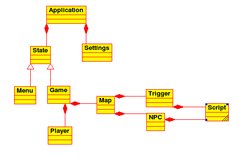
OK, well my ego is far too big to be on a creative team, so I'll try and stick to my CSA role. You and Mark have the art & music skills to set the atmosphere. I'll stick to organising the code and maybe doing a bit of it.
Later on when you've got the sprite style and everything down, I can help with the million animations.
Helping people to get on the same page, I stole some Final Fantasy tiles:
.http://www.allegro.cc/files/attachment/596345 http://www.allegro.cc/files/attachment/596346
So that's the basic idea of how the ship will look as far as the pure dimensions of rooms go. Pretending that will be the screen size and keeping those proportions, I think I'd want the player at least the 16 pixels he is now, maybe 18. I was picturing him Link-sized, with the ALttP style of too-big heads, but if we keep normal dimensions for the player like in the mockup that can work too. Not pictured: life meter, current weapon equipped, etc. The colony, which this is kinda supposed to be, is going to look fairly white and sterile, but be cluttered as hell with various gear and equipment.
Upon reflection, I think all the screens will scroll (not 100% sure yet). Being forced to make all the level designs adhere to compartmentalized room is going to bite me in the long run; I can tell now. All dungeons and the colony will be as you see above; black enclosed rooms that may or may not have to scroll. Perhaps they should all more-or-less stay centered on the player? The overworld will still just be one big tilemap, and if you want to challenge yourselves you could make it load a screen at a time from file so it only has an area 3 screens tall by 3 screens wide loaded around the player at any time. The idea of moving with arrow keys and shooting with the mouse appeals to me, and I should probably start thinking of ways to design rooms/enemies/puzzles around that philosophy ....
PS: Tilemap engine needs parallax scrolling; don't forget that detail.
if you want to challenge yourselves you could make it load a screen at a time from file so it only has an area 3 screens tall by 3 screens wide loaded around the player at any time.
I started writing an iso tile engine that worked like that. I eventually realized it was more trouble than it was worth. After calculating the memory it would take for say, a 1000x1000 tile map, it wasn't really worth it, and making sure thing that are off the loaded map keep state was more of a pain than just keeping stuff loaded, and using a few extra MB of ram.
I did actually get the code working though. Supported 9 layers as well or something like that.
I actually had been thinking of making a little demo of that (which is why I brought it up) and I think we had very different designs, but that's another thread ...
I think we had very different designs
For my first tile engine, the code is rather pathetic but it let you load NxM "blocks" of tiles, where normally you'd just let it pick the best number of blocks for the resolution you're using (larger mode has more visible blocks on screen). And as I mentioned, that style of dynamic map loading didn't mesh well with the features I wanted to support.
I like the player proportions in that shot (needs bigger doors to match, though), and I would prefer that to anything else. Where did you get that player sprite?
Okay, I should be able to have everything setup by tomorrow night. Just need a method to control the users, and once that's done, I'll let you have it. Next week, I'll see about allowing other people to control user access as well. For this weekend, just allowing a way to allow people to change their password will be enough for me.
I've never used, or heard of, SVN. Hopefully it's straightforward enough to jump right into.
Subversion clients can be installed from numerous sources. Official binaries appear to come from here. That's mostly useful for Windows users. *nix users will probably either have Subversion installed already or will be able to easily find it in their distribution's software repositories. Or you can get the source and build it yourself (there are probably also binaries for most common distros). For Windows, it's definitely easier to just use pre-compiled binaries though. And for those not comfortable with the command line, there are a few GUI front-ends that do the job. ToroiseSVN is a pretty good one for Windows, I guess.
The command line client works a little different from most *nix tools in that it doesn't have a --help option (nor a /? switch for the Windows users). This used to catch me quite often. Instead, it just has a "subcommand" as the second argument (examples of these given by Thomas Fjellstrom are checkout AKA co, update AKA up, commit AKA ci).
svn [subcommand]
The one you'll probably use most often when first starting out is help, which lists the various subcommands available or, if supplied a subcommand, lists the help for a particular subcommand.
svn help [subcommand]
You can either view the Subversion Documentation online or download it and view it locally (Reads pretty much like a tutorial; I recommend you at least attempt to read through the first few sections so that you know how to use Subversion and get a general idea of DOs and DONTs):
v1.5*: Download (.tar.gz / ~350KB) | Online (~1.1MB)
v1.4*: Download (.tar.gz / ~364KB) | Online (~1.2MB)
* Not sure which version MiquelFire is running on the server. I'm not sure if the client/server have to match so to be safe I'll say they should (though they very well might not have to).
I'm guessing "-m" means "message",...
I find it much easier to set the SVN_EDITOR environment variable (i.e. In Windows, I have it set to notepad because it's so light weight that it takes no time to launch). Then, when you don't pass the -m variable, the Subversion client will launch the editor set in SVN_EDITOR and let you take your time to write a detailed log message (Which also allows you to write multi-line log messages; which might be possible, though not pretty, on the *nix command lines, but not in Windows). When you're finished, just save (to the temporary file that was created by the Subversion client) and exit the editor. The client will examine the temporary file and react accordingly (either committing with said log message, or if you didn't modify the file, asking you what to do).
Sorry, it's the short form for "commit".
Fixed.
My server (if you clicked on the link) is 1.4
Though I think a higher version client should work with a lower version server. After all, if they weren't backwards compatible, how would you explain how they handle the SVN repository for SVN itself? Yea, to check out 1.5, you need SVN 1.5... chicken/egg... wait, what?
Maybe Monday's evil twin could be Yadnom?
I know this is blasphemous, but I stumbled across the ClanLIB library (competitor to allegro), but they have some really good ideas that we could "borrow" from if anyone needs to know how to do GUIs, use networking, use their style of maps (or map editors), etc.
I like the OO approach (almost entirely C++), though that may grate on some people here.
I know this is blasphemous, but I stumbled across the ClanLIB [clanlib.org] library
If I look at just one more 'CL_' I think I'll barf. Their naming conventions are awful. Haven't they ever heard of a namespace? The abstraction levels for image formats seem pretty low and their class names are rather lengthy. There are some interesting things there though, like their Sprite class with animation support.
Regarding the group project :
Keep at it people, I'd like to see everything come together. I may make myself available for proof reading once code starts materializing.
Play Game:
    Centered buttons:  New Game, Load Saved Game, Exit
I don't see any value in having a Play Game sub-menu. Putting the New Game and Load options on the main menu (and perhaps a Save option while in-game) is more efficient from a user's point of view. Speaking of which, it may be a little early, but how do we intend to save the game? Are we going to store the exact player position, health, or perhaps just the inventory and progress?
Maybe we should start recording all of this stuff in a single place so we can find it later (either a Wiki or the OP?).
How did we define player vs. enemy fights? Zelda-like, where they attack each other on the world map, or will it do the FF thing where you're all in your line, they're all in their line, and you have very limited animations ("sword attack! Hi-ya!")?
I'm just thinking of the number of frames that need to be drawn in either case. For FF-style, you have "stand and wait for your turn" animations (a few "ho-hum" ones), but for Zelda-like, it's more like:
"walk left", "run left", "attack left", "defend left", etc.
Thus, we would know what kinds of animations they'll need. For just these four "left" movements, you may need to have 2-3 of each (so 8-12 different animations each).
With that new Spore game's monster-creation lab, we may be able to quickly create hideous monsters through that interface and just take a highly-pixelated snapshot of a few of its different movements (and then rotate in the different directions you'll need to use for 2D animations and do it again).
But that's obvious plagiarism...
EDIT:
I don't see any value in having a Play Game sub-menu. Putting the New Game and Load options on the main menu (and perhaps a Save option while in-game) is more efficient from a user's point of view.
From what I learned, many people prefer tend to prefer fewer "distractions" in a screen than having to click through a few more screens to get to where they want to go.
You COULD put the screen-configuration settings on the same page too, but then you immediately see how that could become more cluttered quickly.
There may want to be a design spec that says that we should limit the number of on-screen elements (buttons, information panes, etc.) to a certain number (as a standard, not a hard-fixed rule, of course). That would help us know when "too much" is too much...
How did we define player vs. enemy fights? Zelda-like, where they attack each other on the world map, or will it do the FF thing where you're all in your line, they're all in their line, and you have very limited animations ("sword attack! Hi-ya!")?
I'm just thinking of the number of frames that need to be drawn in either case. For FF-style, you have "stand and wait for your turn" animations (a few "ho-hum" ones), but for Zelda-like, it's more like:
"walk left", "run left", "attack left", "defend left", etc.
Thus, we would know what kinds of animations they'll need. For just these four "left" movements, you may need to have 2-3 of each (so 8-12 different animations each).
I think we agreed on real-time, which likely means "world map" battles. And it's seemingly going to be a shooter. For the record, FFXII and FFXIII have world map battle systems though.
Like I said, we should record the details in a single place so we can look these things up easily as time goes on. What should it be? A post, wiki, static Web page managed by an elected member, or something else entirely?
From what I learned, many people prefer tend to prefer fewer "distractions" in a screen than having to click through a few more screens to get to where they want to go.
You COULD put the screen-configuration settings on the same page too, but then you immediately see how that could become more cluttered quickly.
It really depends on just how clean the title screen is. Keeping the background of the actual menu uncluttered will make the menu easier to see. I think that's key. So long as the menu items fit nicely on a single screen there should be no problem. I've played games that did either well and either badly. It's really just a matter of making the title screen UI first and art second. It shouldn't be too difficult to experiment with each though.
we should record the details in a single place so we can look these things up easily as time goes on.
The best and most concise references right now are 23's posts (the long ones). I reviewed them last night before I went to bed and found some things I had missed. I recommend that other people do that as well.
Trezker, did you use Dia for that UML? Can we have the file to play with please?
I don't see any value in having a Play Game sub-menu.
This was to provide an opportunity to put more games (or expansions) in the same exe . The first main menu would be the framework's, and could have [PLAY GAME1], [PLAY GAME2] [WEB UPDATES(clickthrough;D)] buttons. It would have its own style (flames for Flamework (earlier typo) is what I'm thinking, done in a slick, corporate style, so if you a) don't read it b) don't press a key and c) only have 1 game in the exe, then after a few seconds it would jump straight to the game's main menu, and you would think you'd just seen a publisher's logo. It's like lilo in a launcher
The Game's main menu would be the individual game's main title screen, with its own graphics etc.
Hmmm, as some of you know I've recently become interested in Unicode programming. And it just occurred to me that it might be a nice thing if we use Unicode internally. Assuming the story will be told 100% through text, we could even conceivably store said text in locale-specific XML files, which would allow for easily translating the game to other languages. And with Unicode, it would conceivably enable the game to be translated to any language.
Obviously, the font we chose would have to support it as well. We'd need to make sure the "speech bubbles" and any other text controls were dynamic too. They'd need to be able to calculate the required horizontal and vertical space and split the text appropriately across lines and screens... There might be issues with incorrectly formatting some languages, though members fluent in those languages could advise us on those quirks...
It would probably add a considerable about of work so it should be put on the list of extra features or whatever. If it's not a big deal to any of our multilingual members then it's probably not worth risking the project on another optional feature. Just a thought for consideration.
Allegro has full support for UTF-8 built in. Fonts are the only concern.
I made a full Unicode Allegro font from a free one but it's rather plain. I think we should suck it up and let the user select the best font on their system, rather than try and supply a good, complete one with a compatible licence (which would be a huge file anyway) This removes stylistic control from the design team, unfortunately.
On the subject of internationalisation, I've got an evil plan for the Japanese version. Let's do to them what they did to us with Zero Wing. Nobody with any degree of fluency shall be allowed to assist. Otakus + Google Translate = Mirthful Joy Feeling \:)/
We're going for a subtle mystery plot here
Scooby Dooby Doo!
I think that internationalization/translations should wait until we maybe have a working game.
I find it much easier to set the SVN_EDITOR environment variable
It'll actually use the EDITOR variable on linux/unix which is normally set to vi or something similar, though mine is set to "nano", and I just prefer to pass short messages in, instead of messing with the editor when it launches. Basically I only use it when I have long messages to apply.
I used Umbrello to make that UML.
Umbrello doesn't seem to export to many formats so I don't know if I can give you something that loads in other programs, maybe you can load the format it uses...
I think that internationalization/translations should wait until we maybe have a working game.
Yeah, but it's worth considering before hand-drawing a custom multi-coloured font.
Do you guys have any consolidated design documents, including role allocations, for those of us that are dipping in and out of the conversation to use to keep up? It might increase your probability of getting further volunteers.
Did you pick a lead programmer?
EDIT: as ever, I can throw my code for drawing TrueType fonts with OpenGL geometry at anyone who is interested. Though I suspect you're all heading for a CPUy, pixely game?
There are still no code ?
Still on your UML thing ?
Move in team ! Go for the Objectives !
EDIT:
Did you pick a lead programmer?
Trezker is IIRC.
The most ambitious thing we should be worrying about, text-wise right now, is word wrap. If we're following good coding principles, upgrading the engine to handle more will be simple.
If anyone is coding anything, it should be a general framework. Whoever is on that should just start writing a simple engine that handles the main menu, player movement, and changing maps. Once the world is more or less established we can add NPC interaction to it, quest points, simple GUIs for player inventory, enemies, items, scene scripts/triggers, and the like.
So if the coding team is looking for "step one", there you go. Write a basic framework that we can plug all the other crap into later. Simple main menu, the player can move around simple tilemaps and switch maps by stepping on "doors", and just have lots of comments what should go where later. Keep the design open enough that we can add in everything else easily. For now the player can be {int x, int y, BITMAP* sprite}. Tilemap can be {int w, int h, int[][] map} and each number in map can be for drawing a rectangle of a solid color. Simple like that. In the making of the framework we'll have figured out how to handle everything. Will you keep separate arrays of each object? Use polymorphism and STL to keep every game object in one big vector<>? Figure it out now!
I've made a second stab at UML. This time I made a god class which is preached against by OOP gurus... But it's simple, and we can split it later.
http://www.allegro.cc/files/attachment/596355
is Game a global base class? So all those objects are all in a "isa" relationship with it? Or does Game just "havea" (contain) bunch of other objects?
Game has a lot of stuff. It's the manager of everything.
I figure Monster, Player and NPC will share a lot of functionality so I made a Unit base class for them. I don't know why I bunched in trigger with them though...
On the subject of word wrap: I have some code from my TINS entry that wouldn't be too terribly difficult to put in.
I think that internationalization/translations should wait until we maybe have a working game.
Sure, but some thinking ahead might make it a lot easier in the long run. It would be nice to be able to just drop a new translation file, pick an option from a dynamic control, and have the game 100% translated. Again, optional, but I think it's worth consideration before starting.
If anyone is coding anything, it should be a general framework. Whoever is on that should just start writing a simple engine that handles the main menu, player movement, and changing maps. Once the world is more or less established we can add NPC interaction to it, quest points, simple GUIs for player inventory, enemies, items, scene scripts/triggers, and the like.
So if the coding team is looking for "step one", there you go. Write a basic framework that we can plug all the other crap into later. Simple main menu, the player can move around simple tilemaps and switch maps by stepping on "doors", and just have lots of comments what should go where later. Keep the design open enough that we can add in everything else easily. For now the player can be {int x, int y, BITMAP* sprite}. Tilemap can be {int w, int h, int[][] map} and each number in map can be for drawing a rectangle of a solid color. Simple like that. In the making of the framework we'll have figured out how to handle everything. Will you keep separate arrays of each object? Use polymorphism and STL to keep every game object in one big vector<>? Figure it out now!
Notice how when KQ was suggested, people started looking into the code, immediately saw that it was overwhelming and ugly (by their standards) and decided they hated it? The same thing can happen to the code written by others if it's not governed by the project. The framework is going to be the foundation of the project and if people don't like it or find it difficult to understand, they probably won't be too excited about the project.
I think we would benefit from coding standards and a thorough design. It might even be a good idea to use an automatic source formatter on the code before going into the repository (i.e. GNU indent). I personally have a compulsion to reformat code that I find difficult to read. This would allow me to hopefully do that without actually changing anything (in theory, GNU indent could put it right back again). It could be used on the client, instead, but then the repository itself would likely end up storing a lot of white-space differences (I think Subversion can ignore white-space, but that just seems like it would grow increasingly messy).
It just seems like some members would rather dig this project an early grave than take it's time and succeed.
The thing is, if we don't get anything done, then it's just a lot of talk and no code. I think we need to do something.
The thing is, if we don't get anything done, then it's just a lot of talk and no code. I think we need to do something.
I agree. Something like defining coding standards and modelling the application. It's a major part of writing good code. Designing it first. Think of how easy it would be to write the code if all the modules were documented beforehand!
Doing it right takes time. If you disagree with me then you'll be every manager's dream, every maintainer's nightmare, and every user's enemy.
I AM modeling, not getting much of a discussion going though.
Sure, but some thinking ahead might make it a lot easier in the long run.
The basic idea is we're trying to keep this from being a "long run". This is a very simple design with very basic mechanics which a single person could probably make easily enough given some time. We have enough of an idea of what we want that we can start putting code down. The last thing I'm worried about is indenting.
It looks like there's still some discussion on how the classes will be organized, and that's fine since it's actually important. But don't sweat too hard over it; agree on a design that works and start implementing it.
I AM modeling, not getting much of a discussion going though.
Yup, and it's appreciated. My only input is that all the managed objects should derive from a base class but you've got that anyway. If anyone else has a problem with how you're setting it up they can speak now or hold their peace.
Since people are talking about classes, it seems that we'll be using C++. I don't know too much about that, but there's got to be some code we can write that is independent of how we decide to organize the classes.
I AM modeling, not getting much of a discussion going though.
I've never written a game like this so personally I don't know too much about the overall design/structure. I'll happily try to critique it though...
The model appears to be missing items/weapons. Are we still planning to have upgrades that the player can find? And what about NPC's and Monsters. Are either of them going to be able to have/use items and weapons?
It think it's awkward that the ScriptGlue and Script are not related at all... I think it makes better sense to have Game -> ScriptGlue -> Script and the game itself will still manage everything, but scripts are then able to communicate with the game (i.e. to control Units, for example). My only experience with a game engine and scripting was with Torque during a short 3-day "class" (?) at the local university. I don't remember the how, but C++ classes in the actual engine were bound to scripting classes in that if you called a method on an object in script it would be called in the actual engine, resulting in the desired behavior. That's how I see this going... Anybody done this before? Is this what we're planning?
Does anyone see value in a SpeechBubble class for managing the text, etc.? This way an actual Unit could just say() something and it's SpeechBubble would take care of the actual drawing. We'll likely need some way to tell it to switch pages though (i.e. say_more()) when given user input.
http://www.allegro.cc/files/attachment/596374
Essentially, CGame represents the actual game (:P). So far the game contains a configuration manager (CConfigManager), save game manager (CSaveGameManager), script manager (CScriptManager), tile maps (CTileMap; though perhaps we also want a tile map manager), and units (CUnit).
CGameObject is a base class that everything derives from, directly or indirectly. Obviously all of these classes will need to be wrapped in a namespace.
There is a lot still missing... Critique/revise! For those of you familiar with the kinds of work that will need to be done (collision detection, path determination, etc.), it might be a good idea to start thinking of how to wrap these things into a framework that can later be used...
** EDIT **
Hacked menu system back into it (Umbrello crashed and I forgot the menu system the next time around). I'm not sure why I went with "System"... I guess for the sake of the model, "Manager" and "System" are synonymous. So we can pick whichever we prefer.
UML would be so much more attractive if the software was intelligent enough to automatically arrange entities and relationships so they were readable and didn't overlap... :-/ Trying to do this manually, as demonstrated in the above class diagram, is a bitch. :P
First, I don't see the point in putting a C in front of every class name. I find it very distracting.
Second, I prefer Speech_bubble over SpeechBubble.
I see how a universal base class might be useful, especially for saving and loading games. We should discuss how saving should work.
As for items and weapons. I don't think they will cause much trouble. Your model for that looks good.
In my model Script wraps a script specific to the instance that uses it. A certain NPC for instance needs to be bound to its specific script.
Scriptglue is there to make various functions available to all scripts. So the connection between Script and Scriptglue is made in Lua or whatever we use, not within the engine.
First, I don't see the point in putting a C in front of every class name. I find it very distracting.
Personal preference, I guess. I like it because it frees up ClassName as a module-scope identifier, which frees up class_name for limited-scope identifiers. For example...
| 1 | class CGame |
| 2 | { |
| 3 | protected: |
| 4 | CConfigManager* config_manager; |
| 5 | public: |
| 6 | CConfigManager* ConfigManager(void) |
| 7 | { |
| 8 | return(this->config_manager); |
| 9 | } |
| 10 | |
| 11 | /* |
| 12 | * Obviously naming a method parameter the same as a property could lead to |
| 13 | * hard to spot bugs. That's why, regardless of naming convention, we should |
| 14 | * enforce explicit property access (i.e. the this keyword). |
| 15 | */ |
| 16 | CConfigManager* ConfigManager(ConfigManager* config_manager) |
| 17 | { |
| 18 | return(this->config_manager = config_manager); |
| 19 | } |
| 20 | }; |
Second, I prefer Speech_bubble over SpeechBubble.
Which is exactly why we should nail down our coding standards. Odds are a lot of us will be disappointed that the project won't be using our standards, but it's a little bit easier to deal with when it's the "project's" standards as opposed to "his" or "her" standards. And as I said, formatting can hopefully be handled mostly with software (i.e. GNU indent). The naming conventions will need to be nailed down, but that's also why it makes sense to document the entire project model... It won't be individual programmers coming up with names for things. It will be them implementing an already detailed, named, project idea.
In my model Script wraps a script specific to the instance that uses it.
I think we're the same here...
A certain NPC for instance needs to be bound to its specific script.
I haven't actually used scripting in a game engine before so I'm a little confused as to how it works exactly... I think having to write a separate script for every single action or NPC would become lengthy. It seems like being able to write a single script for a "scene", for example, would be nice and clean. How to do this, I don't know. Perhaps the script will need a concept of a "timer" and "frame" as well so it can time it's actions appropriately (although "triggers" will help with this, they probably won't be able to handle everything).
Since people are talking about classes, it seems that we'll be using C++. I don't know too much about that, but there's got to be some code we can write that is independent of how we decide to organize the classes.
The low level stuff, although I can't think of what isn't in Allegro already, except the tile renderer, and that has to wait for the game spec.
I haven't actually used scripting in a game engine before so I'm a little confused as to how it works exactly... I think having to write a separate script for every single action or NPC would become lengthy. It seems like being able to write a single script for a "scene", for example, would be nice and clean. How to do this, I don't know.
I think you can have a library of functions in one script, which can be called by name from the NPC_update() func in the binary. You might need a flag to distinguish scripted from hard-coded actions or at worst a vtable. Or, you could have scripted funcs that wrap the hard-coded ones, so all NPC actions are scripted.
Are we agreed that LUA is the scripting language? The only alternatives I can think of are Python (making an interface API is verbose) or Ch which may have licence problems with the free version. I can't tell from reading it if it's allowed to distribute binaries with Ch embedded.
Lua seems to be the language to use. I haven't personally used it before, but I guess I can take the opportunity now to give it a try. Mmmmz, Linux.
READ THIS: I'm going to keep the summary of our progress and game concepts on this page: http://www.zeoxdesign.com/monday recommendations and suggestions are not only welcome, they're necessary! ;)
Feel free to use the wiki as well.
I think we should go with plot #1, btw.
Sorry, i've been out for a while, so somebody might have already said this...
Not to be the enemy of all freelance coders here (myself included), i think that to avoid the problem of having code that some members of the project consider "evil", i think we should set up some style guidlines, everything from newlined curly braces to what should be a global variable, to should we use gotos (just kidding. )
To save time on deciding style rules, the group could use the Allegro Hacker's Guide.
agreed
I didn't even know that existed!
For the coding standards, that's fine. I'm uncertain about how the indentation will work. The way I do it is two spaces for each new level of indentation, replacing any eight spaces in a row with a tab. I'm not sure if you can set Emacs to do anything else.
I'm not sure if you can set Emacs to do anything else.
Two seconds of googling says you can.
alright, that's 3 for the allegro hacker's standard... none opposed
Fourthed. Although it doesn't explain all things, like naming conventions of:
1) Classes (class CClassName, class ClassName, class class_name, class _class_name, .. ?)
2) enums (enum PLAYER_DIRECTION { ... }, enum Player_Direction { ... }, enum player_direction { ... }, enum _player_direction { ... }, etc.)
There may be others, but these first few would be important for me.
To save time on deciding style rules, the group could use the Allegro Hacker's Guide.
Then we all have to read the Allegro Hacker's Guide!  Actually, it was looking good for a minute,...
/* foobar:
 *  Description of what it does.
 */
void foobar(int foo, int bar)
{
    /* do some stuff */
}
...but I personally prefer to line up braces at the start of the indentation level (i.e. Nothing on a line before the braces, but single-line blocks can follow...). It makes it a lot easier to find missing braces and also makes the program structure clear.
if(foo)
{
    /* stuff */
}
else
{
    /* stuff */
}
Fixed.
do
{
    /* stuff */
}while(foo);
Fixed.
switch(foo)
{
case bar:
    /* stuff */
    break;
default:
    /* stuff */
    break;
}
Fixed.
I'm not really trying to start a flame war, so if the majority agree on the Allegro Hacker's Guide I won't fight it, but I think my recommendation is valid. The newlines add clarity. The spaces between a condition statement keyword and its condition generally don't, IMO (though spaces should be used inside the condition to make it readable and parenthesis should be used to make it clear).
if((condition1 && condition2) || (condition3))
{
    /* stuff */
}

// -- OR if conditions are long --

while((condition1 && condition2)
        || (condtion3))
{
    /* stuff */
}
Mark, put a <title> tag in that document.
Anyway, got some time, will start coding up the interface to handle users for the SVN now. Won't be too long now.
And also, we would probably benefit from using a documentation system (i.e. Doxygen) standard in the comments.
Mark, put a <title> tag in that document.
Allegro hackers guide looks good. I'll set my IDE up for that.
What classes are we going to have? Maybe it's just a personal preference, but i prefer to have a complete object API before we begin coding, even if none of the structs are actually coded. I was thinking:
{
NPC
Map
grid-square
Main character
}
at least.
It's a work in-progress.
http://www.allegro.cc/forums/thread/597566/769552#target
http://www.allegro.cc/forums/thread/597566/769787#target
http://www.allegro.cc/forums/thread/597566/769906#target
Far from complete.
** EDIT **
Thinking a little more deeply, are speech bubbles going to be dynamically positioned/sized or perhaps there will only be one at a time (in which case, each unit will not really need it's own and the say() method could communicate with the game's single speech bubble instead).
Okay, SVN is up and running. All I need to do now is add users basically.
The repository url is: http://svn.miquelfire.com/monday/
The url to change your password is: http://svn.miquelfire.com/svnadmin/?project=monday
For now, only Chris and Matt (as they're leaders of this project) can send me usernames to add (VIA PM), so bug them about getting access. Later (next weekend I hope), I'll allow them to just add and remove names themselves without having to wait for me.
Oh yea, they need to contact me for the usernames they want. And Chris, if their anyone else you want to allow to add/remove user access to SVN, just let me know.
MiquelFire, what version of SVN do we need to have?
MiiquelFire, what version of SVN do we need to have?
My server (if you clicked on the link) is 1.4
Though I think a higher version client should work with a lower version server. After all, if they weren't backwards compatible, how would you explain how they handle the SVN repository for SVN itself? Yea, to check out 1.5, you need SVN 1.5... chicken/egg... wait, what?
- Source
Much appreciated!
I feel like I've gotten out of my league. The last page or two... so confused! Is there some non-programming position available, I still want to help, you guys are just way beyond my technical skill.
Design graphics
Develop storyline
Get some sort of simplistic framework ready
Even if you only write code in C, it won't be too difficult to have some of these C++ programmers to convert it, if they need to (though, since C can be compiled FINE without much/any changes, I don't see this being a big issue, or at least a time-consuming one).
I nominate myself to work on the storyline! Any objections?
Mildly Annoying Man
hahaha.
anyway, yea, these last few pages of programming specifics aren't quite in my relm either, but that's why I'm glad I'm not doing them! I think once those experts iron that stuff out there will be some good mid-level stuff to do, even for programming. They're pretty much working out how it'll all be structured in the grand scheme so that the little guys will know what to do.
I think you should wait and see if there is anything in the overall design that you have experience with (or even think you can handle). And regardless of your coding contributions, there is always documentation and testing.
Fine, I'll wait. The storyline will just have to do without my pure literary genius.
I've started a few files to get an idea of what needs to be done, and it should be flexible enough that even with radical changes, it won't be hurt too badly.
I need some concrete specs for the maps.
| 1 | map |
| 2 | | |
| 3 | +- multiple layers // this can EASILY be dynamic, like with a std::vector |
| 4 | | |
| 5 | +- tile width and height // 16x16, IIRC |
| 6 | | |
| 7 | +- # of tiles per layer // horizontal and vertical |
| 8 | | |
| 9 | +- "markers" // can be set on any tile that can be used to trigger events or |
| 10 | | // be a "move to this position" target |
| 11 | | |
| 12 | +- an "obstacles" layer // can block 1 or more direction of movement ONTO or OFF OF |
| 13 | | |
| 14 | +- BITMAP *tilemap // all layers of the same map would use the same tilemap, so the |
| 15 | // map should take care of this (layers don't need to know that |
| 16 | // information) |
It would look something like:
void the_game(...)
{
   Map map;
   map.set_tilew(16);
   map.set_tileh(16);
   map.set_dimensions(200, 240); // width, height
   map.set_num_layers(3);

   // ...
}
What else does it need? I think that the "layer" tile values should be public, so you don't have to call expensive getters/setters: just access the array directly.
This is something at least that we can start on. More features can be easily added as needed.
Fine, I'll wait. The storyline will just have to do without my pure literary genius.
I'm not saying you can't work on the storyline. I think the storyline should be worked on collaboratively though, as a team.
the team being Mark Oates and his team of brain cells...
just kidding
Is that akin to brain children, but just with more neurons?
Hey OnlineCop I think your map proposal would work nicely. I approve
with vector and all
except I think the tilemap should be a seperate class
The storyline should be collaborative, bet we really need one or two people to do the actual writing. Division of labor is a wonderful thing for getting team projects done.
What else does it need? I think that the "layer" tile values should be public, so you don't have to call expensive getters/setters: just access the array directly.
Opinion #1
Isn't this in direct conflict with Thw Whole Bloody Point™ of C++? I don't think performance is an issue here if we are aiming for SNES age gaming tech. The renderer might need direct access but that can be done as friend class.
I suggest by-the-book (Stroustrup, zzz) clean, elegant, OOP code. Ideally the classes output by the UML tools will be used verbatim.
Opinion #2
What the hell, yeah go for it. Do whatever works. We've only got one week, after all
The storyline should be collaborative, bet we really need one or two people to do the actual writing. Division of labor is a wonderful thing for getting team projects done.
This made me smile Why, do you suppose, do writers go and live in a cabin for the duration, with nothing but a manual typewriter and a tube of bear repellent?
Sure, throw ideas at the writers, but don't be offended if they don't stick.
Personally I'm not very fond of the one week limitation. I think it's good to set dates to motivate productivity, but to say the whole project must be done within a week (before even really nailing down the details of the project) sounds dangerous. I'd rather do a good job and take something away from the experience than release another semi-functional embarrassment upon the world, or possibly nothing at all.
It would make better sense for the project/team leader to set goals for individual task completion so the whole thing falls into place nice nice. A week may seem like a lot of time for a project like this for some, especially with so many volunteers, but most of us have day jobs or school. Heck, some of us allegedly have lives. I think it makes sense for a project like this to be flexible with it's schedule.
This way when it's not satisfactorily done in a week, moral doesn't have to drop to the point of giving up. Instead, we revise our plan and continue working until it's done right.
The original idea of a one-week thing was unrealistic for this project. I think it was set so low because problems maintaining interest were expected.
I've pretty much got a basic plot in mind, I'll flesh it out and post in detail down the road. It has no bearing on the engine anyway. We already know what we need to code, and the cutscenes/dialogue won't be anything special. If I feel something fancy might be needed you'll get lots of notice. Scripts really only need to handle dialogue, movement, and the occasional animation change right now.
I hereby put myself in charge of overall plot, and level design. Which are the two hard jobs in my opinion anyway. The basic requirements of the engine are laid out; let's get on that.
Map map;
   map.set_tilew(16);
   map.set_tileh(16);
   map.set_dimensions(200, 240); // width, height
   map.set_num_layers(3);
Down the road, you can replace that with this:
Map map("dungeon 1.map");
Then we all have to read the Allegro Hacker's Guide!
At least it's written. Code format affects the final game not one iota; it barely warrants 5 minutes discussion. We won't be writing the code long enough to care. If we need to get everyone on the same page then there's our page. Code beautification is not a pressing issue for short projects!
Lua works for scripting. It's proven and I'm sure a few of us have experience. And no, this is not going to be just a one-week project. Like I said, I'd really like to have seen an executable by now. Not a very usable one (black screen, please press Enter ftw? ), but one with the internal flow of the game mapped out if nothing else. Extremely basic interfaces and variables to be added to later, zero implementation.
K, I've updated the Monday Game Progress Summary Document Webpage Area.
everybody review it please and make sure it's correct/we're on the same page.
You are missing me.
Are we going for 16x16 or 32x32? Nice page btw, I like the Web 2.0'ness. I agree with bamccaig on the time limitation issue.
I suggest we write out tasks for everyone on Marks page/the Wiki and then everyone can set out to do their jobs.
We've been ordered decided to use 16x16.
Pretty much.
We'll need a simple tilemap structure, flexible enough to handle arbitrary tile and map sizes, but for this game let's shoot for 320x240 resolution, 16x16 sprites. I would honestly like to make it 320x240, 32x32 but I don't want the graphics to be a burden to progress. I'm open to being outvoted there.
What color depth? I don't like 8bit.
Neither do I. Forgot to say that, yeah. 16 bit plskthx.
For some reason I've always thought that Allegro couldn't do 16+bit with a 320x240 resolution.
not with GFX_VGA etc 320x240x8 does indeed work with (nearly?) any old Allegro 3.x driver, but even djgpp has options for higher depths
IMO, 16x16 are no quicker to do well than 32x32. The only advantage is reduced file size, which is no big problem these days. Kids today are not bashful about getting a 5GB game via torrent, if it's worth it.
If whoever is drawing/compiling the tileset and drawing the characters disagrees with me then that's fine.
A possible motive for increasing the res is font size. It's pretty hard to represent a Chinese char in less than 16x16.
k updated the color depth and Vanneto (sry).
I like the Web 2.0'ness
oh? what's web 2.0 about it?
Obligatory Redundant Link to the Monday Game Progress Summary Document Webpage Area or ORLMGPSDWA for short.
We're representing Chinese chars now?
We're representing Chinese chars now?
I think we've unofficially decided to indirectly keep internationalization an easy possibility in the future. Something crippling towards that goal would be unfortunate.
We have? Why? I thought the whole point of this project was to get something done. WHEN ARE WE GOING TO GET SOMETHING DONE!?
For some reason I've always thought that Allegro couldn't do 16+bit with a 320x240 resolution.
Fair enough. 16x16 tiles in 320x240 at 8bit is out. We're now running 32x32 tiles in 640x480 at 16bit colour depth.
And I agree with Neil Black. If I wasn't about to start writing up a hard plot outline I'd just code the bloody framework myself. Honest question: what's left that I can't see this by the end of the day in a format that compiles?
| 1 | // STL includes |
| 2 | // random incomplete classes and subclasses |
| 3 | |
| 4 | int main() |
| 5 | { |
| 6 | // initialize game |
| 7 | // menu loop |
| 8 | // play game |
| 9 | // new game |
| 10 | // call game loop function |
| 11 | // load game |
| 12 | // call game loop function |
| 13 | // options |
| 14 | // exit |
| 15 | // deinitialize and exit |
| 16 | } |
| 17 | |
| 18 | void game_loop() |
| 19 | { |
| 20 | // initialize player, load file or new defaults |
| 21 | |
| 22 | { |
| 23 | // handle level changes, run scripts, handle player input, run logic, collision detection, draw it |
| 24 | } |
| 25 | } |
You get the idea. Make a .cpp file, put the rough classes in it, get the inheritance and STL containers rocking, and start plotting this thing out. Here, I'll get you started:
     // Initialize standard Allegro stuff
  allegro_init();
  install_keyboard();

  set_color_depth(16);
  if(set_gfx_mode(GFX_AUTODETECT_WINDOWED, 640, 480, 0, 0))
  {
    set_color_depth(15);
    if(set_gfx_mode(GFX_AUTODETECT, 640, 480, 0, 0))
    {
      allegro_message("No support for 16bit or 15bit!");
      return 0;
    }
  }
For realz? Link with Lua, get some empty functions for obvious stuff like the initialization and shutting down, make (mostly empty) .h and .cpp files for the major classes ... you don't need much of a design doc for a skeleton this basic. Whoever is in charge of the coding team, get the basic flow going in code and be ready for details. You should have a basic idea what the game will need; we've already seen diagrams. Write it up, upload it, and let's flesh this puppy out. And remember to follow the Allegro Hacker's Guide for formatting!
Once we've got the files organized then we can probably start delegating. We'll decide what we need, everyone will grab a class and start writing. Once we've got them all together we'll edit as needed until the engine pieces all fix (be nice if they did without editing but what are the odds on that?), and by that point we'll long since have the plot done, script requirements finished, and some levels to play with. Graphics and sound will be last concerns, but obviously the engine should be written to take care of all resource loading, playing, managing, and deleting.
Theres no reason to forcefully leave out i18n.
Theres no reason to forcefully leave out i18n.
Time? Otherwise you do it.
Its no more work to keep it in mind, than it is to consciously leave support out. Besides, allegro has a function to get translated strings, and natively supports Unicode.
EDIT: edited.
It's in mind. Waaaay in the back, is all.
What controllers will be used? Keyboard, Mouse, Joystick?
Will keys be remappable or fixed/set?
I have a self-contained module that completely hides whether the input comes from a gamepad, a keyboard or even (in principle) a mouse. It lets you use multiple sources at the same time (so you can switch between gamepad or keyboard by putting aside one and picking up the other) and you can remap physical keys to "logical" keys. You then query whether a logical key, say GAME_KEY_UP or GAME_KEY_USE_ITEM has been pressed.
If there's any kind of demand for this, let me know. I haven't touched the inner working of that code in years though and it might be a bit convoluted. It's also rooted firmly in Allegro 4, so it'd have to be rewritten for Allegro 5. It's also in C rather than C++, but a C++ interface is of course easily written for it.
I have started putting together the Game class. The hub of activity in my design.
Now there is one question I would like an answer to. How do we handle input?
I'm imagining this as an old style console game with only button input, no mouse. I thought we could make an input hierarchy of menu>dialog>player. So if a menu is open it gets all input, then if a dialog is open but no menu it gets all input and if neither dialog or menu is open you can run around with the avatar and blow shit up.
As an improvement over KQ, you should always be able to open an in game menu by pressing esc (or select/start on whatever) and choose to skip dialog or exit to main menu. Pressing esc in any menu should close it.
Anyone have objections?
No objections to that. For cutscenes, there should be an option to press space and skip through.
How do we want the .map file designed? We could do XML, standard UNIX config file, our own proprietary thing, or one of those other things that Cortex Command uses.
whaddayathink?
I'm for our own proprietary map format. It makes us look a lot more l33t!
I agree with Trezker about the input. Simple and easy, thats the way it should be.
So, is the SVN server going to be Miquel's?
Trezker: I need to finalize this as I design the dungeons, but we're currently going with the idea of keyboard movement, mouse aiming/shooting.
For cutscenes, there should be an option to press space and skip through.
I prefer Trezker's suggestion.
As an improvement over KQ, you should always be able to open an in game menu by pressing esc (or select/start on whatever) and choose to skip dialog or exit to main menu. Pressing esc in any menu should close it.
I'm the kind of person that watches cutscenes 99% of the time, even when I've seen them before (unless they suck, in which case I'll probably still watch them once). I hate when I twitch or something and hit a button or click the mouse and unintentionally skip the cutscene and have to reload the game from a previous save and work to get back just to rewatch the cutscene (even if I'm right there it still takes time to load). The better solution, demonstrated in games of late, is to bring up a menu offering to skip the cutscene or exit to the main menu. And a confirmation prompt might be a good idea too, at least for the exit to menu option. This way the user is much less likely to trigger it unintentionally.
The better solution, demonstrated in games of late, is to bring up a menu offering to skip the cutscene or exit to the main menu. And a confirmation prompt might be a good idea too, at least for the exit to menu option. This way the user is much less likely to trigger it unintentionally.
This seems extremely unintuitive to me. I think a skip button makes a lot more sense, and not just to me, but your average joe. I can't even remember a time where I accidentally skipped a scene.
If you're worried about people skipping them on accident, I think the best idea would be to keep a "journal" of all the scenes, and the player is able to replay scenes that they've encountered.
The journal is a good common sense feature that too many games leave out these days.
But I still think it is reasonable to display a confirmation prompt if they skip the cut-scene early, maybe something that asks if they are sure and tells them that they can always view it again in the journal, and has a tick box to disable prompting in the future. That seems quite sensible.
This seems extremely unintuitive to me. I think a skip button makes a lot more sense, and not just to me, but your average joe. I can't even remember a time where I accidentally skipped a scene.
SquareEnix did it in FFXII and I think it's brilliant. I'm sure they'll do it again for FFXIII. There's nothing unintuitive about it. That's like saying a file deletion confirmation is unintuitive.
If you're worried about people skipping them on accident, I think the best idea would be to keep a "journal" of all the scenes, and the player is able to replay scenes that they've encountered.
This is a good idea, however, it doesn't solve the problem of accidentally skipping the cutscene. Either way, the flow of the game is broken, which is very annoying for users (at least for me).
...and has a tick box to disable prompting in the future. That seems quite sensible.
Agreed. The optional prompt makes it even more user-friendly. Everybody gets what they want and if a user does unintentionally skip a cutscene it's probably his own damn fault for disabling the prompt.
The menu also has the advantage of offering to exit the game faster (rather than waiting for the after-cutscene elements to load and render, he can immediately exit if he so desires).
I must have missed the point. I think a confirmation would be a great idea. But I was thinking something like "Press spacebar to skip..." in the corner and then after you push it, it would ask if you were sure. I got the impression that you were saying that the user pushed the "main menu" button or whatever, and one of the options there was to skip the cutscene.
Anyway, hardly matters. It seems we're on the same page.
Trezker: I need to finalize this as I design the dungeons, but we're currently going with the idea of keyboard movement, mouse aiming/shooting.
I don't think it matters much. I mentioned mouse because for some reason I figured it might cause some kind of problem... But now I've realized I was wrong.
I've written a very simple Menu class that has pointers parent menu and child menu. So you can go further into submenus and escape to parent menus, no mish mash. For now I just send in ALLEGRO_EVENT events to the top menu which sends it on to child if available, to its own handler if no child.
However we implement specific menus, I have no idea.
I'm attaching what I have done so far. I'm too lazy to start using svn for this yet. Also, an attachment is easy for everyone reading the thread to just download and take a look at. See it as a nightly snapshot...
There is not much comments in the code, so you'll have to just look around at your own risk. The Player, Animation, Animator classes is just something I ripped from my allegro 5 test project, I thought it'd be fun for everyone to fly around with Mr. Smiths famous Gryphon sprite.
Oh, maybe I should also mention I build the project with scons.
But it's using the speedhack organisation so you can use a makefile from there.
cool!
I usually keep keyboard input separate from my player classes, just wondering why you decided to include it in Player? just cause?
I like the Animator/Animation classes. I've never done that before.
Yeah, the player class probably shouldn't know where the input comes from. It should just get events called up, down, left, right, shoot...
Having actual code is good. Using the SVN repository that we have now is even better. You should import that.
Also, in case anyone needs help with SVN: http://svnbook.red-bean.com
Okay, as long as we're using the Allegro hacker's guide, and it doesn't contain ALL the coding formats that we may encounter, where will this "new and updated" version be? Maybe as part of Mark Oates's page?
How do we want the .map file designed? We could do XML, standard UNIX config file, our own proprietary thing, or one of those other things that Cortex Command uses.
I'd like to do our own proprietary thing. Then you'd be forced to use a map editor to make changes. This means that the map editor itself could do a lot of the error checking and corrections, at the expense of easy readability and flexibility...
and it doesn't contain ALL the coding formats that we may encounter
it doesn't have to. Just use your best judgement. A 2nd line brace isn't going to cripple the project, but worrying about it will.
For the map format, binary formats are a pain in the @$$. It should be plain-text, editable with any text editor. We can provide a map editor and say "don't edit these unless you're sure you know what you're doing", but taking out the ability of knowledgeable users to fiddle the maps by hand is not a good idea.
EDIT: Also, we should start getting the code we have imported to SVN and giving developers access to it.
I agree with the text-editable map format.
Everybody familiarize yourself with trezker's basic game structure here.
Obligatory Redundant Link to the Monday Game Progress Summary Document Webpage Area or ORLMGPSDWA for short.
I third the text-based map format. Assuming we're going for open source, the whole project should be as open as possible.
And if we're not doing open source, then we need to make it as open as possible so as to avoid annoying users any further.
My system (with the SH2007 makefile) doesn't like Trezker's project:
[bamccaig@rufus ~]$ cd src
[bamccaig@rufus src]$ mkdir -p allegro/4.9 && cd allegro/4.9
[bamccaig@rufus 4.9]$ svn co https://alleg.svn.sourceforge.net/svnroot/alleg/allegro/branches/4.9
snip
[bamccaig@rufus 4.9]$ mkdir tmp && cd tmp
[bamccaig@rufus tmp]$ cmake GRADE_STANDARD=on GRADE_DEBUG=on GRADE_PROFILE=on SHARED=on STATIC=on ..
snip
[bamccaig@rufus tmp]$ make
snip
[bamccaig@rufus tmp]$ su
Password:
[root@rufus tmp]# make install
snip
[root@rufus tmp]# exit
exit
[bamccaig@rufus tmp]$
Then...
[bamccaig@rufus tmp]$ cd ../../../Monday
[bamccaig@rufus Monday]$ make
g++ -Iinclude -O3 -s -W -Wall -o obj/Animation.o -c src/Animation.cpp
src/Animation.cpp: In member function ‘bool Animation::Load(std::string)’:
src/Animation.cpp:43: warning: no return statement in function returning non-void
src/Animation.cpp:43: warning: control reaches end of non-void function
g++ -Iinclude -O3 -s -W -Wall -o obj/Animator.o -c src/Animator.cpp
g++ -Iinclude -O3 -s -W -Wall -o obj/Dialog.o -c src/Dialog.cpp
In file included from src/Dialog.cpp:2:
include/Dialog.h:17: error: ‘ALLEGRO_EVENT’ has not been declared
src/Dialog.cpp:13: error: variable or field ‘Event’ declared void
src/Dialog.cpp:13: error: ‘ALLEGRO_EVENT’ was not declared in this scope
make: *** [obj/Dialog.o] Error 1
[bamccaig@rufus Monday]$
** EDIT **
Corrected cmake arguments to be identical to what I think I did. Also added the cd tmp, which was missing. I didn't have the original history (ex_opengl crashed X on me) so I had to go by memory.
are you using a5?
Wow. A5 is a LOT different than A4. I'll have to learn it first.:-X
are you using a5?
AFAIK (edited the above post). Is there a command to check the installed version?
** EDIT **
[bamccaig@rufus Monday]$ allegro5-config --version 4.9.5 [bamccaig@rufus Monday]$ allegro5-config --libs -L/usr/local/lib -lalleg-4.9.5 [bamccaig@rufus Monday]$ ls -Al /usr/local/lib | grep alleg -rwxr-xr-x 1 root root 929520 2008-09-14 21:40 liballeg-4.9.5.sorw-r--r- 1 root root 1145556 2008-09-14 21:41 liballeg_s-4.9.5.a [bamccaig@rufus Monday]$
Replacing allegro-config with allegro5-config in the makefile has no effect...
Until I get access to the SVN, how about this for just the layers?
It only needs to have a few things:
type (unsigned char, unsigned short, or unsigned long: 1, 2, or 4 bytes)
number of tiles (horizontal and vertical)
z-index (since the map has to keep track of which layer is above/below the others, it makes sense just to store this along with the rest of the structure)
array (std::vector) of tiles
The other things are functions like different constructors and map-resizing support (to make bigger or smaller).
In my prototype "CMap" class, I've typedef'd the layers with a "unsigned short":
typedef CLayers<unsigned short> Layers;
Then, I've got a std::vector of these Layers (or CLayers<unsigned short>):
  std::vector<Layers> layers;
  // ...or...
  std::vector< CLayers<unsigned short> > layers;
The map is responsible for the size of data type (the "unsigned short") for the map, since we may use less than 256 tiles in one map (then you'd use "unsigned char" to define the tile datatype), or less than 65536 (hence, the "unsigned short").
The layer itself doesn't need to know any other information than that.
Ideas, comments, or suggestions?
Ideas, comments, or suggestions?
Why not replace the TILETYPE with a CTile pointer (assuming I understand its purpose)...
The CTile class can even store most, if not all, of it's properties statically.The tiles_x and tiles_y properties should be width and height, IMO.
I'm not sure why the class name is plural. AFAIK, it represents a single MapLayer.
IMO, we're not ready to be writing code yet.
** EDIT **
[Wrote some pseudo-classes and struck out a statement]
Why not replace the TILETYPE with a CTile pointer (assuming I understand its purpose)... The CTile class can even store many of it's properties statically.
I'm not understanding what a CTile pointer is supposed to do. How can it tell whether we need an unsigned char (for tilemaps with <= 256 tiles in it), or an unsigned short (for <= 65536 tiles in it)? I mean, if it does that, it's fine with me. Implementation isn't really as important to me as just getting something that we can work off of.
The tiles_x and tiles_y properties should be width and height, IMO.
And that's fine.
I'm not sure why the class name is plural. AFAIK, it represents a single MapLayeri.
I just haven't figured out good naming conventions yet
I'm not understanding what a CTile pointer is supposed to do. How can it tell whether we need an unsigned char (for tilemaps with <= 256 tiles in it), or an unsigned short (for <= 65536 tiles in it)? I mean, if it does that, it's fine with me. Implementation isn't really as important to me as just getting something that we can work off of.
Maybe I don't understand what it represents... What is the TILETYPE for? I was assuming it was an identifier to reference the actual tile (i.e. bitmap, whether it's walkable, etc.) in a container or array somewhere else. If so, we could just store a pointer to the actual tile instead. If not, you'll have to tell me what it is.
After writing some psuedo-classes, I realize that I was likely wrong about the static properties though... Unless we want to actually define subclasses for each unique tile. I haven't really thought out the details of the storing and loading of tiles/layers/maps yet.
I just haven't figured out good naming conventions yet
My bad. I'm just OCD like that. The little things bother me.
** EDIT **
Stupid Umbrello displays the class diagram with most of the classes too small to read... I shouldn't have to rearrange the diagram every time I open the file!
Whoops, forgot that speedhack doesn't use a5 yet...
If you want me to commit the code to svn, I'll need an account I guess.
Umbrello problems... Weird, it works perfectly for me.
Umbrello problems... Weird, it works perfectly for me.
Maybe the result of trying to squeeze it all into one screen? My resolution is set to 1024x768.
I just watched the latest video from GyroVorbis. They describe a bit how they use lua, starting 2 minutes into the video.
http://www.youtube.com/watch?v=ik6lCtxYj28
I thought this might be educational to someone, or give ideas for how we should use lua.
Okay, here goes the plot, mostly. Incoming stream of consciousness attached ... I highly suggest anyone seriously involved read it all because it's not all plot related.
looks for attachment
...
fails to see attachment
I forgot to hit the upload button; yeah, I fail.
looks for attachment
...
fails to see attachment
I've added a makefile to the project and discovered that indeed, you cannot compile because I forgot to include allegro in Dialog.h which confuses me a bit. I wonder in what order I actually did stuff last night...
Now I got that working though and trying to figure out what to do next. The Base class for game objects maybe? Game loading framework?
Game loading can wait. Get a base class going imo.
EDIT: You'll only be able to save at actual save points, btw. Not Zelda's save-anywhere system.
Incoming stream of consciousness attached
Nice. I like it. Especially (1) the rock crusher which can be 'upgraded' with new rock frequencies, (2) most of the dungeons are underground, eg. rocks and mountain tiles are relatively easy to draw , and (3) the rockin ending.
For controls the big question is should we go two mouse buttons or one?
One mouse button would lead to a combination of quick-keys QERTFCX for items, spacebar for weapons menu, select with mouse.
2 button would mean the same quickkeys but right-click for menu, mousewheel for scrolling through weapons. Space to interact with objects.
2 buttons would probably be best then, even though initially I though 1mouse would be more 'universal'. But that's just silly in 2008.
about lights for Dungeon 1, I think we should consider (very basic) shadow layer for the lights. It would be relatively easy to put into the map (a 'light' tile could have a larger light circle drawn on the light layer at the same coordinates). We could do really erie blinky lights too.
most of the dungeons are underground, eg. rocks and mountain tiles are relatively easy to draw
Only Dungeon 2 will have much rock to speak of. Dungeon 1 is the ruins of the original city, fairly technological. Dungeon 3 is underground, but it's still a build city; it's very simple since this race needs few trapping that we'd be accustomed to. It will still be quite shiny.
I'm thinking a 2 button system will be necessary. How will you fly with the rocket pack and shoot at the same time? Or will that ultimately be necessary ...
PS: If you jump/fall down a hole to a lower level, again much like ALttP did, after the upper level fades to black, the new level will fade in as you land with your jetpack, regardless if you had it equipped or not. So I guess I can't put any holes until after the jetpack dungeon if that goes through.
Start asking questions about the plot so I can find holes to fill.
So what it appears we are looking at for art direction (to which graphics will come second) are:
1. Overworld
- contains several types of basic alien-type planetary terrains
- exteriors of the temp colony (how big to scale?)
- interiors of the temp colony
2. Wrecked Human Space Ship (interior and exterior)
3. Dungeon 1: ruins of the original Human city.
4. Dungeon 2: rocks, underground pebble laden world
5. Dungeon 3: underground alien race, simple, minimalist designs and shiny stuff.
... ?
Most importantly, how big is the colony and how big is the space ship?
How will you fly with the rocket pack and shoot at the same time? Or will that ultimately be necessary ...
That struck me as automatic like the ladder in the original legend of zelda.
What wrecked human space ship? I missed that bit ....
Overworld is mostly rock. Sandy ground, rocky mountain "walls", loose rocks here and there, maybe minor plants and moss. The tileset will include the colony exterior and some sort of outer dome/wall on the original city (if I had not made it clear, it was covered). For some reason I'm seeing this in purple. Yeah, purple rocks, you heard me.
The colony will be fairly white and drab as far as walls and floor go, and lots of research equipment that's a bit of a clash in tone. Rememeber, the building is just some general-purpose prefab thing they threw together. It looks like a hospital designed by a science engineer and is somewhat sterile looking. The actual equipment, vehicles, tables and chairs, etc. should look much less clean, gritty, "real".
Dungeon 1 will be a futuristic city. We'll be cribbing heavily from Mega-man style of textures, I imagine. Lots of wreckage though, no shiny. Since we're in a power plant, there will be a lot of computer equipment in various degrees of "working". I'm seeing offwhite and blue in my head.
Dungeon 2 art will be mostly rock, reddish-brown. There will be some tiles on load from Dungeon 3 since they discovered alien ruins; old city I guess. But of course the tiles will be cracked, dusty, rusty, etc. Also, the mine will have all the trappings of a mine, with areas for scanning, equipment, etc.
Dungeon 3 will be lots of shiny. Flat surfaces and techno-stylized lining. I imagine more heavy cribbing from Mega-man, though very unlike Dungeon 1. It looks like it was made from sheets of cut emerald.
The final dungeon ... well, imagine every starship ever. Lots of whites/grays/blacks and blinky lights. Think Death Star.
Scale-wise, everything should be (roughly) as it is on the map I drew. Because of the way the player changes room when he goes through doors, we can lie a bit about the size anyway (see my "screenshots"). The colony won't be terribly big since it won't be serving as first or last dungeon as I thought it might. But all dungeons, command ship included, will be roughly the size they are in Zelda, probably a bit smaller.
That struck me as automatic like the ladder in the original legend of zelda.
Hmmm, so anytime he steps over a hole, he's flying? And if there's floor below, he auto-hovers down? I guess that works, but I'd rather my idea. I was thinking of flying like in Cave Story or Little Nemo, where you can take off and fly for five seconds before you have to touch down again (like the gun, the meter builds up quickly when not in use). I was thinking of a boss or other obstacle where you have to use the pack to avoid some kind of ground attack; that wouldn't work so well if it's a passive ability. I need to finalize the items and gameplay, I'm sure the coders would like that info as quickly as possible.
Oh I meant broken human vehicle.
Ok, your idea for the hover-mechanism is better. I'm assuming it's a button-press trigger that sets it off for 5 seconds, as opposed to holding the button for 5 seconds? I think that would make the gameplay more interesting.
What I meant by scale... I've attached the map with a Link sprite. Which size did you have in mind?
Obligatory Redundant Link to the Monday Game Progress Summary Document Webpage Area or ORLMGPSDWA for short.
Either your "favorite", or a touch smaller. Subject to change based on final colony layout.
I'm assuming it's a button-press trigger and it's off for 5 seconds, as opposed to holding the button for 5 seconds?
Either or. That's just a detail.
Oh I meant broken human vehicle.
It'll be roughly the same graphics style/tiles as the colony equipment. It's not like they only have one vehicle.
It'll be roughly the same graphics style/tiles as the colony equipment.
ah, ok. gotcha. Like a Magitek suit... but bigger. I wasn't sure if it was like, a small room or something you walk in.
I discovered some flaws in my menu class and decided to fix it before moving on.
I also made a fake main menu and added a ttf font.
As for the base object class. What features should that have? How do you want to use it?
Either your "favorite", or a touch smaller.
I forgot to mention: assuming the link sprite and everything is upscaled proportionally to 32x32 instead of 16x16, correct?
Chris Berry
What kind of berry is he?
You know what, Just PM me if you want SVN access. I'll use the name that you're using when I get your PM (Removing space, and replacing non-ascii character (if any) with their acsii versions). Note, you only need access for writing only!
I have acquired svn rights and committed the stuff.
So now everyone can checkout, check it out and feel good about themselves.
That's just a detail.
Just so we're clear:
If someone submits code, it is subject to review, modification, removal, or complete overhaul. Since the Leaders need to have final say, no one should feel bad if their contribution(s) get tweaked or obliterated.
The game is going to be evolving, so if there are things that just aren't needed, don't fit, cause crashes, or has bad formatting, I'm in favor of the Leaders to be able to have the Final SayTM in the matter.
All in favor? All opposed?
Vote for despotism?
The best despots seize power on their own initiative. Objections and rebellions will result in a truckful of soldiers at your house in the middle of the night
Just so we're clear:
If someone submits code, it is subject to review, modification, removal, or complete overhaul. Since the Leaders need to have final say, no one should feel bad if their contribution(s) get tweaked or obliterated.
The game is going to be evolving, so if there are things that just aren't needed, don't fit, cause crashes, or has bad formatting, I'm in favor of the Leaders to be able to have the Final SayTM in the matter.
All in favor? All opposed?
While I agree that code submitted is subject to those things, and the leaders should get the final say, I think the best approach is to communicate before committing something to the repository (and preferably before developing something in the first place) so there's no need to throw away somebody's hard work (I'm pretty sure the Subversion documentation recommends this approach as well). There should be no need for people to waste their time here. Let's make it clear who is doing what how so it isn't a matter of two or three dominant members overwriting the project while the others see their efforts gradually filtered out.
Ideally, nothing should be "overhauled" without the project deliberating over it first and preferably coming to an agreement (or if need be, the leaders having the final say). It's normal for a project's design to evolve. It's not normal for a project's team to develop abstract concepts individually without guidance and attempt to mesh them all together in the end.
All in favor? All opposed?
Have to be careful though. Some people get attached to how they do things, and change things just for the sake of changing them, and will get into a commit war with others...
But otherwise, that is how opensource tends to work.
Ideally, nothing should be "overhauled" without the project deliberating over it first and preferably coming to an agreement
Oh, I totally agree. However, if the Leaders only want to give vague "it needs to do this..." descriptions, it leaves the programmers free to implement it as they know how to do so best.
But if the implementation is missing features (like having a lot of empty framework stub functions), I feel that the Leaders should be able to go in and tweak the calls: map.get_tilemap(0); may be changed to be map.get_tilemap();
If the "leaders" feel something needs to do something and they don't really need to wait, they can just go change it. I can't see myself doing something like that, but part of the idea is this is a group project anyone can contribute to, right? Surely that includes the lead programmer.
I don't like the idea of my work being thrown out or altered beyond recognition but I suppose that's an inherent danger of coding. I've thrown out my own work plenty of times so it should be no shock. We'll still acknowledge any meaningful contribution.
Just so we're clear; lead programmer is officially Trezker? I just need to know who to poke with a stick should the need arise ...
I forgot to mention: assuming the link sprite and everything is upscaled proportionally to 32x32 instead of 16x16, correct?
Yes. And since it's been finally officially pointed out, fix my name.
If the "leaders" feel something needs to do something and they don't really need to wait, they can just go change it. I can't see myself doing something like that, but part of the idea is this is a group project anyone can contribute to, right? Surely that includes the lead programmer.
Well by that logic anybody can just go change it. I think anything that could be seen as an alteration warrants a discussion, or at the very least, some attempt for discussion. If those attempts fail and somebody is confident that their change is valid, I see no reason why they shouldn't press on (it can usually be undone should the need arise), but they should make it clear in the revision log why they made said changes and what their justifications were. This way at least, when I come back and see a void where my hard work once stood I can be reassured that it was done for a good reason and not some political or religious reason. The point is, nobody likes to be neglected or mistreated so do unto others applies, basically.
I don't like the idea of my work being thrown out or altered beyond recognition but I suppose that's an inherent danger of coding. I've thrown out my own work plenty of times so it should be no shock. We'll still acknowledge any meaningful contribution.
Well the Subversion repository should keep a history of the codebase at every revision, meaning that unless something happens to the repository, it will be possible to recover your (committed) work if you or somebody else erroneously obliterates it. It's one of the many benefits of using version control software. However, that doesn't mean that recovering it will necessarily be effortless and it does pave the way for other problems (i.e. as Thomas suggested, commit wars, being one of them).
I have a question on "preferred uploading practices":
I would like to propose that, when we check in our code submissions/changes, that they are all done at the same time (in a single commit).
This way, if anyone were to try to do a checkout while someone is committing, they won't get partial code as the other programmers are submitting the files individually (it takes time to write the "what was changed, and why" comments!).
So when I commit 4 different files, the commit comment would look like:
// All these are in a SINGLE entry when all the specified files are checked in at the same time:

Animation.cpp: changed how foo() was implemented.

Animator.cpp/.h: Updated to tie into changes made to Animation.cpp

Menu.cpp: Updated bar() to be able to use changes to Animator class (Animator.cpp/.h).
Added new foo2() function as private member to simply checks for changes to bar2();

Vector.cpp: Changed blah() and barf() to use the new barf() format.
Will this work for everyone else?
I would like to propose that, when we check in our code submissions/changes, that they are all done at the same time (in a single commit).
Bad idea in general, but I take it you mean that if the addition of one feature requires the modification of more than one file, then those modified files should be committed together. That is a good idea.
It is usually a bad idea to have big commits that change ten different things at the same time and add three new files.
Anyway, if you'll take some advice, discuss (major) changes in the code before you commit them.
Will this work for everyone else?
Certainly. IMO, code shouldn't be submitted to the repository until it's working or at least has no effect on the compilation or execution of the project. If somebody is working on something large that will take a while to complete and they want to "backup" their code in the repository, I believe that is what branching and merging is for.
Bad idea in general, but I take it you mean that if the addition of one feature requires the modification of more than one file, then those modified files should be committed together. That is a good idea.
It is usually a bad idea to have big commits that change ten different things at the same time and add three new files.
Good revision.
Bad idea in general
Indeed, and I still feel guilty over my last few large commits in branches/4.9-fshook. Specially that last merge. Yeesh. Took for absolute ever for svn to do the merge, then some more "ever" to commit it to the repo.
Yes, make branches if needed.
Though why everything is currently in a folder called monday... that I'm not so sure of. (Plus the svn path for it..., and the directory structure if someone just checks out trunk into a folder called monday.)
Changes (meaning commits that alter the future path of development) should be discussed here or wherever; if you are working on a change and want to save it to the repo, make a branch. Contributions, meaning advancements in the path of development that don't change it except for moving farther along, need not be. Bug fixes especially not.
EDIT: Also, make sure what you commit to the main repository compiles and doesn't make anything else unusable.
| 1 | /* gamedriver.h */ |
| 2 | /* C version looooowwww level game to framework API */ |
| 3 | typedef struct GAME_DRIVER { |
| 4 | main_init, |
| 5 | main_update, |
| 6 | main_draw, |
| 7 | play_init, |
| 8 | play_update, |
| 9 | play_draw, |
| 10 | load_game, |
| 11 | save_game, |
| 12 | load_player, |
| 13 | save_player, |
| 14 | configure_keys(bkgbmp, keymap, keydefs, "Monday.cfg"); |
| 15 | } GAME_DRIVER; |
Just too lazy to switch to Notepad
Though why everything is currently in a folder called monday... that I'm not so sure of.
OK, who's gonna fix this?
** EDIT **
Assuming trunk/monday is redundant, I have a working copy ready to commit that should fix it, if nobody else has bothered to do this yet... Is that what we want to do or is it there for a reason?
The question becomes, if something happens with the path, should it be renamed (so that any tools can have their own directory?) or just moved to trunk and the extra monday is 'lost'?
The question becomes, if something happens with the path, should it be renamed (so that any tools can have their own directory?) or just moved to trunk and the extra monday is 'lost'?
What path? What's gonna happen to the path? IMO, we should move the project into trunk and get rid of trunk/monday. Tools can just be nested in subdirectories; or, if you're feeling generous, afforded their own repository.
They are not going to get their own repository!
Anyway, I'm moving the everything to trunk.
IIRC, it's in monday/trunk/monday. We should get rid of one of the Mondays. It's general SVN practice to say trunk/monday, but it's not really important.
It's general SVN practice to say trunk/monday, but it's not really important.
Depends on how you setup the repos. Some projects have more than one "part" and they only give them selves a single repo, like kde, so they have trunk/blah, but all of my projects each get a separate repo, so its just project/trunk, instead of project/trunk/part.
OK.
Now it looks like I have to learn Scons. sigh...
Really, I think it's a better idea to use make, because it's more universal and fits in with the autoconf system, which is even more universal.
Ok, I'm a bit lost.
Is this a multiple team competition for the allegro.cc community? Or is this just a single game that the allegro.cc community is collaborating on?
Either way, count me in for sound design.
It's a single game.
>> Neil Black: It's a single game.
Aww. I was kind hoping for a group competition. Maybe next time. Oh well.
Offer still stands. If you lads need help with the audio, just let me know.
You can try to form a group. Maybe some competition will get us moving.
I am arbitrarily defining a group to be at least four people.
If you lads need help with the audio, just let me know.
Audio is currently filed under "pray for this", so yes, we will.
Too late, I'm stealing him for my own group.
I can do audio but I'd prefer to work on the art direction for this one. decepto, if you want to do audio I'd be thrilled.
No problem.
Are we going to be sumbitting this project to any competition? Or is it just for kicks?
The goal here is simple accomplishment: group projects are a running joke around here and it would be nice to set a precedent that, yes, they can be done. If we can get a finished product in reasonable time, maybe more people will make more honest stabs at this, and we can actually make games faster by splitting up the work. Anything beyond that is gravy, or an afterthought imho.
Reasonable time being the operative word. This was supposed to last a week.
Well cool!
Like I said, anything dealing with audio, and I'm your man. Everything from small special effects all the way up to 15 minute+ music scores. My home is more or less a shrine to Bob Moog, so I have all the equipment needed.
Also, I'm pretty efficient with AI algorithms. If you run into any algorithmic or combinatorial problems, let me know. I also have several dedicated servers in case we want to set up Git or SVN. Just let me know. Here's my email:
nacarlson {{{{a___t}}}} gmail ((((Dooo-dodododod--dot}}}}} com
That'll get teh bots!
edit: Sorry, my ambien kicked in, and I'm not very coherent. Talk to yall in the morning.
I need some communication from the coding team as to what they're waiting for. What needs to be done before you can just start matching people up with hpp/cpp files and tell them what needs doing? Has Lua been linked? Have interfaces been written for Lua so we can move people around and trigger dialogues? Can we display a tilemap? Do we have a game loop running to call logic, do collision detection, etc. even if the functions the loop is calling are mostly empty right now? Tell me what you'll need and I'll get it.
Reasonable time being the operative word. This was supposed to last a week.
This was never going to get done in a week. People are still talking about how to coordinate the code uploading. But on the upside, if you guys can work out a good agreeable system that works, we'll have a process set up that everyone else can just reference if they want to do this. And then we can cut like a week off future group projects, which is part of the point ...
I tried that email, but it caused a compile-time error. I think it was either the unclosed parenthesis, or the extra closing braces.
I tried that email, but it caused a compile-time error. I think it was either the unclosed parenthesis, or the extra closing braces.
Just be happy I didn't write it encoded in brainfuck.
Just be happy I didn't write it encoded in brainfuck [en.wikipedia.org].
Or White space.
I just googled some lua in C++ and found this little gem.
http://www.bigbucketblog.com/2006/03/02/lua-and-c/
I think it looks very simple and good, maybe thanks to this I can finally learn lua. Does any lua experts have complaints to file against anything on that page?
I've been working on tiles and want to know about translucency. Since we're in the modern age, using a5 hardware accelerated and only running at 640x480, would it be ok to use png tiles that include an alpha channel?
I'd say yes. Alpha is ok. Unless people decide the graphical style should not include it.
I have added lua to the project. I've only bound a method to change the player position to test. It's checked in to svn.
I'll record vocal stuff. Just tell me what sounds are needed and I'll see what I can do.
Anyway, I'm moving the everything to trunk.
revision += 4;
Reasonable time being the operative word. This was supposed to last a week.
A week isn't reasonable time, ffs... No wonder projects here fail.
I need some communication from the coding team as to what they're waiting for. What needs to be done before you can just start matching people up with hpp/cpp files and tell them what needs doing?
We should probably identify and document hpp/cpp files... And from there, identify and document modules, inputs, outputs, etc... The whole damn thing should be documented before people can go off and do it. Otherwise, we won't be using everybody as efficiently as we might. We'll just have those people that have done it before hacking it all up and throwing it in the repository...
Tell me what you'll need and I'll get it.
You're the leader...
Tell me what you'll need and I'll get it.
Really ?
{"name":"596416","src":"\/\/djungxnpq2nug.cloudfront.net\/image\/cache\/1\/8\/18b77e340d176a3a301628dedc98a84a.png","w":802,"h":530,"tn":"\/\/djungxnpq2nug.cloudfront.net\/image\/cache\/1\/8\/18b77e340d176a3a301628dedc98a84a"}
Here's a rough stab at the purlpe-hue Overwolrd. This is just a non-screensize tile taste. I'm just throwing this out there for feedback, but (1) there will be more rocks and (2) the stone stuff will be textured.
The shot shows the basic terrain, color, a few variations in the terrain type, grassie stuff (not frequent in the map) waterie stuff (also not frequent), some alien plant life (my favorite ), a locked door (the kind that goes to one of those random hole-in-the-wall), and two items at the top left, a key and a data chip with drop-shadows.
Don't stare too long, it gets crappier the longer you look at it
That looks nice. Do you have tiles for those? If not, you should make them. I like the alien plant life.
no tiles yet, but they're all lined up to a 32x32 grid and extracting tiles is relatively easy. You're looking at a tile-size accurate render (scaled 2x for beautification), though the screen will be wider and taller.
class Tilemap
  void Load(std::string filename);
  bool Collision( ? );
  void Render();
How precise collision? Fill in that ? with what we need.
If we will have layer(s) below stuff and layer(s) above stuff maybe have two calls to render these separately. I don't suppose we'll be using a zbuffer...
Any other considerations? Let's iron out what features the interface needs.
Then decide who will implement the tilemap.
I'm considering handling items outside the tilemap, so items doesn't have to be aligned with the map grid. Then they'll have their own manager in which we could implement a quadtree if that's necessary.
class Item_manager
  Load(std::string filename);
  Clear(); //Remove all items before loading another map
  Render();
  Item* Pick_up(Vector position); //If an item is found close enough to the player
  void Drop(Vector position);
Anything else for items?
I'm considering handling items outside the tilemap, so items doesn't have to be aligned with the map grid.
I'd like that. I think it would be easier to do that than trying to work items in with the tile map.
No Z buffer I don't think, just draw each layer back to front.
bool Collision( ? );
My thoughts are that we should have an enum for the type of collision-precision we want, then call that one as needed:
typedef enum _collisions
{
   PIXEL_PERFECT,
   BOUNDING_RECTANGLE,
   BOUNDING_CIRCLE,
   // ...
} COLLISIONS;
Then we can write all the collision routines once, and choose later which one to use (we may want to use all of them at some point...).
EDIT:
I don't suppose we'll be using a zbuffer...
The ONLY reason I was thinking about this is for use with parallax. If you have a z-buffer set really high (or really low), then when you show that on the screen, it better simulates height (like overlooking cliffs, walking under tree limbs, etc.).
It's not necessary, and can be removed because, like was pointed out, we just need to draw in the order of layers (bottom-to-top).
I'm considering handling items outside the tilemap, so items doesn't have to be aligned with the map grid.
The only way I've ever handled items in a game, it works by having an obj_map[][] that contains the object map in the grid, that's used to find things, but you can put the objects wherever and obj_map is automatically updated when it moves.
You're the leader...
Yes, and? I go to my team leader when I need something all the the time; if something is a hindrance to production I want to know about it.
Don't stare too long, it gets crappier the longer you look at it
Actually that's really nice! Original art by you? Good job. The ground texture and the grass are excellent imo, the striped plants are good, I wasn't really picturing any water in this area but it doesn't look bad. The buildings look more like rock than metal and a bit beat up but even as it is it's pretty close or better to what I pictured the overworld as being like. Just need to worry about rocky tiles now, the colony tiles can wait a bit until we figure out how they're going to look, unless you want to take a stab at designing that too.
I didn't even know Allegro 5 was usable yet ...
How precise collision? Fill in that ? with what we need.
Tilemap collision will be strictly binary so far; the settings we have in mind imply a lot of right angles and I don't see much need for sloped tiles. If someone wants to implement them I'll use them but not real necessary. And yeah, draw bottom-to-top, no need for a z-buffer.
And yeah, draw top-to-bottom, no need for a z-buffer.
Um... top-to-bottom or bottom-to-top?
Sorry; more noobness on my part. Wasn't thinking.
I suggest using bounding rectangle collision.
Maybe bool Collision(Rect brect, Vector velocity, Vector &adjust);
Then the function could provide an adjustment vector that would move the brect onto free ground.
Yes, and? I go to my team leader when I need something all the the time; if something is a hindrance to production I want to know about it.
You've basically told us to git'r'dun without documenting what 'r is. Where's the leadership? You should be telling people what they're doing, IMO. And you can't do that until you know what needs to be done and what people are capable of. That's my opinion anyway. I'm not just gonna start adding code to the repository unless asked to do something because it probably won't fit into what the others are working on. I suspect there are others among us that feel the same, but maybe I'm wrong.
Tilemap collision will be strictly binary so far; the settings we have in mind imply a lot of right angles...
So are we saying that we're doing more of a free-flowing movement style, or a "I'm on this tile, I want to go down to THAT tile..." approach?
If we did the tile-to-tile movement, we really don't need much in the way of collision detection for player movement. "if (is_occupied(map[...]) {...}"
But if we do more of a free-flowing movement (especially for shooting things with the mouse), it would be more "if (is_in_line_of_fire(object[...]) {...}"
You've basically told us to git'r'dun without documenting what 'r is. Where's the leadership? You should be telling people what they're doing, IMO.
I have been telling people what to do and "git'r'dun". If something is getting in the way of that, the leader needs to know. This is a two-way street here. I agree the programming team doesn't have all the details yet but if they need to know something in particular they need to ask. Right now they have enough to start and if they're waiting on me for something in particular, I need to know it so I can keep them informed.
So are we saying that we're doing more of a free-flowing movement style, or a "I'm on this tile, I want to go down to THAT tile..." approach?
Free-flowing, like the typical Zelda games. This is an action game; movement is pixel-based, not tile-based.
Hmm, line of fire might be needed too with these high tech weapons and all. Good call there.
Well, I'm imagining characters moving freely and have a bit smaller bounding box than tiles. So when going through a one tile thin alley you can still jiggle a little. And maybe we could have "monsters" that are too big to go pass through some places, or just a fat NPC.
Yes, you'll have to worry about line of fire especially if we're shooting with the mouse. Lots of funny angles to fire at ...
Well who is working on what? And what isn't getting worked on that I'm capable of?
I second that question.
I as lead programmer is being lazy.. But I have done some stuff and is thinking of what to do next and who to delegate stuff to.
Maybe time for some nominations.
OnlineCop for tilemap coding?
bamccaig, are you capable of making an item manager?
That depends on what an item manager is in this context. I'm going to assume I can probably figure it out, but I'm going to need some details to do so.
The item manager manages Items that are on the ground.
A little info was posted here: http://www.allegro.cc/forums/thread/597566/770566#target
Basically you can add items at given locations and pick stuff up.
The Item class itself hasn't been designed clearly yet, but from the managers point of view it just needs a few functions I think.
Item::Render()
Vector Item::Get_position();
Item::Set_position(Vector position);
I don't think it needs to interact with the map, just assume things can be put where it's asked.
Yeah, I should be able to handle that... I don't get off work for another 4 hours though.
Will somebody please think of the children!
Right, the children. Their bounding rect should be so small they can pass by each other in a one tile wide passage.
What all do we need to implement tilemap coding?
Map:
layers (std::vector to include # of layers and actual pointer TO the layers)
# of tiles high and wide
layer identity (0 = normal tiles, 1 = obstacle layer, 2 = shadow layer, etc.)
[/list]
Does this look right? I don't want to start coding unless I'm on the right track.
People were talking earlier about some line_of_fire() code? I have some vector code that could be useful. All in C, but it's there.
C is fine (it's REALLY easy to import it into a C++ file, so it's not really like there would be that much heartbreak over the code...)
[bamccaig@rufus trunk]$ ./monday
./monday: error while loading shared libraries: liballeg-4.9.5.so: cannot open
shared object file: No such file or directory
[bamccaig@rufus trunk]$
** EDIT **
Fixed. I had to add the installation path (/usr/local/lib) to /etc/ld.so.conf and then run /sbin/ldconfig.
Fixed. I had to add the installation path (/usr/local/lib) to /etc/ld.so.conf and then run /sbin/ldconfig.
I usually spare myself the trouble (even if debian does include /usr/local/lib by default), and just set the install prefix to /usr for allegro.
mkdir build; cd build; cmake -DCMAKE_INSTALL_PREFIX ..
Or some such (I usualy use ccmake .. instead, which lets me set all of the cmake vars).
Anyway, I need more details before I can write said item manager... I'm still not sure what it is. Is it just going to be a container of sorts for inventory items (i.e. weapons, items) located somewhere on the map, detailing where they are so the engine can render them?
Hey bam, essentially, you'll need to create a class which holds a bunch of items on the screen at whatever their coordinates. basic example:
| 1 | class item_class |
| 2 | { |
| 3 | int x, y; |
| 4 | item_type item; |
| 5 | void draw() {} // will include camera offset at some piont |
| 6 | void update() {} // checks for player collision (all items will have the same w/h, 32 lets say |
| 7 | void add_to_player_inventory() // will be worked out. |
| 8 | }; |
| 9 | |
| 10 | class item_manager_class |
| 11 | { |
| 12 | vector<item_class *> items; |
| 13 | |
| 14 | void add(item_type i) // add an item to the list |
| 15 | void draw() // draws all the items |
| 16 | void update() // updates all the items, maybe includes an |
| 17 | // item.erase() if the item gets picked up |
| 18 | //or times out or whatever |
| 19 | }; |
everything ultimately managed by item_manager.update() in the main loop
Items could have a bouncy thing or... ya'know whatever have fun be creative
For bamccaig. Let's keep it basic for starters. All we need right now is the ability to add items at positions, remove items at positions and render all of them.
class Item
{
   void Render(Vector position); // position provided by whatever is holding the item, just draw a circle or smth for now
};

class Item_manager
{
   std::vector< std::pair<Vector, Item*> > items;

   void Add(Item* i, Vector position) // add an item to the list
   void Render() // draws all the items
   Item* Remove(Vector position) //returns an item if one is found near position
};
[EDIT] Scratch bamccaig from the contributtors list, I did it myself
We chatted a bit on irc and agreed that I might as well code this myself, as you can see it wasn't much work really. We were just wasting time arguing over design.
Maybe we can find something for him later, some advanced function maybe pops up in the tilemap department.
Yeah, without a design in place I don't really see a part for me in this project... I don't like the idea of everybody designing as they go and hacking it together later (I'm stuck doing that all day at j0rb and hate it). As many of you know I'm a little OCD sometimes and really don't like hacking things up unnecessarily. As was demonstrated with the item manager, rather than putting me to use I'm being assigned trivial problems and, to add insult to injury, refused a detailed explanation of what those problems are. I can't solve a problem if I don't know what that problem is. It's just going to slow this project down in the long run so I might as well step aside. I'd still like to help out if something comes up that I would be well suited to, but there's no sense in the project making sacrifices to make room for me. It's a waste of my time and yours.
I would like to request permission to use IP from this project on a sister/branch project so that I can still sort of participate without holding this one up. Does anybody object to me using art, sound, story, etc., from this project or have any terms in mind (I would certainly open source anything of mine)? More precisely, does anybody (everybody?) give me permission to use the IP from this project for a sister/branch project?
OnlineCop: As you can see items are handled outside of the map.
So, no "stuff" on the map, just tilemap layers. As for what layers we need there has been mentions of shadows and parralax and stuff.
So make it easy to add new layers, but start off with the old basic ground we walk on and collision.
I'm a little OCD sometimes
Sometimes? Seriously, its something you might want to look at improving.
I get a little Obsessive my self, and tend to way over plan/engineer stuff, and its something I've been working hard to fix. I think the current progress everyone is making is a huge improvement over past efforts.
shall I write up the item code then, Trez? Is it ok if I go with my model from the inside? I've never used std::pair but I think a little simple function could get whatever data is necessary.
Obligatory Redundant Link to the Monday Game Progress Summary Document Webpage Area or ORLMGPSDWA for short.
As long as you get the general api right, it doesn't matter how you implement the functionality (so long as it works), that can always be replaced later if needed.
Hey bam don't be discouraged, it's less technically cumbersome than you might think! Put your OCD aside and pretend you're Captain Kirk.
Yeah, I can't think of anything better than just getting in there and doing something.
Just got home, lots of posting. Apologies to those who feel discouraged for lack of design and info, much appreciation to those who "get it" and are making progress. Admittedly, I don't know much about the code delegation and progress since I'd like Trezker to handle that (don't do all the writing yourself, buddy ). When there's something compilable and playable let me know; I want to check it out.
I did some long hard thinking at work today about the items this game will use besides the jetpack and rock crusher. I'm going to write up another detailed text doc and attach it presently. It'll have some details besides just "this weapon does that" so this will be vital info for the coding team moving forward.
Can we get a post devoted to what exactly has been done so far, code-wise? Do all the major classes have at least a declaration? Does someone have a basic idea how game objects will be managed, rendered correctly, etc? Is Lua in the pot?
I would like to request permission to use IP from this project on a sister/branch project so that I can still sort of participate without holding this one up. Does anybody object to me using art, sound, story, etc., from this project or have any terms in mind (I would certainly open source anything of mine)? More precisely, does anybody (everybody?) give me permission to use the IP from this project for a sister/branch project?
This is actually probably worth bringing up. Anyone care to propose a license for this thing? People will get individual credit for work done so as long as credit is given to this game (which will have well-documented individual credits) I'm down ...
Is Lua in the pot?
I believe LUA is in.
For the license I'd say everything's fair game, just don't sell it.
You can has poorly formatted weapons doc! I may have forgotten some things, possibly like the plot doc (I would still like someone to poke holes in that so I can consciously fill them). Ask questions!
I believe LUA is in.
Awesome; I missed that. Thanks.
We have lua, can position the player but nothing else yet.
I have coded the item manager, but item itself needs proper rendering and script functions.
I have written a Code_todo and it's in svn.
http://svn.miquelfire.com/monday/trunk/Code_todo.txt
There's quite a bit of question marks in it that 23 needs to take a look at.
Anyone wanting to code should take a look and see what they can do, ask questions that break my illusions etc...
Well right off the bat, there will be no "drop item". There won't be much "move to" in the AI but if someone can do some simple A*, maybe we can give it to the odd abnormally-intelligent enemy. "Use item" will be a straight mouse click. If I click with the gun equipped, I fire in the direction of the cursor. Interacting with level objects like consoles will be a key press (Ctrl or Space or something). No on-screen buttons for that. Info about items will be if you have it highlighted with your cursor on the Inventory screen; there can be some text in a lower window with items in the upper window. Equipping an item from inventory will be just a click; right click to bind to right mouse button, left to bind to left. Graphics should pretty much all be animations, not still bitmaps. Renders ... I'd like to get away with 4 directions for everything, but my gut is telling me it'll end up being 8.
can I get a list of regular items like health, big_health, heart_container, ammo, etc?
Interacting with level objects like consoles will be a key press (Ctrl or Space or something).
how bout for simplicity sake you just walk up to it and it works, if you need a key then "You need the red key" pops up. Can this work?
Ammunition is a non-concern; everything is energy based on purpose. Health will be restored fully when you kill (most) bosses or minibosses. There will be the odd strategically placed med kits which will probably come in small and large varieties. So the challenge will be surviving from save point to save point with the health provided. Dungeon trash enemies will not "drop" anything.
how bout for simplicity sake you just walk up to it and it works, if you need a key then "You need the red key" pops up. Can this work?
I was thinking of adding a lot of flavour-text to this system (examine stuff, read colony documents, etc), but we can drop that and just go with this system. If the dungeons are designed so the player is unlikely to accidentally trigger a script because he's fighting enemies and brushing the wrong wall 20 times, it could definitely work. I was honestly thinking the extra button might be a bit clumsy with the other controls required, so that would actually solve a design flaw ... I can get behind it.
I was honestly thinking the extra button might be a bit clumsy
exactly, that's the reason I mentioned it.
maybe like a floaty blinky aarow that shows "put key here" icon, I dunno.
We could also have a universal "click here" icon over terminals and stuff, so when you click it, the game checks if you're standing in the right spot and facing the right way, and if so runs the appointed script. Or some other telltale sign that tells the player "come here I have candy". I leave that up to popular vote to decide.
No comments on proposed weapons yet?
Ok, I have updated the todo list with the new info given.
I also added some more stuff I thought of.
So you can go through it again.
http://svn.miquelfire.com/monday/trunk/Code_todo.txt
Now I think it would be useful with a diff viewer online. Then it'd be easy to see what I just changed in the todo.
Looks okay from here as I skim it; I'm not sure how much you want to do with scripts as opposed to hardcoding so I guess some depends on that. I'm going to draw up some more crappy screenshots between today and tomorrow.
EDIT: I forgot an idea. One thing I always liked about some games is how they throw you into a "minigame" sometimes to progress the story. Twilight Princess does this on several occasions; flying that giant bird to hunt those light beetles, snowboarding, etc. The old Battletoads game did it every other level. Monday leaves the base to pursue the bad guys to the capital ship to kick off Dungeon 4; can you find room in the engine for a quick shooter level in there? It'll be fairly quick, over in two minutes, and not be terribly unlike the Allegro Demo where you shoot rocks. In fact, that will basically be it. You can steal my code from the third STL tutorial for Pixelate if you want, I don't care. But I feel it will be good for the game to go that extra mile just to keep the player interested. Just a thought.
Jet pack sounds cool and so does the rock crusher. I like their refiningness.
the scanner is a good idea too, does it have two functions?
(1) in a lit room will show a hidden enemy within cursor radius?
(2) in a non-lit room will light up within cursor radius?
and I like the other items, too and their upgrades. I'll design some sprites for them.
This is cool, it looks like there'll be a lot of room for variety in the gameplay, more than I had figured.
I'm going to draw up some more crappy screenshots between today and tomorrow.
could you... uh... hold off on that for a couple days? I'm still working on tiles and they're starting to look pretty sweet. Here's a wip door:
http://www.allegro.cc/files/attachment/596443
(next to an upscaled chrono trigger sprite to see proportions and perspective, which are a little off)
I want to get working on those item sprites first.
the scanner is a good idea too, does it have two functions?
(1) in a lit room will show a hidden enemy within cursor radius?
(2) in a non-lit room will light up within cursor radius?
And in a non-lit room with hidden switches/enemies it does both (although I guess hidden enemies in an unlit room is kinda redundant). Also, it's the only "weapon" that doesn't require clicking.
could you... uh... hold off on that for a couple days? I'm still working on tiles and they're starting to look pretty sweet. Here's a door:
My screenshots will only concern screen layout for things like dialogue boxes and inventory. It didn't occur to me there might be confusion there; I need to spell out more for the coders and stop assuming they can read my mind.
Any other concept art I have in mind is for things like weapons and vehicles. You can have full reign on tile art IMO since I like what you've done so far. Though I've got ideas of my own for all the graphics too (graphics guy that I am), I need to learn to let go of some control and delegate.
You can have full reign on tile art IMO
rock.
I've got ideas of my own for all the graphics too
please tell or show, we could bounce visual ideas. For the items I was thinking white plated like in portal. Each item would have a different shape and lights or whatever but I think the ipod thing is, like, totally in.
Minigames is noted. Though I think we'll keep that on the wish list until we have the basics done.
So, waiting for programmer volunteers to step forward. I'd like to see some people who can work without too much help from me.
Now I think it would be useful with a diff viewer online. Then it'd be easy to see what I just changed in the todo.
If the host needs help with setting that up I'd be happy to help (or do it). I've setup SVN::Web several times now on my own server. Its real pretty.
Yea, help is needed on that front.
Eventually, I'll set up a mailing list, just need to find out where the e-mail will be coming from and add it to the list, then give out the URL for subscribing to it. (I been too busy to even look at it much more since Sunday)
Sorry for not following the general forum common-sense ethics, but... I didn't read any of the 19 pages.
Is what my eyes tell me true? A Monday project on a.cc is working out? This is just so impressive I'll offer my help as well (well, not because it's impressive, I always like to help).
If someone sums up the whole story behind this thread so far to me, you can count me in for music
Obligatory Redundant Link to the Monday Game Progress Summary Document Webpage Area or ORLMGPSDWA for short.
The Player will move around with ASDF
Let my contribution to the project be this: WASD would be a much better default arrangement.
Thanks a lot! As I said, you can count me in for music.
I'll try to keep track of this thread from now on.
I have been coding on a character class and ran into a lua problem.
I can't figure out how to call lua functions from C++.
It says "attempt to call nil value" so I guess it doesn't find the Test function in the script but I don't understand why.
I load a script that looks like this
function Test ()
  player = Get_player()
  Player_set_position(player, 100, 200)
end
And try to call it.
  lua_State* L = game->Get_lua_state();
  lua_getglobal(L, "Test");
  int errors = lua_pcall(L, 0, 0, 0);

  if (errors)
  {
    std::cout << lua_tostring(L, -1) << std::endl;
  }
I was honestly thinking the extra button might be a bit clumsy with the other controls required, so that would actually solve a design flaw ... I can get behind it.
I think it adds to the interactivity of the game to make the user do it himself; it feels less like he's watching and more like he's doing. I don't think it's clumsy, though it may require testing to determine each trigger's dimensions. You might also take Square's approach by displaying a (!) icon when the user gets close to an interactive object (and perhaps add some easter eggs that don't display the icon). I generally hate when things like that happen automatically on me. I'm imagining walking by a terminal and suddenly the game mode changes.
Also, it's the only "weapon" that doesn't require clicking.
To add to the complexity/difficulty you could implement a battery for all of the electronic equipment. This way, when the user wants to use the scanner he does have to click, thereby deciding to use the battery. This adds to the complexity and makes it seem more real (infinite anything is boring) and also makes dark rooms or hidden enemies more overwhelming. Something to consider, at least. There could either be replacement batteries located at strategic places on the map or recharge stations or something.
Let my contribution to the project be this: WASD would be a much better default arrangement.
Seconded. I can't believe I missed ASDF... WTF is that!?
(I haven't had a chance to read the plot or TODOs yet so I'm basing this off of the thread)
I can't figure out how to call lua functions from C++.
It says "attempt to call nil value" so I guess it doesn't find the Test function in the script but I don't understand why.
Everything in the code you provided looks alright. I'd guess that the error here is that the script doesn't actually load properly for some reason - Lua cannot find the function in the global index.
No the file loaded properly. The problem was that I had execute the script to make the functions global names.
Took me this whole damn day to find that information. I think this is exactly what kept me from learning lua every other time I tried.
Took me this whole damn day to find that information. I think this is exactly what kept me from learning lua every other time I tried.
Well yeah, the documentation for Lua is not very organised or complete. It's also a rahter annoying language - I always wondered why it was always considered first choice among game developers for scripting.
Still, I don't want to derail this thread, considering that you are making progress regardless of the Allegro Monday curse. I don't have much time nowadays, so I can't really help myself - but I'm cheering from the sidelines. Keep it up .
On the topic of a code license, I would recommend the MIT license, because it is less controversial than the GPL, and also shorter. If people want to modify it to preclude selling the game, then that's also doable.
Now there just two difficulties left in my lua checklist. Matt is doing some menu stuff that may contain more hindrances though...
Now we can do one off script calls. Just call script, it does stuff and that's it, all good.
But for something like NPC movement, the script can't say Character_move_to(x, y) wait until it arrives the do something else. The game needs to keep running. For this I'm thinking to call the script every time Update is called on character in the engine. So the script has to maintain a state for the character.
Then there's the case where the object that triggers a script just starts it but doesn't maintain it. For instance a trigger that starts a series of stuff moving around. Then I'm thinking to register the script function to a list of functions that are updated every frame and removed when they return a completion value (true or false).
If any lua experts read this, please inform me of any fatal flaws in my plan.
K I think everything is up to date.
Obligatory Redundant Link to the Monday Game Progress Summary Document Webpage Area or ORLMGPSDWA for short.
And you crossed out the first two links why? They're still valid.
Oh yes, I added a webview [svn.miquelfire.com] as well.
I guess you didn't need my help then
Obligatory Redundant Link to the Monday Game Progress
May I recommend Jottit.com? It's like a wiki in a way, but better. http://jottit.com/gnn3h/
The password is allegro. There's also a history. So if anyone vandalizes it, we can just revert back. Or, we can pick a different password and just email it to everyone.
Btw, please email me on the music requirements.
May I recommend Jottit.com?
Their site appears down to me.
I have opened an irc channel, #allegro-monday. In case people feel like some more intense discussion is needed.
I also wrote a Lua_wrapper, so far it basically just inits, deinits and load/run scripts. I don't know if it needs any more, but if it does the base is in place.
The mailing list is pretty cool (first one I've ever joined). It's nice to get a changelog in the mail like that. I only wish it would specify a mono-spaced font. Is that doable, MiquelFire?
Sorry, I don't know if I can make it monospace font or not. I think it's up to the mail client to handle that.
I think it's up to the mail client to handle that.
Seconded.
Maybe I can stop posting my progress here whenever I solve a problem, it's gonna be read by the subscribers anyway.
I'm waiting for other programmers to come with contributions, whether they take initiative and code something or suggestions for how I can make it more likely for them to contribute...
Then I would like to hear from OnlineCop again. I'm wondering if he started working on the tilemap or what's going on.
Mattymatt is talking about menu coding and lua debug window and stuff like that. But I don't see any activity from him in svn... He also mentioned something about a camera...
What can i do? Give me a list of stuff that needs to be implamented and ill knock them out.
Group, can we trust piccolo?
Anyway, here's the todo list, not entirely up to date though since I forgot to update it along with my latest progress.
http://svn.miquelfire.com/svnview/wsvn/monday/trunk/Code_todo.txt
Group, can we trust piccolo?
There should be no harm letting him contribute. I think it should go without saying that the code (identifiers, comments, etc.) should be in English though, which he might have problems with. If he does any damage you can always undo what he did with Subversion and restrict his write access. I'm kind of curious about what he's capable of, myself.
:-X:-X
piccolo just needs to copy a few lines form his game and he's got Monday right there.
Ooh, ooh ooh, can I say something about those items? I was also thinking about a scanner ! And since the Rockbreaker can scan "frequencies" itself, it should be fed "algorithms" or something. Maybe you would first need a "rock sample" that you scan in your computer (do you have a base?). Or even better with the scanner: because I freaking hate it when a computer character says: "I can't do it" and I'm thinking : "I could do this!". So the dark room would be replaced by a new type of (unbreakable) rock (and it fits in the current scheme). And I'm thinking you're making it too complex with all those "3D" weapons like grenades and jetpack.
I also hate it when I'm prompted to do something I'm forced to do anyway (with the buttons).
And do I see: rockbreaker + jetpack = Jetpac mini-game?(Or was that already mentioned?)
Oh, perhaps you could give some arguments/return values for anyone to make a mini-game?
And do you actually want raving (enthusiastic) loonies in this thread?:-X
Then I would like to hear from OnlineCop again. I'm wondering if he started working on the tilemap or what's going on.
Yea... I'm just a little fuzzy on what I need to do for this
As far as tiles for the tilemap, I'm out of my league trying to draw them. However, if you mean the maps, I can start working on that soon (school and homework allowing).
For maps, this is what I imagine we need:
Maps:
	Multiple Layers
		# tiles: Need to know height and width of layer (in tiles)
		DRAW_LAYER flag: Some layers may not need to be drawn (like a collision layer)
	Tilemaps
		BITMAP resource of tileset
		Dimensions of the tiles: As discussed, this SHOULD be 16x16, but I
		   don't want to hard-code those values in unless we really need to
		Tile animation sequences: Need to know which tiles should animate
		   (and the timing)
	Entities
		Current (absolute) position: need to know where they are in x/y coordinates
		From and To tile positions: need to know what tile the Entity is
		   on, and where they are trying to move to
"Entities" will be the base class for the Player, NPCs, enemies, etc. All I really need from them is their on-map coordinates, their current animation frame, and their BITMAP.
Is this all we need so far for the maps?
Deja-vu.
As discussed, this SHOULD be 16x16, but I don't want to hard-code those values in unless we really need to
I thought we had agreed on 32x32.
I thought we had agreed on 32x32.
Oops.
Exactly why I wanted to ask
Has anyone successfully compiled the repository code? I finally got Allegro 5 installed, had to include a missing header file in Character_manager.cpp, then when I run the exe it says
./monday: /usr/lib/libstdc++.so.6: version `GLIBCXX_3.4.9' not found (required by ./monday)
Anyone have any help? I've Googled, but no solutions suggested there seem applicable.
Then I would like to hear from OnlineCop again. I'm wondering if he started working on the tilemap or what's going on.
I hope you mean code there.
Tile graphics are being done by Mark Oates, since he took initiative and is doing a fine job. The maps themselves will be done by me; I'm doing level layouts as part of design anyway so I might as well do both, and I'm already letting Mark know what he'll need to do in general terms on maps. In the time it takes to communicate the general layout of what I'd like to see, I can just draw it anyway. Plus my tilemap editor kicks ass. So leave that to us. We need code laid down for map loading/drawing/scripting/collisions/transitions ... animations?
I'm currently in the process of drawing up sketches of items since Mark wanted to start on those and I had some ideas (Mark, between this and the tiles expect a very large private message from me in the next day ). I'm also hammering out the finer details of the plot; I gave a long writeup but there's still some holes I need to patch up so the programming team has no surprises. The current priority is the delegation of code writing to this person or that and it looks like people are doing it, so what do we need? More design information? More volunteers?
PS: I'd like everyone who's having a major hand in this to keep in mind that, once this is done, I want you all to write up how this went for you and what you did, challenges, what you needed or didn't need, etc. Start journaling now if you want, but our secondary goal, besides a finished game as a group, is leaving a record of "how" for future groups to look at. Next time a group project is seriously undertaken, I'd like people to be able to go back to our notes and see what we did, what we should have done differently in hindsight, what worked and what didn't, how we communicated, etc.
Ooh, ooh ooh, can I say something about those items? I was also thinking about a scanner ! And since the Rockbreaker can scan "frequencies" itself, it should be fed "algorithms" or something. Maybe you would first need a "rock sample" that you scan in your computer (do you have a base?). Or even better with the scanner: because I freaking hate it when a computer character says: "I can't do it" and I'm thinking : "I could do this!". So the dark room would be replaced by a new type of (unbreakable) rock (and it fits in the current scheme).
You're making my head hurt here ...
And I'm thinking you're making it too complex with all those "3D" weapons like grenades and jetpack.
From a code-perspective, these aren't terribly 3D. The game will simply skip checking if you're over a hole or electric floor or something as long as the pack is equipped and firing. Plus you're drawn a few pixels higher. That's hardly 3D. And the grenade is 3D in drawing only; it arcs. That's a call to calc_spline(). No complexity.
I also hate it when I'm prompted to do something I'm forced to do anyway (with the buttons).
I'm becoming more and more of the mind that you shouldn't auto-interact with terminals. One, it can be annoying in theory (much less so with good level layout) and two, if we have some sort of clickable icon to interact then it helps draw attention to the areas the player needs to interact with.
And do I see: rockbreaker + jetpack = Jetpac mini-game?(Or was that already mentioned?)
One of the rooms in the final level will be a sort of "minigame" in the sense that you use your unsafetied jetpack to fly across a room with no floor, and shoot down enemies along the way. Taking damage while flying cancels the jetpack, so if you get hit ... player goes down the hoooole. It's not a minigame though, just level design.
The only potential "minigames" are the firing range in the base, and the previously mentioned flight to the fourth dungeon, and both could get cut from the final design. Not much room for minigames besides that ...
piccolo just needs to copy a few lines form his game and he's got Monday right there.
Yes, but this is supposed to be a learning process ... that's cheating.
23, could you upload your current tilemap editor to the repository? If anything I'm working on needs to correspond with that, having a framework (even if in early Alpha stage) is useful.
My tilemap editor is currently in transition from C++ to C# and not terribly usable for anyone but me. Since I'm already deep in the code right now, I'll be writing it with an option to spit out maps in Monday format. So basically, get the game engine figured out, decide how to store things in files, and I will get you those files in that format, using Oates' graphics and whatever scripts. When the game is done, I'll make the editor available since it'll be usable then. I was planning on making it available anyway; Mapslapper (the original) was released ages ago. You can go read that Win32 mess if you want a head start that desperately.
Short version: you guys figure out the framework. The editor will conform to the engine. It's not like tilemaps are hard.
On that: we're using Allegro 5 and some alpha channels? I guess my editor will have to compensate for that; it doesn't use alphas yet and I haven't installed A5 yet ...
Maps:
Multiple Layers
# tiles: Need to know height and width of layer (in tiles)
DRAW_LAYER flag: Some layers may not need to be drawn (like a collision layer)
Tilemaps
BITMAP resource of tileset
Dimensions of the tiles: As discussed, this SHOULD be 16x16, but I
don't want to hard-code those values in unless we really need to
Tile animation sequences: Need to know which tiles should animate
(and the timing)
Entities
Current (absolute) position: need to know where they are in x/y coordinates
From and To tile positions: need to know what tile the Entity is
on, and where they are trying to move to
"Entities" will be the base class for the Player, NPCs, enemies, etc. All I really need from them is their on-map coordinates, their current animation frame, and their BITMAP.
Layer height and width in tiles is dynamic, first thing you read from the map file.
Dimensions of the tiles should be coded dynamic also so loading a map with 16*16, 32*32 or x*y tileset doesn't matter to the engine. Makes things easier for us when designers start changing their minds...
Tile animation is awesome. Try using my animation/animator... Wait, how would this work within a whole tileset? Put this on low priority, get basic map working first.
As for entities. You've made me start to think more carefully about this. I realized they need to be draw back to front too.
OnlineCop: Don't start coding this yet. Just make the tilemap for now.
Question to 23, are we gonna have any entities on different layers? Or will all items, characters and whatever be on the same layer?
Entity
{
public:
  bool operator<(const Entity& o); //For sorting, using position.Y() is enough?
  virtual void Render()=0;
private:
  Vector position;
};
My tile animation is done by adding the extra animation frames onto the end of the tilemap, and having a seperate tile animation class swap images in and out of the main image array (not the 2D map array) according to keyframes. It's very fast and looks great; the only downside is it's a bit clumsy since my editor doesn't support it directly yet (I do all the animation edits in the game's code) and all the tiles animate in unison. That can look a little boring, but it can be fixed by adding extra animation objects and is actually a plus if I need a lot of animating tiles to line up.
Question to 23, are we gonna have any entities on different layers? Or will all items, characters and whatever be on the same layer?
Hmmm. I'm going to give a tentative "all on one layer" for that question. If different layers would honestly impact the gameplay that much and weren't too hard to implement I'd say yes, but considering how we're managing the maps (full screen wipe transitions like Final Fantasy instead of scrolling from one screen to another like Zelda/Metroid) I think we can certainly get away with a single layer system.
I vote all on one layer.
Has anyone successfully compiled the repository code? I finally got Allegro 5 installed, had to include a missing header file in Character_manager.cpp, then when I run the exe it says
./monday: /usr/lib/libstdc++.so.6: version `GLIBCXX_3.4.9' not found (required by ./monday)
Anyone have any help? I've Googled, but no solutions suggested there seem applicable.
Did you figure this out yet? Sounds to me like you either need to install glibc or need to install v3.4.9 of glibc. Or maybe you just need to register it with the linker?
I would try to locate the installed glibc libraries and look for "3.4.9". I think locate glibc should work. If you do find a 3.4.9 then it's probably just not cached by the linker (see this post). If the version number is not in the filename then I'm not sure how you would check, but I expect it should be. If you can't find that version of glibc then you might need to install it (check your distribution's repositories).
** EDIT **
Does anybody else notice a long delay for the code tags with so many posts?
Does anybody else notice a long delay for the code tags with so many posts?
Not me.
Did you figure this out yet? Sounds to me like you either need to install glibc or need to install v3.4.9 of glibc.
He needs to update his libstdc++ (for me, it's part of GCC; not sure where other distros would have it). It's how the new ABI stuff works, to avoid complete breakages like when happened with GCC 3
Though unfortunately, whichever Gentoo has, it doesn't have the newest version marked stable.. I've run into a few apps that have a similar error, and I have the newest stable GCC (4.1.2).
...clickable icon...
IMO, the mouse shouldn't be used to click on icons. This isn't a desktop, ffs, it's a game. The user should have to walk up to an interactive item and press a "use" key, preferably while facing it. The mouse should be limited to firing weapons or using certain related items. Icons are useful for drawing attention from the user, but making them click on the icons takes away from the game. Am I trying to rescue a space colony or launching notepad?
I agree with bamccaig about icons; they're a pain in a game. The mouse should be limited to shooting or using equipped items and maybe interacting with menus.
The user should have to walk up to an interactive item and press a "use" key, preferably while facing it.
That was the original idea. The issue is: what key? Shall we use WASD for movement and the spacebar to interact with game items? Because it's tough to pick a key and not make the player wish he had more fingers ...
I've had success playing games that use WASD for moving, Q, E, space and shift for other actions, along with the mouse.
Fair enough; to be honest, I keep imagining using the arrow keys to move. I guess I'm just a console noob.
If you use the mouse, you need to use WASD because mouse + arrow keys = user either reaching both hands awkwardly to the right, or even worse, if it's a laptop crossing their hands. If all your controls are kbd, you generally should use arrow keys because you use right hand for arrow keys + two or three other things, and left hand for other keyboard controls.
Well how much controls do we have?
WASD for movement
Space or a key around WASD to activate stuff (as in good old Doom)
Mouse aim and fire, and for menus / dialog
Is there anything else? Doesn't seem so much to me.
Yeah, that's it.
The "activate" key should also be a shortcut to "next dialog" or whatever.
Also, if it's possible (don't worry if it will delay coding at all) is to have two sets of keys, since we're using the mouse/keyboard combo. So that for left handed users, they can use the arrow keys with the mouse.
Or just allow for reprogramming of the keys (someone may want TFGH for reason, though that seems not too bad of a compromise for handling both left and right handed players, even though I just pick a random spot on my keyboard... Though VERY bad for laptop users)
The best approach is configurable controls, but the default should stick to the WASD in use in modern shooters. They are the easiest controls to use with a mouse (for right-handed users at least...).
I think multiple sets of keys is a good idea. Or make it easy to switch between user defined setups.
I've played games in a place where lots of people use the computers and especially Flatout was almost changing settings every damn time it was played. Some people have either really weird preferences or they just wanted to mess with us...
I've played games in a place where lots of people use the computers and especially Flatout was almost changing settings every damn time it was played. Some people have either really weird preferences or they just wanted to mess with us...
A combination of multiple defined setups and configurable controls is probably the best approach. Preferably, there would be a mechanism for saving the custom setups as well (i.e. control profile or something) so that multiple users can easily use their custom settings.
A combination of multiple defined setups and configurable controls is probably the best approach. Preferably, there would be a mechanism for saving the custom setups as well (i.e. control profile or something) so that multiple users can easily use their custom settings.
It might benefit the project if you think smaller. This is already a difficult undertaking (coordinating multiple people with no solid motivation to get it together), so I think you should make an effort to think simple and restrain the programmer's complicator instincts (we all have them ) for the time being.
Have a simple abstraction for now, for example an interface like this:
enum GameKey (GAMEKEY_THIS, GAMEKEY_THAT, ...};
class InputHandler /* interface, really */
{
   virtual bool pressed(GameKey key) = 0;
}
That way you can both: a) quickly implement this interface with a dumb proxy to key[], b) easily build on it when you have a game to use this clever input methods in.
Of course, you are free to disregard everything I said .
Progress report.
Improved script wrapper with some function calling.
Created Entity and Entity_manager which replaces the item and character classes. I realized they had so much in common.
I have also made my own WIP branch, I thought this was a good opportunity, so I can commit some experimental stuff for people to test and halfdone stuff etc. without pooping all over the trunk.
mattymatt is doing some strange things. He wants write access to svn and doesn't seem to get much attention on that matter.
onlinecop has been silent ever since he committed his own todo.
mokkan offered to contribute a resource manager.
onlinecop has been silent ever since he committed his own todo.
Sorry about that. Really wrapped up with school, so I've only been able to work on the map intermittently. I'll see if I can't at least get a prototype of a map structure in the repository this evening.
Question: Does this initial stage need any sort of Draw() functionality, or can I leave that off for now and just focus on getting the map to load all the layers correctly, and do the Draw() functions later?
You can do it in whatever order you prefer.
[edit] Please make your own branch and commit what you have, then I can see what you're working on. Don't wait until the whole thing is done.
I'm still trying to get allegro5 to work (compile, link, etc.) so I can't even test to see if what I'm working on is functioning (or what the other stuff already on the repo works). That's my major hangup on this... it's not fun to make stuff if you can't even compile to see if empty stub functions are correct...
I'm just not a.cc that much during the weekend.
Just remember, if I give you write access to the SVN, you MUST change your password on the password changing page (which is crossed out on the summary page for some odd reason, along with the URL you need for using SVN on your system)
Has the player class been implemented? If we want to set some sort of milestone, I'd like to be able to get the player moving around a loaded map, shooting, and maybe triggering an extremely simple script ("Hi!" "How are you!" "I have hair!") just for the sake of doing it. I'm glad the tilemaps and scripts are going well; how about the player class? Since we've nailed all the usable weapons and the interface at this point, hopefully nobody is waiting on me for more information on that one because handling all those possible weapon controls will take some time.
I sent Mark Oates a ton of pictures, both sketches and tile examples, so he's have some idea where to go with the art. I'm really happy with my design for the rock smasher; it looks sweet. So hopefully the code will be ready to load and display some of it soon. How are you handling scrolling and the "camera"? The scripting engine will probably need to move the screen around a bit too. Are map transitions controlled by scripts too? Is there a class for things the player can affect in game, like switches, or moving walls?
Thanks for the progress report, Trezker. Are there any classes that need someone to write them that have not yet been claimed? OnlineCop is on tilemaps, that's good. Who's on enemy entities? Who's on the player class? Any particle systems? Or is it all stuff that can wait for now (I'm not really losing sleep over the particle engine, if one is even planned ). I guess this weekend was slow, that's cool, but as long as we have people on tasks who will get their share done in reasonable time then I'm still happy.
And no, you don't get to see my art until I see more code. Call it motivation.
If someone feels like making a particle system that's an open position. It's something that doesn't have much to do with anything else in the engine...
I'd like to get a camera in the game. I'm thinking of doing it myself, but Matt mumbled something about making one and I don't know if he made it.
As for enemies, npcs, items, triggers will just use the entity system. Take a look at that code. It lets you set scripts for UPDATE, PICK_UP, ATTACK (maybe should be ATTACKED). So it can handle any kind of object...
Only update is processed now though, I'll get around to the rest soon...
The player class has not been worked on, it's still the same thing I threw in at the start, probably because there hasn't been anything for the player to interact with.
4/8 direction animation has not been worked on either.
I'll have to look at it shortly. I don't know if I need some kind of access, and I guess I need to install Allegro 5.0, but I guess it's getting to the point where I need to keep a closer eye on it. Meanwhile I'm going to keep working on getting the finer details of this plot/dialogue worked out and get some final designs and layouts for bosses and dungeons ASAP. What would you say the big priority is right now, code-wise? As in, if any one thing could be done right now Trezker, what would be your pick?
You're going to have to start on some of the tilemap things without me... I can't get Allegro5 to compile what's in the repo for the life of me.
Not being able to actually test to see if my code is even compatible is getting a little annoying...
I had to add two cmake scripts to the cmake directory (when compiling with cmake) to get allegro-4.9.4 to compile (probably because I used an older version of cmake though). Have you tried adding those (attached).
Does anyone have any pre-compiled libraries I could use? I have done much compiling of other libraries and I get confused with all the cmake files and such.:-[
Yay! I got it to compile! It doesn't exactly WORK, but it shows a window (then SEGFAULTs, but that's easy to fix now that it's compiling).
Here's what I had to do (under WinXP):
1) Install the allegro5 library (I'm using the dev branch 4.9.5).
2) Copy everything from the allegro5 ./lib directory into wherever your compiler's libraries are stored (mine is Mingw/lib).
3) It would have also created a bunch of DLL files under the allegro5's ./lib directory: copy or move these somewhere into a location specified in your PATH (I just dumped them into my MinGW/bin directory since that was already in my PATH).
4) At the end of Monday's (the project Monday, that is) ./src/main.cpp, add the END_OF_MAIN() macro (it was left off and complains if I don't have it there).
5) Compile each of the source files with this:
g++ -c -o obj/Animation.o      -g3 -ggdb3 -W -Wall -Wno-unused -Iinclude src/Animation.cpp
g++ -c -o obj/Animator.o       -g3 -ggdb3 -W -Wall -Wno-unused -Iinclude src/Animator.cpp
g++ -c -o obj/Dialog.o         -g3 -ggdb3 -W -Wall -Wno-unused -Iinclude src/Dialog.cpp
g++ -c -o obj/Entity.o         -g3 -ggdb3 -W -Wall -Wno-unused -Iinclude src/Entity.cpp
g++ -c -o obj/Entity_manager.o -g3 -ggdb3 -W -Wall -Wno-unused -Iinclude src/Entity_manager.cpp
g++ -c -o obj/Game.o           -g3 -ggdb3 -W -Wall -Wno-unused -Iinclude src/Game.cpp
g++ -c -o obj/Lua_wrapper.o    -g3 -ggdb3 -W -Wall -Wno-unused -Iinclude src/Lua_wrapper.cpp
g++ -c -o obj/main.o           -g3 -ggdb3 -W -Wall -Wno-unused -Iinclude src/main.cpp
g++ -c -o obj/Main_menu.o      -g3 -ggdb3 -W -Wall -Wno-unused -Iinclude src/Main_menu.cpp
g++ -c -o obj/Menu.o           -g3 -ggdb3 -W -Wall -Wno-unused -Iinclude src/Menu.cpp
g++ -c -o obj/Player.o         -g3 -ggdb3 -W -Wall -Wno-unused -Iinclude src/Player.cpp
g++ -c -o obj/Vector.o         -g3 -ggdb3 -W -Wall -Wno-unused -Iinclude src/Vector.cpp
g++    -o Monday.exe           -g3 -ggdb3 -W -Wall -Wno-unused -Iinclude obj/*.o -lallegd-4.9.5 -llua -Wl,--subsystem,windows -la5_iiod -la5_font -la5_ttfd
I think that all that I did. The hardest part was probably the actual allegro5 compiling, but that was discussed in other threads and I finally got it going.
This didn't give me any more errors or anything; I just got a Monday.exe binary as my output. Running it through GDB yielded a segfault, but that's probably just due to the fact that the binary is in the wrong directory (or that I'm in one of my branches that may not have all the resources).
Your results may vary (and you probably don't need "-g3" or "-gdb3" as a regular "-g" may be all you need... I like to have the extra debugging stuff there, though, to give me better GDB tracebacks). I'm just posting my results here in hopes that anyone else with similar problems can use them.
EDIT:
Does anyone have any pre-compiled libraries I could use? I have done much compiling of other libraries and I get confused with all the cmake files and such.
Now, this is only off the top of my head after a lot of tinkering, so it may be partially incomplete. But here's what I think I did (again, for WinXP):
1) Install the latest version of CMake. Make sure that its directory (at least its ./bin directory) is in your PATH. Mine was C:\Program Files\CMake\bin
2) Unzip the allegro5 sources into its own directory: C:\allegro (also remember to get all the dependencies, like the DirectX8 [or 9] that it needs)
3) Change to that directory and then create a new directory (mine was ./BuildCMake)
4) Change into that directory.
5) Run the "cmake-gui.exe" program (the latest version that I installed for CMake included this file in the ./bin directory). It comes up with a graphical interface.
6) When it asks for "Where is the source code:" put in the directory where you put the allegro5 sources (C:/allegro -- it changes the backslashes (the '\') to forward slashes automatically.
7) For the "Where to build the binaries:" put in the directory of that new temp directory (C:/allegro/BuildCMake)
8) Click the button in the bottom-left corner (I think it says "Configure" on it) and it will run through a bunch of startup checks.
9) On mine, I got a few warnings, saying something about FLAC, libMagick (probably from the WANT_ICODEC option), Vorbis, and something from the SNDFILE. Anyway, just uncheck anything that gives you these warnings. Re-click the "Configure" button each time and finally, it will stop giving warnings. Click the "Generate" right next to it.
10) If it finishes the "Generate" stage without problems (I didn't have any problems), go back into DOS (you still be back in that new "temp" directory you created: C:\allegro\BuildCMake) and run "make" (I have to explicitly use "mingw32-make").
It installed allegro5, and I was able to run "make install" (actually, "mingw32-make install") and most of the important files were installed into my MinGW's ./lib and ./include directories.
Then I had to copy the files like I explained above, and compile with some of those special flags, and things started working.
See if any of this helps, and let us know if there are any problems (though I'd recommend posting into a new thread so we don't get too off-topic on this "Monday" thread).
Cheers!
I've just had 2 days of 'fun' installing in MSVC myself Only to get the same segfault at game->Get_lua_wrapper().Call(1); in Entity::Update()
I made a wiki page describing how I got 4.9 installed (using precompiled binaries where available): http://wiki.allegro.cc/index.php?title=Installing_4.9_Windows
and then I had to make MSVC projects for lua and Monday. I'll make a wiki page for that process today, or post the precompiled lib somewhere, once I've conformed it isn't causing that segfault.
After all this grief, I've come to the conclusion that VS's debugger isn't worth the pain.
And on top of all this, the al_font_textout API has changed, so now to stay compatible with 4.9 SVN and the upcoming 4.95 release, we've had to break it in 4.9.4, so don't use 4.9.4
I was under the impression Allegro 5.0 was completely separate from the current 4.x branch. So where is Allegro 5.0 at?
I gave an idea for a milestone a few posts ago; I think a sooner one should be just getting a stable binary everyone can compile and use. Go from there. If that's you already then just keep coding.
I was under the impression Allegro 5.0 was completely separate from the current 4.x branch. So where is Allegro 5.0 at?
4.9 is WIP for 5.0, or will be.
4.3 is WIP for 4.4.
Ah, gotcha.
It's all so much easier in Linux. All the dependencies (strictly optional for a5, but Monday uses iio, ttf, font, png and zlib addons already) are just there in the repo, and it all just works.
I only came to Windows to knock out a quick demo exe. I haven't seen my family in 14 months (for real, 72 hrs of pain so far, and I haven't got VORBIS or some of the others yet)
So, Allegro 5 is here, and it's real, and it works GREAT in Linux, and it works in windows too but with PAIN.
I think a nice precompiled bundle of everything (a5+libs) will make life a lot easier. I'll try and arrange that when I've got VORBIS support in (we will want OGG in the game, won't we?)
OBLIGATORY SCREENSHOT!!! Just to prove it works. This is the crappy keyboard configuration screen from my menu demo branch
http://www.allegro.cc/files/attachment/596519
BTW, I was pleased to see C# supports PNG alpha translucency right out of the box. I was playing with how to implement it in my tilemap editor today, and literally all I did was change the .bmp image file I was using to a .png. I was pretty happy about that.
It's Monday! Quick, add some more features to your game!
I think it would be more interesting if the monday project was never worked on on a monday. But I guess that idea is already broken.
Looking over all the posts dated the 22nd, I'm not so sure.
In other news, I'm focusing on my tilemap editor for a few days, and I have the first 3 dungeon bosses all planned. I'd like some minibosses guarding the special items but I don't want to give everyone too much work. By the way, I skimmed the thread and I appear to be blind; where's the link to our code? I know I saw it earlier ...
Redundant link blabla yaddayadda -> http://www.zeoxdesign.com/monday/
SVN repo -> http://svn.miquelfire.com/monday/
Wiki page, has instructions on stuff, could use more info -> http://wiki.allegro.cc/index.php?title=Monday_project
Hey, could someone make an automated nightly build? Mostly for the windows people since I heard it's a pain to build the project with all the allegro 5 and lua problems. Linux people probably wont mind building on their own.
On the redundant link, none of the code related links should be crossed out. I'm not sure why Mark crossed them out in the first place.
Is there something strange with the SVN repository?
I commited a branch with
~/mybranch/trunk# svn import . http://svn.miquelfire.com/monday/branches/mattsmith -m "menu demo"
and when I checked it out with
~/monday/branches/mattsmith# svn co http://svn.miquelfire.com/monday/branches/mattsmith
, it was all mattsmith/blah instead of blah, so I have mattsmith/mattsmith
Thats because if you don't specify a directory to check out to, it uses the last component of the repo path.
go into ~/monday/branches and "svn co http://svn.miquelfire.com/monday/branches/mattsmith".
On the redundant link, none of the code related links should be crossed out. I'm not sure why Mark crossed them out in the first place.
I thought the new URLs were to replace the old ones. I have them un-crossed them out now.
My name is spelt right. That's all that matters.
I tried to follow the code at work today; at least, the main trunk, I didn't have time to read the branches. The Allegro 5.0 is making my head hurt. I guess there's no main menu yet? At least to the extent that you can navigate and select your options. And dost mine eyes decieve me? No tilemap class yet? Ewww!
The menu options are pretty much set, so how soon before you can actually start the game to a menu and pick selections? Even if Play Game->New Game just takes you to a fullscreen "Hello, World!". It looks like the basic framework is there for the game loop, it's handling time in a way I'm not used to but I guess that's Allegro 5.0 again. Are we basically just waiting for a tilemap class before we can proceed?
Just curious for updates from everyone; how are you all doing? Everyone just still bored and tired coming off Monday blahs? Anyone doing anything today? Keep the group updated!
The menus are in my branch. I've been too busy getting VS set up to handle it to do any coding the last couple of days. And doing gfx for MORE menus
http://www.allegro.cc/files/attachment/596543
I will do the Map and Tilemap classes if nobody else does, but I'm trying to concentrate on the non game-specific parts. Different map types can coexist in the same game, so if anyone wants to code their own minigame-specific Map-derived class then go ahead. The interface that the Game class expects should be fairly apparent by now. Init(), Update() and Render() methods etc. At the moment, you could expect to get raw Allegro events in an Event() method, but this will change soon to a game specific event type so you'll get user-configured key events etc.
I think we are ready for some music now, so we can test A5's ogg handling abilities. Does anyone who has offered want to do (or has suitable placeholders already done for) the following tunes?
Overture - 30 seconds of rousing full-production. Something to gladden the heart of someone who has just spent an hour installing, and has been muttering "this had better be good" for the last half.
Menu Ambient - Welcome to the wacky world of Moog beeps. Something to loop while the menus are showing.
Game Ambient - This should match the tone of The Game, which in my personal fevered dream involves lots of theramin spookiness, because It's A Mysterious Planet.
I will do the Map and Tilemap classes if nobody else does, but I'm trying to concentrate on the non game-specific parts.
Let's wait on OnlineCop to speak up. He said he was going to do it, then he couldn't get Allegro 5.0 working, then he did ... maybe he just got a late start and is slaving over the code as we speak. But if you can't do it or don't have the time, OnlineCop, let us know sooner than later, k?
Edit:
Just curious for updates from everyone; how are you all doing? Everyone just still bored and tired coming off Monday blahs? Anyone doing anything today? Keep the group updated!
Hmmm, no one but Matt since then? And only Trezker just before that? I'm going to keep designing level layouts and writing dialogue and such and hope there's code to meet me when I run out of things to do on this side, but I'm hoping a few more people can try to get active on this. If nothing else, the basic code framework I was asking for seems like it's getting solid. Maybe we should have a Speedhack-like weekend where people grab a source file and start fleshing it out. The members can make time for that, they can make time for this.
Sorry; I was in a big bus wreck yesterday (I was on the bus, not the one hit by the bus) and couldn't commit my current code, etc.
Tilemap is coming, though slowly. I pushed up at least a mini-skeleton for it, but if someone else wants to work on it until I don't have my hands quite so full, that would be great.
OnlineCop is the kind of guy who throw a monday project on rails, and who is just currently dropping it.
Man, eat some powerfull meal, drink some powerad, burner, medics if needed, but GO AND CONTINUE YOUR JOB !
WTF ? You think you can act like you've just without me to bash you ?
Meh, you don't know me enough.
/That_whole_post_is_partly_a_joke
/edited
Have you installed 4.9 + addons yet, GullRaDriel?
Even the critics have to buy a ticket
Have you installed 4.9 + addons yet, GullRaDriel?
Ok, Let me play it nice and admit that I tried, but not finished.
Even the critics have to buy a ticket
Point taken, M. Smith'M'Att-son ;-)
Now look at what you've made, I am in a huge need of finishing that 4.9' install ! Darn you !
PS: I am a good mood today, in a very good mood ! Some madness of the few last day (they were horrible) can still rise up sometimes. You can say 'it's not a reason', please accept my excuses for being a lil' bit too harsh that time, OnlineCop. Next time I will (also) try to help instead of just judging.
OnlineCop, why don't you branch have the other files? Each branch should be treated as if it's a different version. I mean what game have you compiled that had one version just give you a map.cpp file, but no main.cpp file, and yet, every other version is using other files, including the map.cpp (which may not change between versions)
I think what MiquelFire is saying is that each branch of Monday should be a full project, that when stable is compilable and runnable entirely on it's own. IIRC, and if done correctly, the repository doesn't even need to duplicate the data (it will just know that unchanged files copied into your branch are actually files from another branch at a specific revision).
My biggest problem is that some of the other branches are creating things that I need for the Map (or Layer) classes that I'm working on, and so I have to incorporate their work into mine. But then something changes on the trunk, and my code gets outdated very quickly.
I was thinking of JUST changing files on my branch that differ from the (main) trunk, expecting that if you want to compile it, you'd be able to simply drop it into yours without it breaking anything.
I'm still having a lot of problems with the allegro5 library (I had to compile without any of the addon support, so I have to keep going back and adding in one feature at a time and fixing the source files that are breaking it), so that's something else I'm fighting with while doing this.
Are we going to do a simple version of Extreme Programming, where we code only for what's on the current spec without adding any "well, we MAY need this feature in the near future..." features?
AFAIK, it should be possible to keep your branch up to date with changes in trunk by merging trunk into your branch (somebody correct me if I'm wrong). This basically means that even though you're making changes, you can still bring the changes made to trunk into your branch without hurting trunk. In theory, if a conflict arises I assume Subversion will provide you with the same resolution options as with any other conflict. Then, when all is said and done, you would merge your branch back in with trunk (i.e. the other way; again, having to fix any conflicts that may have arisen). This allows everything to stay organized and allows Subversion to version everything properly.
Subversion is very efficient with how it stores this stuff (it only stores change-logs, and only once, AFAIK) so you don't have to worry about the extra space your branch would be consuming. The point is, somebody should be able to just checkout your branch and have everything they need (aside from external dependencies). Having to checkout trunk and then export your files over top is messy, slow, disorganized, and error prone, IMO. I see what you were going for, but I think it's probably just a lack of understanding in version control software (not that I should talk ).
OnlineCop: What is conflicting with your code except maybe the animation classes?
I don't know if you should even use those in the map. I don't know what we could be changing that affects your work...
Anyone able to understand this SEGFAULT backgrace (gdb)?
| 1 | Program received signal SIGSEGV, Segmentation fault. |
| 2 | 0x70841967 in al_draw_bitmap () from C:\Progra~1\MinGW\bin\liballeg-4.9.5.dll |
| 3 | (gdb) bt |
| 4 | #0 0x70841967 in al_draw_bitmap () from C:\Progra~1\MinGW\bin\liballeg-4.9.5.dll |
| 5 | #1 0x02f24cbc in ?? () |
| 6 | #2 0x00ffffff in ?? () |
| 7 | #3 0x0022fbf8 in ?? () |
| 8 | #4 0x70884cb0 in tls_get () from C:\Progra~1\MinGW\bin\liballeg-4.9.5.dll |
| 9 | #5 0x00000007 in ?? () |
| 10 | #6 0x619015f9 in render (f=0x1193680, text=0x4831c0 "Press esc to exit menu", x=100, y=10, count=22) |
| 11 | at D:/Compilers/allegro/addons/ttf/ttf.c:118 |
| 12 | #7 0x6dbc2489 in al_font_textout (f=0x1193680, x=100, y=10, str=0x4831c0 "Press esc to exit menu", count=22) |
| 13 | at D:/Compilers/allegro/addons/font/text.c:53 |
| 14 | #8 0x0040470b in Main_menu::Render (this=0x1198290) at src/Main_menu.cpp:22 |
| 15 | #9 0x00403797 in Game::Render (this=0x22fdd0) at src/Game.cpp:119 |
| 16 | #10 0x00403cc5 in Game::Run (this=0x22fdd0) at src/Game.cpp:75 |
| 17 | #11 0x004045be in _mangled_main () at src/main.cpp:8 |
| 18 | #12 0x686f1c48 in _WinMain (_main=0x404592, hInst=0x400000, hPrev=0x0, Cmd=0x241f19 "", nShow=10) |
| 19 | at D:/Compilers/allegro/src/win/wnewsys.c:116 |
| 20 | #13 0x0040458b in WinMain@16 (hInst=0x400000, hPrev=0x0, Cmd=0x241f19 "", nShow=10) at src/main.cpp:10 |
| 21 | #14 0x004327c0 in main () |
This is coming off of the code from the main trunk; I'm expecting that all the resources are available to it...
al_draw_bitmap crash from a al_font_textout call?
I just got a bitmap crash, but that was from a failed load.
Does the font load? There's no error checking on that (game.cpp:40)
My crash was because something went wrong with allegro after an svn update. If you've done that too, try a checkout in empty folder instead, new shiny install of allegro fixed my problem.
So we're basically just waiting on people to get Allegro 5.0 going still? Has anyone done any code progress this week?
Why are the html tags in those text boxes showing?
That's copy/pasted text going through a parser intended for writing basic html. I just slipped it in a textbox so it wouldn't take up too much space. It's legible despite those <br />'s
Has anyone done any code progress this week?
I've done some inside of my branch, but don't like posting things into the trunk unless we can get something there that doesn't crash.
I need some help with the maps (and tilemaps) that I'm working on, if anyone has some time. I'm not sure what all we need, and how to tie everything together properly. Getting some feedback and suggestions would help a lot, since I've got the equivalent of writer's block.
From all of the code currently found in branches/onlinecop, I can compile and get an executable. I drop that .EXE file into the main trunk and run it through GDB. I get a blank window, then immediately a SEGFAULT. So I can't see if my code (and code stubs) are even being hit (through debugging messages, etc.) because of this problem.
We do have a Lua problem on Windows. That may be your problem. I'm not even getting warning signs on Linux so I have no idea what it might be.
MattyMatt said he'd be debugging it, but you could try figuring it out too, if Lua is the crasher.
From all of the code currently found in branches/onlinecop, I can compile and get an executable. I drop that .EXE file into the main trunk and run it through GDB. I get a blank window, then immediately a SEGFAULT. So I can't see if my code (and code stubs) are even being hit (through debugging messages, etc.) because of this problem.
If you want to know whether a line or function has been executed, set a breakpoint for it in gdb.
gdb>break [filename]:[line_number]
Use the continue command to keep going and 'delete #' where # is the breakpoint number to get rid of a breakpoint. Use 'info breakpoints' to find the breakpoint number if you forget. If you're not already, use 'backtrace' to find the contents of the stack at the time of the crash.
I'm here to throw in my ignorance of the development of this thread again.
How is it going? Much progress?
Remember, people not following closely the progress like me won't do anything unless asked to explicitly. Is there any musical need yet? I'm up for anything music, anytime, but (normally) you need to reach out for me and ask... it's just that this time I felt like coming back and checking on everything.
Yeah, the need is for code right now. I have a short list of what music we need but I'd like to get something remotely playable first so people know what they're making music for, and just in case the list changes. I was actually going to make a new thread just to ask how much anyone knows about what we've done so far; from the look of the Programming Support Group thread maybe some people don't realize what's going on here.
Just so I'm up to speed, the coding team is basically Trezker, Matt Smith, and OnlineCop right now? I get the impression that there's some internal communication between you three in the last few days I don't know about. Is there some progress being made, if only to help OnlineCop get compiled? Has anyone else contacted you offering their help?
I need to spend some time today getting SVN and Allegro 5.0 set up, although I'm still just doing design work and finishing the necessary tilemap editor over here. Mark Oates, done any more graphics?
I was actually going to make a new thread just to ask how much anyone knows about what we've done so far; from the look of the Programming Support Group thread maybe some people don't realize what's going on here.
I, for one, am clueless. I stumble into this thread periodically, but I've no idea what's going on. Not that I could help anyway.
Me and Matt are talking on IRC. OnlineCop is pretty much on his own, he only posts in this thread and leaves some clues by committing to svn...
Then there's Mokkan who said he's gonna convert his resource manager to allegro 5, that's not a critical task though.
I have made a somewhat usable entity system with Lua interface, so you can make items and characters in script.
Matt Smith is working on menus and gui, which will be bound to Lua too.
OnlineCop is working on map code. Don't know how far along that is, unfortunate that this task fell on someone so short on time. This part is the one most people seem to be waiting for. It also seems he's working on Windows, which has that annoying Lua bug...
Sorry for the off-topic post, but according to my calculations, this thread is now the longest by post count at Allegro.cc, having surpassed the Team Chess thread (580 posts) with Trezker's last post. The Team Chess thread is still the longest lived thread by time, lasting almost 11 months.
Carry on.
[append]
Well, 23 demonstrates I'm wrong I'll update my calculations
I already looked into that a while ago. We're not there yet.
The longest thread on a.cc is about sports?
Inconceivable!
What I've got on SVN is basically all I've got.
I don't have an IRC client, which is why I've not been chatting with anyone. So at least on my part, no, there's been no outside communication with the team except through this forum.
I've posted my backtrace report a few times now, but I can't make heads or tails out of it. With the code I've posted in branches/onlinecop, I doubt that there's a way that a NULL-pointer access is happening, since I've got all sorts of "if (blah && blah->foo != bar)"-style guards. So I'm really stumped.
I'm working with LUA 5.1.3, if that helps at all. Don't know if this is the source of the crash, but I'll have to keep digging.
And yea, I don't have as much time now as I did when the thread first started (I had a week until I started classes, so wanted to have a "one-week competition" before my time ran out ). But I'll help out whenever and with whatever I can.
Should I post what I've currently got into the main trunk, or should I leave stuff where it is (branches/onlinecop) so you can check it out and see what's there without it breaking anything?
OnlineCop: Check out this web-based IRC client, Mibbit. Set your server to Freenode, pick a suitable user name, and set the channel to #allegro.
For me at least, I have to mkdir obj in branches/onlinecop. Then I get a bunch of invalid conversion errors in src/Main_menu.cpp between line 26 and 29. So onlinecop, if you're managing to compile your branch then I'm going to say that your branch in the repository is not a full reflection of your working copy (or I'm overlooking something...).
Haha, my last attempts at either C++ or a Monday Project were during that World Cup. I may revive some of the GL code. It has little stick men, on a pitch, with little WoW nametags floating above their heads. Just what we need
I've merged some simple hard coded menus into the trunk.
No luck with the lua bug in Windows yet.
Well for Lua I'm guessing 5.1.x should work but the latest version is 5.1.4 so that's probably the best...
I'll take a closer look on the map code. Maybe put it in trunk if it works here.
[edit] Well I would unless someone already broke the trunk...
[edit2] Trunk reverted to where it works. I also merged my own latest changes.
OnlineCop: what's with all the namechanging and making everything pointers? And why are you using std::nothrow everywhere?
Your branch is a mess, I'm guessing you manually moved files to trunk and committed. If you had a real branch you could just do the following in trunk.
svn merge -r LAST_MERGE:HEAD http://svn.miquelfire.com/monday/branches/onlinecop
Make sure everything works here, resolve conflicts..
svn commit -m "merge"
I'll be taking a look at your code now, see if it works with the trunk code.
First of all I had lots of trouble compiling it. All sorts of strange errors. You also have optimized and inlined stuff, why do that before even rendering a simple tilemap?
I also wonder what the idea is with the TILE_TYPE template? I don't see any use for a template in this. Why not just graphical layers and a special collision map?
edit:nm
Ok, since I was not so satisfied with onlinecops design I tore everything up and made my own... In my own branch of course. Still nothing visible, the loading code isn't in there yet.
Check out my branch if you want to have a look at my Map, Layer and Tileset classes.
http://svn.miquelfire.com/monday/branches/trezker/
Well I'm kinda disappointed in that. I mean, okay, OnlineCop can't finish the tilemap, stuff comes up, fine. But Trezker picks it up? No one else on Allegro.CC has coded a tilemap and has some time to spare? Wow. The guy has enough to do.
I can throw you my current tilemap engine code if you want Trezker; if you haven't done much yet it may give you a head start. I told OnlineCop no when he asked since it kinda defeated the purpose, but I guess the purpose has been TKO'ed at this point and is being dragged out of the ring.
If anyone cares what I'm doing, I'm basically writing up the quest points proper. Talk to this guy, get this item, go here next, back it all up with logical plot, from start of game to end. By the time we can walk around a map, talk to NPC's, and switch maps via doors/stairs I'll probably be done. Hopefully that's not far off?
PS: I just accidentally added "Hopefulyl" to my dictionary. Lawls ...
I would participate, but anything I code belongs to my company However, I am still watching this from time to time (especially because I want to learn the new API).
I have Allegro 4.9 installed and currently a bit too much free time. I could check out OnlineCop's branch tomorrow and either use that or start from scratch--a tilemap engine doesn't seem too much work.
I'll check it out tomorrow.
Meh, I don't have much to do. I threw together some code because I felt like it in just a few hours.
When did we decide this whole thing had to be made from scratch BTW? I think if someone has good ready code that we could just plug in, that'd be great. If it's not a perfect fit we could just tweak it a bit. We would have had map in the engine weeks ago...
Mokkan's resource manager is an old thing he based on X-G's even older thing... I don't have it yet though...
When did we decide this whole thing had to be made from scratch BTW?
I don't recall anyone deciding anything had to be from scratch. I was basically expecting someone to do exactly that; grab some old code and modify it. You could do 75% of this engine that way. I was just hoping even that little effort could be spread around more. Think of how fast we could have been done ...
I feel a bit bad about coding a new map system when OnlineCop had written so much code. But it was too much enterprise...
Also, I don't think the project can wait for the map much longer, I can't wait for it much longer. There's only so much I can do on entities...
I think I'm only gonna do the basics of the map. Someone else can extend the tileset class with animation, code the collision handling, line of fire, parallax scrolling...
That is unless someone throws a good map system that's done most of that. Then I can drop my code.
I would participate, but anything I code belongs to my company
Even your personnal work ? Even if you are not at the office ? Man, that contract is soooo restrictive that I am astonished you still have the right to speak on a forum !
That is unless someone throws a good map system that's done most of that. Then I can drop my code.
I only have an Isometric tilemap system under my hands, and IIRC yours isn't destined to be isometric.
Why not use Tegel ?
Well, if I'm doing it I'm continuing my own work, I kinda like how it turned out. But if someone else really likes to do tilemap coding and wants to do it another way...
While you all are thinking about that, I've completed basic loading and rendering of map.
Map file format, pretty simple. First a line saying "layer" followed by which tileset to use, then dimensions of the layer (in tiles), the the tiles in logical order. It's loaded with std::ifstream>>(int).
| 1 | layer |
| 2 | media/test.tileset |
| 3 | 5 5 |
| 4 | 5 6 7 8 9 |
| 5 | 9 8 7 6 5 |
| 6 | 0 1 2 3 4 |
| 7 | 4 3 2 1 0 |
| 8 | 10 11 12 13 14 |
| 9 | |
| 10 | layer |
| 11 | media/test.tileset |
| 12 | 7 7 |
| 13 | 0 1 2 3 4 5 6 |
| 14 | 4 3 2 1 0 6 5 |
| 15 | 5 6 7 8 9 10 11 |
| 16 | 9 8 7 6 5 11 10 |
| 17 | 10 11 12 13 14 15 16 |
| 18 | 10 11 12 13 14 15 16 |
| 19 | 10 11 12 13 14 15 16 |
The tileset file just points to an image followed by the dimensions of a tile.
media/tileset_placeholder.png
32 32
So, if this works like I think it does, you can have layers with different tilesizes, the tileset determines that.
Then we could make a collision layer with it's own tilesize too, if anyone would be so crazy as to think that's a good idea. But it's almost simpler for me to implement collision of dynamic granularity than fixed so why not do that?
I would participate, but anything I code belongs to my company
Even in your spare time?
My collision detection usually consists of an array of tiles. That's not just image data; the tile structure also contains an index into a collision array. I use an array of bitmasks for most of my tilemaps. In the case of Monday, it can be strictly a binary value.
Depending on how far you want to go, we can also give each tile a speed and direction (for conveyor belts that affect player movement), a number that corresponds to the script it triggers, animation info, the walkable/throwable/shootable properties I mentioned some time ago, whether it's a hole since we already know there will be holes you can fall in, etc ...
Either way, get the tilemap class implemented and working with all the features we want off a few hardcoded maps before worrying about the file format too much. I don't want us to be loading off maps and then realize we need to change the file format to accommodate something we forgot, and end up scrapping all our map files.
PS: 600 post get
Why aren't you using a binary file format?
Text has been recommended for this for some odd reason. AFAIAC, if you can put data in it and pull data out of it, it's all good. It's not like memory will be a huge concern on this project.
I don't think its very logical, considering you have a tilemap editor, but oh well.
Yea, but only he has the editor. How else will the others be able to edit the maps without the editor?
I just used text because I don't have an editor and didn't feel like writing dummy code to create test data.
For the tileset I think it's quite alright to use text. But when you're making big maps with multiple layers binary is preferable.
How well does std::ifstream work when you switch from text to binary. I feel it should work quite well... But I've had problems fetching values after eachother before... It's like file<<int1<<int2; doesn't put that space between the values so when you do file>>int1>>int2; it doesn't handle it right. But I suck at this...
But I suck at this...
Yeah, you can't use the "formatted output" operators on binary files. They write textual strings. The only difference between a binary file and a text file (to an fstream) is the line endings.
You need to use put, which writes one byte. You need to break up longer types yourself. Food for thought.
Well, I'm still willing to do something if you ever need more manpower.
If you want to code, report to Trezker. He'll find you work. Feel free to just comment on the design of any given aspect of the project as well. Right now the tilemap format seems like a bit of a hot topic. If you see a not-yet-implemented function but don't want to commit to more than a few minutes, feel free to fill it out and mail Trezker the code so he can review and add it. Anything is helpful; input in general, code, or even just questions.
I feel a bit bad about coding a new map system when OnlineCop had written so much code. But it was too much enterprise...
I have NO problems with you redoing the map system. In fact, I liked 23yrold3yrold's suggestions and ideas for all the structures that the map can use.
Having a good OO design will help if/when we decide to change things like map structure and format, loading/saving, etc.
I like the structure you have already, Trezker. I have been completely out of the loop for a while because of intense classes, so go right ahead...
Also, I don't think the project can wait for the map much longer, I can't wait for it much longer.
...which is why I'm actually happy that others are working on this. (Who put me in charge of maps, anyway? I don't remember ever volunteering for it... )
I can ask my sister if she wants to work on the map editor herself; she's pretty versed in things like that (although with 2.3 kids, I don't know if she even comes on a.cc anymore...).
Lastly, my branch is pretty hack-and-slash. I'm writing everything with a focus on Windows, and I know a lot of you don't use it. What ARE all of you using, anyway? Should I whip out my Mac and start programming on that for a while, or stay on this OS and keep using the editors I'm familiar with?
Trezker: what should I start working on now (hopefully, something not too "we're all waiting and depending on you, OC!")?
I can ask my sister if she wants to work on the map editor herself
RAWR!!!
Sister? RAWR!!!?
Hey, who knows? She may have some experience with this kind of thing. I know I sure don't... At least, not compared to the others here who have single-handedly created entire games. You all are like, Chuck Norris cool compared to me.
The point has been missed. One of my three current projects is re-writing my tilemap editor in C#, and it's pretty far along. Obviously it will be able to spit out Monday files.
I thought I had been pretty clear about that ....
EDIT: Mapslapper has pretty much everything vital but the animation editing at this point. And the saving, but I need a format for that.
You mean animation of tiles right? Well you could make that yourself in the tileset class. You could add a timer variable in Tile, which currently resides in the same header, or use the same timer for the whole tileset. Then you'd need to get an Update call in there to update that timer.
OnlineCop... Ok, I see communication has been very poor between us.
Perhaps you could play around with making a particle system, I don't think that's something people will be waiting eagerly for.
Anyone disagree? Is particles urgent?
What else is there? Entities, menus, and maps are covered.. Any specifics will be going into scripting...
I know how to animate the tiles; The Mighty Stoopid had that implemented like 3 years ago. I just mean figuring out a good way to handle editing the animations. Time to check out how C# handles drag and drop ... and no, particles is far from urgent.
"And the saving, but I need a format for that. "
FMP, otherwise it's your call.
If we devise a new complex format with loading & rendering, it would be easy enough to make an in-game editor from there. All we would need would be the saving func, and some GUI work.
Speaking of GUI, we may have MASkinG working on A5 by the weekend, so I'm not going to implement a new GUI from scratch. One of the MASkinG examples is exactly the kind of generic game menu front ends that I've been making, so I'm gonna learn the MASKinG API, and reimplement the menus I've done.
I tried to look into FMP; it doesn't seem to have much documentation beyond "here's an open source program that loads it, look in there or something, I dunno". I'll probably look again later. And yes, in-game editors are win, but I was going to make this program anyway.
EDIT: I found a straight-C Mappy demo which seems to have the loading files in it pretty plainly. It's not formatted very well and there's no comments, but I'm in the process of documenting it and cleaning it up for my own purposes. I'll probably post it later; I can't be the only one who could use that ...
How do I get involved? What is left to be assigned?::)
Edit:
Noticed this (don't know if it has been fixed yet)
lua_State* Lua_wrapper::Prepare(std::string function, void* caller)
{
  if(function == "")
    return NULL;

  lua_getglobal(state, function.c_str());
  lua_pushlightuserdata(state, caller);
}
This function is returning without returning a value...I changed it to:
lua_State* Lua_wrapper::Prepare(std::string function, void* caller)
{
  if(function == "")
    return NULL;

  lua_getglobal(state, function.c_str());
  lua_pushlightuserdata(state, caller);
  return state;
}
Holy shi! How the hell did we miss that!
Thank you. I very much suspect this is what's been bugging us on windows.
My compiler on Linux must be something spectacular, it includes headers for standard functions on its own and maybe even returned that state for me...
It's pretty troublesome since other compilers don't do this so when I forget to include say stdlib, the windows guys can't compile, and get bugs like these.
Always always always always have warnings turned on when you compile. Assume a warning means an error until you've confirmed it to be otherwise.
My compiler on Linux must be something spectacular, it includes headers for standard functions on its own and maybe even returned that state for me...
It probably returns the return value through a register. If you're lucky, the contents you want is already there and not returning a value doesn't break the program.
Still in that case, an unrelated code change somewhere can suddenly break it.
I've never used LUA before. I am trying a test program, using the Lua_wrapper functions...I get this error: "attempt to call a string value" whenever I call
lua_setglobal(state, "game");
Any suggestions???!?
Edit: I am using Eclipse on Linux:D
Edit2:
I noticed this when looking for answers...apparently not good to export lightuserdata:
As a rule: never export light userdata to Lua scripts!
Use them within your C code and never make them visible outside of
your module. If you do, a Lua script may bomb your system.
I am trying a test program, using the Lua_wrapper functions...I get this error: "attempt to call a string value"...
As you probably know, in Lua, functions themselves are stored in variables as references that can be passed around, the same as tables and userdata. IIRC from the Lua tutorial I did recently, when you attempt to execute a variable as a function (i.e. some_var();) that does not reference a function, you get an appropriate error message returned usually in the form attempt to call a <type> value. I haven't gotten to the C API yet, so I'm not sure what you're attempting to do, but it sounds to me like you're unintentionally attempting to execute a string as a function, which Lua cannot do.
** EDIT **
Actually, while running the interpreter and manually executing statements, the error message is attempt to call global '<identifier>' (a <type> value). So maybe it's something different.
Yeah I've been worrying about the safety of giving Lua a pointer to an instance and let it call functions in C++ that uses the pointer lua provides...
In a lua script for monday as it is now you can do this.
Entity_set_position(anything, x, y);
This will obviously screw up the execution of the game, if you're lucky it just crashes...
So I've been thinking of adding a check that makes sure the script hasn't sent a bad pointer. This could be costly though, any ideas on how this should be done?
Even if it's costly, we could at least include this check in debug.
Don Freeman, don't ask us what help we need, keep telling us
Lua crash in Windows confirmed as resolved.
I think rigourous safety checking in gameplay Lua scripts will be essential if this game goes mainstream. They should be passing handles or ID, not pointers. We don't want the modding community to fall victim to Lua viruses
EDIT: and furthermore, it will be useful to segregate gameplay scripts into namespaces so that, for example, a character AI scripts cannot directly deform the map. Instead it could trigger an event which causes the map to deform itself.
So I've been thinking of adding a check that makes sure the script hasn't sent a bad pointer. This could be costly though, any ideas on how this should be done?
Even if it's costly, we could at least include this check in debug.
To Trezker:
Maybe here?
I think I fix the first problem I was having, but now I get:
Init.lua:6: attempt to perform arithmetic on global 'x' (a function value)
[Init.lua]
player = Get_player(game)
x = Player_get_x_position(player)
y = Player_get_y_position(player)
print(x)
print(y)
Player_set_position(x+10,y+100)
[/Init.lua]
[main.cpp]
| 1 | #define ALLEGRO_USE_CONSOLE |
| 2 | #include <allegro.h> |
| 3 | #include "Lua_wrapper.h" |
| 4 | #include <cstdlib> |
| 5 | #include <iostream> |
| 6 | #include <string> |
| 7 | |
| 8 | Lua_wrapper lua_wrapper; |
| 9 | class Player |
| 10 | { |
| 11 | public: |
| 12 | Player(){ x = y = 0; } |
| 13 | ~Player(){} |
| 14 | int X( void ) { return x; } |
| 15 | int Y( void ) { return y; } |
| 16 | void Set_position( int _x, int _y ){ x = _x; y = _y; } |
| 17 | int x, y; |
| 18 | }; |
| 19 | |
| 20 | void Player_register_lua_callbacks(lua_State* state); |
| 21 | |
| 22 | int Player_get_x_position(lua_State* state); |
| 23 | int Player_get_y_position(lua_State* state); |
| 24 | |
| 25 | |
| 26 | int Get_Player(lua_State* state); |
| 27 | |
| 28 | int main( int argc, char **argv ) |
| 29 | { |
| 30 | Player *player = new Player; |
| 31 | if ( !player ) |
| 32 | return 1; |
| 33 | lua_wrapper.Init(); |
| 34 | lua_State* state = lua_wrapper.Get_state(); |
| 35 | lua_register(lua_wrapper.Get_state(), "Get_player", Get_Player); |
| 36 | Player_register_lua_callbacks(lua_wrapper.Get_state()); |
| 37 | |
| 38 | lua_setglobal(state, "game"); |
| 39 | lua_pushlightuserdata(state, player); |
| 40 | lua_wrapper.Load_script("Init.lua"); |
| 41 | lua_wrapper.Deinit(); |
| 42 | delete player; |
| 43 | player = NULL; |
| 44 | return 0; |
| 45 | |
| 46 | allegro_init(); |
| 47 | set_color_depth(32); |
| 48 | set_gfx_mode(GFX_AUTODETECT_WINDOWED,800,600,0,0); |
| 49 | install_timer(); |
| 50 | install_keyboard(); |
| 51 | install_mouse(); |
| 52 | show_mouse(screen); |
| 53 | while ( !keypressed() ); |
| 54 | return 0; |
| 55 | }END_OF_MAIN() |
| 56 | |
| 57 | int Get_Player(lua_State* state) |
| 58 | { |
| 59 | std::cout<<"Get_Player(...)\n"; |
| 60 | return 0; |
| 61 | //return NULL; |
| 62 | } |
| 63 | |
| 64 | int Player_set_position(lua_State* state) |
| 65 | { |
| 66 | std::cout<<"Player_set_position(...)\n"; |
| 67 | Player* player = static_cast<Player*>(lua_touserdata(state, 1)); |
| 68 | |
| 69 | int x = lua_tonumber(state, 2); |
| 70 | int y = lua_tonumber(state, 3); |
| 71 | |
| 72 | player->Set_position(x, y); |
| 73 | |
| 74 | return 0; |
| 75 | } |
| 76 | |
| 77 | int Player_get_x_position(lua_State* state) |
| 78 | { |
| 79 | std::cout<<"Player_get_x_position(...)\n"; |
| 80 | |
| 81 | Player* player = static_cast<Player*>(lua_touserdata(state, 1)); |
| 82 | if ( player ) |
| 83 | lua_pushnumber(state, player->X()); |
| 84 | |
| 85 | return 2; |
| 86 | } |
| 87 | |
| 88 | int Player_get_y_position(lua_State* state) |
| 89 | { |
| 90 | std::cout<<"Player_get_y_position(...)\n"; |
| 91 | |
| 92 | Player* player = static_cast<Player*>(lua_touserdata(state, 1)); |
| 93 | if ( player ) |
| 94 | lua_pushnumber(state, player->Y()); |
| 95 | |
| 96 | return 2; |
| 97 | } |
| 98 | |
| 99 | void Player_register_lua_callbacks(lua_State* state) |
| 100 | { |
| 101 | std::cout<<"Player_register_lua_callbacks(...)\n"; |
| 102 | //lua_register(state, "Player_set_position", Player_set_position); |
| 103 | lua_register(state, "Player_get_x_position", Player_get_x_position); |
| 104 | lua_register(state, "Player_get_y_position", Player_get_y_position); |
| 105 | } |
[/main.cpp]
Don't mean to hijack thread...just want to learn this LUA so I can help...:D
This could be costly though, any ideas on how this should be done?
To do so, give the pointer (a.k.a. userdata) a metatable that's stored in the registry. Then, before executing commands, check to make sure that the provided userdata has the correct metatable. As long as the user doesn't use the debug library (you can just open the libraries manually and only have the debug library in debug mode) to change the userdata's metatable, all will be fine and dandy.
Example code is like so (not tested):
| 1 | /* In the Lua state setup function... You can add an index method or |
| 2 | * whatever else you need, for example to do something like "Entity.X" |
| 3 | * instead of "Entity_get_x(Entity)" |
| 4 | */ |
| 5 | void Lua::Initialize(lua_State * L) |
| 6 | { |
| 7 | luaL_newmetatable(L, "Entity"); |
| 8 | lua_pop(L, 1); |
| 9 | } |
| 10 | |
| 11 | /* In the creation function for pushing the userdata. I would recommend, |
| 12 | * and do use (when I use plain C or don't use LuaBind), a "wrapper" |
| 13 | * struct/class for this, like so: |
| 14 | * |
| 15 | * struct Userdata |
| 16 | * { |
| 17 | * public: |
| 18 | * ILua * Userdata; // Or void *, but this is somewhat "safer" |
| 19 | * bool Shared; // If this shouldn't be collected by the Lua |
| 20 | * // state |
| 21 | * } |
| 22 | * |
| 23 | * However, I will not use this for the example. |
| 24 | */ |
| 25 | |
| 26 | /* This could also be "Entity::Push" or something similar. */ |
| 27 | bool Lua::PushEntity(lua_State * L, Entity * entity) |
| 28 | { |
| 29 | Entity ** e = (Entity **)lua_newuserdata(L, sizeof(Entity **)); |
| 30 | |
| 31 | luaL_getmetatable(L, "Entity"); /* Remember the Entity metatable |
| 32 | that was created earlier? Yep. */ |
| 33 | lua_setmetatable(L, -2); |
| 34 | |
| 35 | *e = entity; |
| 36 | |
| 37 | return true; /* You can check for errors if you need to add more |
| 38 | to this function. */ |
| 39 | } |
| 40 | |
| 41 | /* Lastly, to get the entity, you do this: */ |
| 42 | Entity * Lua::GetEntity(lua_State * L, int position) |
| 43 | { |
| 44 | Entity ** e = (Entity **)luaL_checkudata(L, position, "Entity"); |
| 45 | |
| 46 | return *e; |
| 47 | } |
Of course, you'll need to use "heavy" userdata, and not that light pointer stuff.
This will ensure that, unless the user does something stupid (like below) in the Lua script, everything will operate correctly and there is no way a normal modder/whatever can cause the game to crash.
debug.setmetatable(Something_create(0, 0), debug.getregistry().Entity)
I hope this helps!
Well, that is rather cryptic technobabble, and lots of pointers...
And I need three things.
Create_entity - function that creates an entity in C++, puts it in the entity manager and returns a handle to the new entity.
Destroy_entity - function that removes an entity from entity manager, this is quite safe as it is...
various interaction functions - needs to be able to tell if the handle sent from lua is an entity that exists in the entity manager.
The simplest way to solve the problem would be to just ask the manager if the pointer is in the managers entity container using a std::find. I'm just wondering if that'd risk being way too slow.
Unless we load all scripts that we need at once (not to run-just check), process to see if they are correct, if not we abort...if so we can continue with the game.8-)
Edit:
This way we can keep things from breaking our systems, yet the run time will be quick. Of course this could be a problem if the user changes the scripts while running...but then we could store md5 checksums after the check in process to keep that from happening.:D
Matt (et al.), here is the bulk of the speech synth stuff I have collected, as promised.
Some of your strange animated mouth project is in there with my original Speechy stuff, as well as a bunch of datasheets, allophones, various text-to-speech code, formant synthesizer code, and others. Most of it is public domain.
Enjoy!
Ooooh, actual work has been done! Debugging and testing! Didn't even occur to me we were far enough along to warrant that! Yay!
In other news, my tilemap editor sure slows the crap down if you load a decent sized tilemap image into it. Still working on that, but I figured out how to deal with animation editing ...
By the way, I'm still here when you guys need playtesters.
I've noticed strange behavior with the animations...like it is "off" by 1-2 pixels in the width of the images or that the bitmaps are not being cleared to a mask color before being loaded with animation data that does not completely fill the bitmap. Also, I get a segment fault every time I run the program and exit. Doesn't matter if I am just in the menu, or actually in the game. I've noticed problems with the menu code for the keyboard section. You can move up and down the menu, but sometimes the menu goes psycho and "loses" it's start and end positions. I will look at the code later...8-) Also, I've got a TON (over 150MB) of weapon sounds in ogg format...very high quality. These are hand guns, rifles, machine guns, explosions, rockets, etc. Someone just let me know what ya want, or if I get SVN write access...it will be included in my branch.::)
Wow, it will suck when you upload that, and when others download your branch for the first time.
I don't HAVE to upload all that...someone could just request what they want to include...::)
Yeah, could always post it elsewhere and let the team figure out which files they do want... Or if MiquelFire can spare 150MB, you could upload them into a separate wpnsndfx branch, and files could be fetched from it with svn export.
I have another group that is only about 3mb in rar format...I'll just include it. It has a lot of sounds in it...8-) Almost forgot about it!
Also, found some old civil defense posters...like fallout shelter info, etc. Government issue, so is public domain.;D
I made a folder you can put stuff like that in the repo. I won't mind the occasional 150MB or so file actually. Just big really big file in that one directory to not hurt those on slow connections (including slow DSL).
I've uploaded the smaller one (3mb) and some posters from old civil defense. I think I am doing something wrong...it was included in the trunk...not MY branch! What am I doing wrong?!? I am using kdesvn if that helps. Also, it will not upload my include/src directories correctly...I thought only MY branch would be added...no touch to the trunk.
I think I am doing something wrong...it was included in the trunk...not MY branch! What am I doing wrong?!? I am using kdesvn if that helps. Also, it will not upload my include/src directories correctly...I thought only MY branch would be added...no touch to the trunk.
When you checkout a repository path a working copy is created on your machine that represents the repository structure. You need to put things in your working copy path exactly where you want them to be in the repository. For example, if you have checked out the repository to ~/src/monday, and you wanted to add your files to ~/src/monday/rawdata/wpnsndfx you might...
cd ~/src/monday/rawdata
svn mkdir wpnsndfx
cp ~/mywpnsndfiles/*.ogg wpnsndfx
svn add wpnsndfx/*
Before committing to the repository, you should always check the output of svn status (kdesvn surely has this somewhere), which will tell you which files have been added, modified, or deleted; or are unversioned. This way you can review your structural changes before committing them.
There's a move command that changes where your working copy is pointed to.
When you checkout a repository path a working copy is created on your machine that represents the repository structure. You need to put things in your working copy path exactly where you want them to be in the repository.
I DO have the structure layed out correctly...or at least I thought so.
This is the layout I have:
The Monday Project/monday/branches/donald/Monday:
[include]
[media]
My Branch Notes.txt
[obj]
[Release]
[src]
Story.html
Weapons.html
[wip_media]
I think kdesvn screwed something up with the structure...???
When I first started, I just checked out the SVN state as it was, created a branch called donald, and created EVERYTHING in that folder ONLY!
There's a move command that changes where your working copy is pointed to.
svn switch
To find out information about a local or remote item you use the svn info command. From inside a working copy directory, with no arguments, it should tell you the remote URL of the directory.
MiquelFire:
Is there a way that you could move this stuff into MY branch ONLY...this way I can fix what I have here and then try again????
Edit:
I think I will only use the command line svn instead...the kdesvn is confusing...since I never used svn before, well...not to ADD stuff anyway.::)
Edit2:
Ok...I fixed the SVN...I will upload my stuff later. Sorry everyone.::)
I see there's a ton of files in your branch under wip_media. If you merge, these files will end up in wip_media in the trunk...
The wip_media folder really shouldn't be under trunk or under a branch.
I've got the stuff uploaded...
also, I noticed (and fixed) the code in the keyboard menu that was causing the fuc@ ups I was having. The corrected code is:
(in the keyboard menu source file)
    switch (event.keyboard.keycode)
    {
    case ALLEGRO_KEY_UP:
      option--;
      if (option<0) option=3;
      break;
    case ALLEGRO_KEY_DOWN:
      option++;
      if (option>3) option=0;
      break;
I can't seem to actually PLAY the game...I get the main_menu_option = 0, but nothing happens. I can go into the other menus fine... We need to fix the problem of the game exiting when you are backing out of the key/joystick configuration...it SHOULD just go back to the main menu.8-) Also...I still get the segment fault EVERY time I run it...no matter what!:(
The wip_media folder really shouldn't be under trunk or under a branch.
It would be fine in a dedicated branch, but not in one where project development is going on. I think that's why MiquelFire created /rawdata.
Sorry if anyone thinks the new /ma5king dir is intrusive. Apart from revision numbers it won't interfere with us in any way. It was the quickest way to get ma5king into SVN and it would be great to use for all the GUI, even the ingame stuff.
Fine with me...
The segfault all the time error, must be some lib compat problems on the lappy. I am not having any issues on the desktop...same OS, so...I must have done something different with the allegro libs.:P
Argh, Back to work maities!:D
With everyone working on slightly different things in their own branches, is everything in the "trunk" considered to be the "stable branch" that we can/should help out with bug fixes?
For example, trunk/src/Character.cpp, line 28 is:
Lua_wrapper *wrapper = game->Get_lua_wrapper();
However, game->Get_lua_wrapper(); doesn't return a pointer; it returns the reference to the local variable (g++ reports "src/Character.cpp:28: error: cannot convert 'Lua_wrapper' to 'Lua_wrapper*' in initialization").
If we find things like this, is it safe to assume that we should go ahead and fix it?
From my personal, non-affiliated perspective, yes, you should. It will save you hours of going back and forth on the forum. The worst that can happen is that someone will have to revert the changes—nothing serious.
Personally, I think one of your biggest goals should be working towards the point where each developer doesn't need his own branch. Of course, I'm not participating
From my personal, non-affiliated perspective, yes, you should. It will save you hours of going back and forth on the forum. The worst that can happen is that someone will have to revert the changes—nothing serious. Personally, I think one of your biggest goals should be working towards the point where each developer doesn't need his own branch.
That would be nice, yes ...
I think it's positive that we work in branches. Though for really small tasks you can work in trunk, as long as you don't have to commit half done work.
Word of advice: trunk should always compile cleanly - anyone committing to trunk should check for compiler error and warnings before going ahead.
I STILL get the strange segfault error on the lappy! It's not the allegro libs, as I have compiled them again to make sure. Both systems I've tested on where x86_64 openSUSE 11, both with the same SVN of allegro (latest), both are AMD chips...the only major difference (besides lappy vs desktop), being nVidia on the desktop and ATI on the lappy. Doesn't show any graphical errors though...???
I've got a collect of game tiles and sprites here from various places...I will upload them to the SVN later.8-)
Quick question: Is the game suppose to allow us to play the "demo" map yet? I remember being able to before, but I can't get past the menu system anymore...Just will not do it!???
Have you pressed escape?
All that I know has changed is that I don't render the entities, player and map when the menu is open. The only way out of the menu is escape, or exit but that exits the whole thing.
Is the game suppose to allow us to play the "demo" map yet? I remember being able to before
wait wate w8 what?!
Oates! I need tiles!
I get this when I press the "action" button on the "Play Game" main menu option:
Main Menu - press space option=0
Have you pressed escape?
I must have done that before...that is why I was able to "play" the game before.::) I seriously HOPE that the menu system gets changed later.:o
Added new graphics for someone to look at/use (in my branch under wip_media)8-)
Ok I committed a little fix to make that menu option work.
The menus are gonna change completely when Matt gets Ma5king running, I think.
Oh, and is that a Monday folder I'm seeing under your branch? It's getting really weird.
Uploaded some fixes to a couple of things (menu, animation, container, etc) They are commented by me in the files.
Most recent error (during menu for keyboard menu to main menu a couple of times):
X Error of failed request:  BadAlloc (insufficient resources for operation)
  Major opcode of failed request:  144 (GLX)
  Minor opcode of failed request:  27 (X_GLXCreatePbuffer)
  Serial number of failed request:  1187
  Current serial number in output stream:  1188
Strange...I've got a 256MB GFX card...so I doubt that I ran out of texture memory in just the menu!;D
The menus are gonna change completely when Matt gets Ma5king running, I think.
I guess I'll just forget about the menu system for now.:P
Oh, and is that a Monday folder I'm seeing under your branch? It's getting really weird.
It was for my setup I got in Eclipse...still learning it.:P
Wow, off the front page. To the top with you!
For my part, I've pretty much finalized the plot progression, and actually drew up the final dungeon layout, among other stuff. Problem is it's all in a notebook I've been writing in in my spare time and I don't feel like typing out 20 pages of notes just yet, so once the game has reached "playable" I'll compile it all into The Final Script and the responsibility for doing work will shift off the programmers and onto us content guys. Let's make sure the basic engine is playable for everyone, bug free, and can handle some basic gameplay and in-game cinema correctly.
I've done a fresh SVN checkout of all the trunk and branches. I can compile most of the individual branches fine, but the main trunk still gives strange compiling errors:
src/Entity_manager.cpp:43: error: prototype for 'void Entity_manager::Render()' does not match any in class 'Entity_mana
ger'
include/Entity_manager.h:24: error: candidate is: void Entity_manager::Render(const Camera&)
I am able to compile some of the different branches. But regardless of which branch I compile, I get the same SEGFAULT:
| 1 | This GDB was configured as "i686-pc-mingw32"... |
| 2 | (gdb) r |
| 3 | Starting program: D:\Monday\branches\donald/donald.exe |
| 4 | [New thread 5088.0x111c] |
| 5 | [New thread 5088.0x3ec] |
| 6 | [New thread 5088.0x14a0] |
| 7 | [New thread 5088.0x688] |
| 8 | |
| 9 | Program received signal SIGSEGV, Segmentation fault. |
| 10 | 0x679c2030 in al_draw_bitmap () from C:\Progra~1\MinGW\bin\liballeg-4.9.6.dll |
| 11 | (gdb) bt f |
| 12 | #0 0x679c2030 in al_draw_bitmap () from C:\Progra~1\MinGW\bin\liballeg-4.9.6.dll |
| 13 | No symbol table info available. |
| 14 | (gdb) k |
| 15 | Kill the program being debugged? (y or n) y |
| 16 | (gdb) q |
| 17 | |
| 18 | D:\Monday\branches\donald> |
Now I'm not sure whether this is Monday that's causing these segfaults (because I've put debugging info around EVERYTHING that accesses pointers and/or ALLEGRO_BITMAPs to see if I'm just attempting to dereference a NULL pointer), or if it's actually the Allegro library that I'm using (latest SVN version as of a couple hours ago).
The strange thing is that all of Allegro's example programs work fine for me...
I don't get the segfault on my desktop running opensuse 11...but I do on the laptop running opensuse 11, both have EXACTLY the same version of allegro. Desktop is nVidia, laptop is ATI. What GFX card do you have? I wonder if it doesn't have something to do with allegro's openGL interface with ATI's gl driver.
Those errors you posted about (about the entity...I have them corrected in my branch I am working on here...but have been busy TRYING to compile allegro for windows ) I will most likely boot into Linux later this evening and take a look and fix the trunk...:)
What GFX card do you have? I wonder if it doesn't have something to do with allegro's openGL interface with ATI's gl driver.
Platform is a laptop, ATI Mobility Radeon X1400. I don't have any other WinXP machine (I've got a Mac with Parallels and VMWare, but I don't know if that's the same), so I can't check to see if this is localized only to laptops, but it's good to know I'm not the only one with problems.
And sorry to "pick on" your branch, Don. It's the only one that compiled for me "out of the box" without having to modify a bunch of the sources first
This is one of the biggest things that is stopping me from doing any serious programming for the project so far...
So...another ATI chipset with segfaults. Anyone else confirm my suspensions?:D
Edit:
To OnlineCop:
Any suggestions on how to actually get allegro compiled under windows? I have mingw and visual studio 9...I would prefer visual studio 9, but at this point...I don't give a damn...just to have a windows version so I can do some tests of Monday in windows.::)
This is my current visual studio attempt.
Replied in that thread so as to not derail this one.
Thanks, I've managed to hack it together somewhat...just need to get a a5_ttf.dll and I'll be able to run the "Monday" project.
Edit: never mind...it's static built only, which means no dll's...
Back on track:
I've fixed the trunk, so it compiles cleanly with the changes. Also, doing debugging, I've noticed:
/bin/sh: line 1: 26686 Segmentation fault      /home/donald/Desktop/Programming/Monday/debug/./src/monday
// first frame is:
/usr/X11R6/lib64/libGL.so.1  // What is causing the segfault...it seems to only happen with an ATI chipset.
src/Entity_manager.cpp:43: error: prototype for 'void Entity_manager::Render()' does not match any in class 'Entity_mana
ger'
#include <algorithm>
For some reason, Trezker doesn't need this Ah, it's fixed already
I'm afraid I never got as far as a working X desktop with my onboard ATI (hd3200 on 780g)
Don Freeman: Your commits o svn lacks commenting. It would be nice to get a hint at what you've done without having to do compares.
Sorry...I will do this in the future.
Of all the programmers [thinking about] working on the Monday project, what is the biggest bottleneck? For me, my only bottleneck with the project (besides day-to-day time constraints) is actually the allegro5 library. Other than that, I'm still all gung-ho about the project.
I just keep fighting with allegro5 and all of the unexplainable segfaults that I get when I try to compile and run it.
Leaders (23yrold3yrold, Matt Smith, Trezker, etc.), should I assume that all of you are able to get it running without problems with allegro5? Or are you having problems too?
Seems to be slowing down.
I seem to have the leas problems of all, which kinda sucks, I think the lead programmer should have the mos problems so he knows what needs fixin'.
I don't think Matt has much problems either...
There is one segfault I know of, but it's just when I shut the program down so it's not critical, and I have a strong suspicion of where it is. I think I introduced it myself when I refactored my entity and container stuff.
Don Freeman is doing some good work with null checks and such, though he's not using asserts, I think it would not hurt to make errors shout a little louder. We do have a pretty nice assert macro in Debug.h.
Oh, and I have started working on collision code.
As for the state of the project. I think people could start making maps and scripts to test it (if you can get it to build and run). The two .lua files demonstrate all available functions I think, though not properly documented. I should write some documentation on that...
Trezker, OnlineCop: set aside an hour or two and meet in a real-time chat application (#allegro), and get OnlineCop's system working.
CGamesPlay: Too late, we already got a working map, his system was scrapped. It was far from functional as it was.
We're only missing collision, and fancy features.
I would work on this, but my computer chose the wrong time to brick and now I can't get a5 installed. Sigh. If I get it working I could maybe help with the end stages.
Leaders (23yrold3yrold, Matt Smith, Trezker, etc.), should I assume that all of you are able to get it running without problems with allegro5? Or are you having problems too?
I have problems even making Allegro 5.0. I have this itching feeling I need to mess with MSYS again ...
I'm really happy with how the dungeons are turning out btw. Let me know when you have some idea how the game will load levels and script map transitions and I'll start making some test maps. I haven't heard from Mark "Tile Art" Oates in a distressingly long time though ....
I have problems even making Allegro 5.0. I have this itching feeling I need to mess with MSYS again
You only need MSYS if you want to compile your own versions of some libs like sndfile, flac, ogg, etc. Allegro itself doesn't require it.
23yrold3yrold: I'm curious: how are you able to view/test the dungeons if you can't make Allegro 5? If you have a secret that you're not sharing with the rest of us, I'd sure like to be a part of your Band 'O Allegro Workarounds.;D
At the moment it's not necessary. I can view the dungeons just fine on my end here with the tilemap editor. I'm sure I'll have to compile Allegro 5.0 eventually, looks like I (hopefully) just need to install CMake before I can do that ...
I haven't heard from Mark "Tile Art" Oates in a distressingly long time though ....
Real life is taking over for the time being. I'm trying desperately to get this client on a job but I'm still on it.
looks like I (hopefully) just need to install CMake before I can do that ...
That depends if theres binary versions of the libs that allegro's addons depend on (if the game uses them).. If you don't end up using them, then no problems
Otherwise you may need to install MSYS to compile up libogg, libvoribs, sndfile, etc.
Of all the programmers [thinking about] working on the Monday project, what is the biggest bottleneck? For me, my only bottleneck with the project (besides day-to-day time constraints) is actually the allegro5 library. Other than that, I'm still all gung-ho about the project.
I just keep fighting with allegro5 and all of the unexplainable segfaults that I get when I try to compile and run it.
I agree, it took me FOREVER to finially get a working system on windows. I have the static libs needed here.8-)
I have the static libs needed here.8-)
For MSVC9.
Huzzah! I got it to run! Woot!
What was strange for me is that [most of] the allegro example programs would run just fine, although the Monday project wouldn't.
So I re-compiled allegro5 with VERBOSE=1 to see what the exact command-line calls were, and came up with the following:
g++.exe -W -Wall -Wno-unused -o monday.exe src/*.cpp -Iinclude -lalleg-4.9.6.dll -la5_iio -la5_font -la5_ttf -llua5.1 -Wl,--subsystem,windows
So as long as I can get this little bit to compile and run (it always compiled, just never ran) like it's doing now, I'll be good to go and start working again on the project. Yay!
(Oh, by the way, this post was also targeted at others who are having similar problems... and yes, I'm using 4.9.6 instead of 4.9.5 if that makes any difference.)
Wow... I didn't realize how much I've enjoyed this thread being somewhere within my top 20 "recent threads" listings... if it gets too quiet for too long, we'll never beat the longest a.cc thread!
Wow... I didn't realize how much I've enjoyed this thread being somewhere within my top 20 "recent threads" listings... if it gets too quiet for too long, we'll never beat the longest a.cc thread!
What is the largest? Is it over 9000?!?:o
g++.exe -W -Wall -Wno-unused -o monday.exe src/*.cpp -Iinclude -lalleg-4.9.6.dll -la5_iio -la5_font -la5_ttf -llua5.1 -Wl,--subsystem,windows
I did not know that you could use the * operator like that in g++! Cool!! Lot better than having to manual name each one.:D How did you get the dynamic version to compile for you using ming? What version are you using (gcc and friends)?
Umm... gcc and g++ versions:
g++ (GCC) 4.3.0 20080305 (alpha-testing) mingw-20080502
gcc (GCC) 4.3.0 20080305 (alpha-testing) mingw-20080502
I've never had problems compiling the dynamic versions, though you have to remember that for whatever reason, allegro5 calls the new allegro library "liballeg-4.9.6.dll.a", instead of just "liballeg-4.9.6.a"... no idea why they chose to do it that way...
the dll.a file is a helper to link against the dll, the .a file without the dll is the static version. IIRC
Yes, but the naming convention get a little confusing for me... sigh
I am just gonna use Visual Studio 9 for Windows and KDevelop or Eclipse for Linux. I tried to use the gcc 4.3 version, but it gives me errors about astdbool.h in the allegro\include\allegro5\platform\ directory. I'm tired of playing with this...I'll wait until a more stable version is complete. I will just continue with what I am used to and comfortable with for now...
Well, that fell quite a ways. I was sick all weekend; bleh.
How's everyone doing?
I implemented some nifty collision with map. And an entity that wanders around.
Now I'm messing with a dangling pointer problem.
Other people are still working on Ma5king.
...Why is the mailing list broken!!!
investigates
Trezker, are all of your implementations only in your branch, or have you moved them to the trunk? I'm rather excited about what you've got. Of course, if this stuff IS in the trunk, I apologize. I've been out of the loop lately (due to heavy class loads).
EDIT: Don, I'm checking out SVN now and you have a LOT of unnecessary stuff there; mainly, .obj files. Is your working directory and your SVN checkout directory the same?
On my machine, I've got one directory that holds everything, including object files and binaries. Then in the directory that I have for things that I will actually upload to my own branch, I copy only the source, header, and make files (if necessary) that others would need to compile the same project. I see your Visual Studio .prj files, and those are actually okay to upload, as that's what others would need to compile your project with VS.
How's the tilemap engine going? If you can make an entity that wanders and do collision detection then you're probably close to being ready to load a map. Despite some DirectX clumsiness, Mapslapper is going great so I'd love to know the game can load levels that I create.
Just so there's no surprises or guesswork when it comes to the engine, I'll make a note of sending you the more-or-less final layout of Dungeon 4 shortly. I meant to do it a while ago.
Ma5king is just for the menus, right? Never used the library myself ...
The map loading currently only loads layers, with tilesets, and a collision map in text mode.
What are we still missing? Entity loading...
Then I suppose the format should be made binary. If we still need to make maps "manually" I guess a text->binary converter would be a good solution.
I've been underperforming this week myself, but I should be on track now with the menus.
ma5king is there on SVN for its own sake really, as Milan started a new job, and Miran has not answered my PM, so that is just a temporary repo until the ma5king can be merged into the official MASkinG project on SF
I am cherry-picking parts of the MASkinG API for the menus, but it isn't clear whether we'll have the actual ma5king library to use in the game. I would suggest we try and keep to the MASkinG conventions when making HUD, in-game GUIs etc. where possible, but not to worry too much about it. My concern is that we'll end up inventing a whole new pragmatic GUI library that'll need supporting, the same way that Gimp spawned gtk. If we try and stay compatible with MASkinG, then at worst we'll only have to invent half a new one.
The maps could all be statically typed into the source, for all I care at the moment. Each map can use its own methods, and we only have 4 maps to worry about, supposedly
We will need to worry about whole game-state, for savegames, so entity serialisation should be flexible and compact enough for this.
Is your working directory and your SVN checkout directory the same?
On my machine, I've got one directory that holds everything, including object files and binaries. Then in the directory that I have for things that I will actually upload to my own branch, I copy only the source, header, and make files (if necessary) that others would need to compile the same project.
That's not necessary. All you have to do is make sure that you don't commit generated files to the repository.
The svn merge sucks...
OnlineCop just did a little replace a few lines with something else and svn couldn't detect that and just merge, it decided this was in conflict with the file I merged from my branch. And it couldn't even mark up just those few lines, it thought the whole damn file was in conflict.
Anyway, I just put a resource manager to use so we're not loading duplicate graphics. Mokkan gave me a slightly adapted version of X-G's old resource_manager, which doesn't have much fancy features but that can be worked on later.
The svn merge sucks...
Especially if you don't know how to use it. It'll do all sorts of odd things. Many people tell you to give the versions from the start of the branch to the end, but you don't want that, you want the version of last merge, and current. and then if there is a conflict, don't use the svn merge little console thing to do it, press p for postpone, do the merge manually, and then `svn resolved filename`.
Also one thing that confuses svn is white space changes. if either you or OC changed the white space, even accidentally (many editors will do it automatically, like change tabs to spaces, remove excess spaces, add new lines at the end of the file, etc), it could cause svn to get plenty confused.
Ooh, I want to be the 700th post!
Okay, that out of the way...
I don't think I've been changing whitespace (if I did, it was unintentional) so it shouldn't be making SVN freak out. But I think it's necessary to be very pointer-safe, especially since it doesn't appear that allegro5's routines take into account that you could possibly send in a NULL bitmap pointer that it tries to draw to.
So Trezker, you're saying we're still missing Entity loading? Are the Entities in the trunk, or are they in one of the branches?
I saw the "flying griffin", whatever that is supposed to represent. Isn't that an Entity, or am I thinking something else?
All entities have a little red box. So there's two entities you can pick up, two you can interact with (they put an entity in players inventory) and two NPC's that move around, one jumping and one moving smoothly.
The player is an entity too, but a little special, you can actually put scripts on the player too I think... But I haven't tried it, but I think you could make a working update script, so you can make the player appear drunk or smth. This game needs vodka shot entities.
And the flying griffin is just my testing animation placeholder thing.
Now I'd also like to link to a google tech talk about a monday project that went pretty well.
[url http://www.youtube.com/watch?v=tKSYJYV_RGs]
Massively Multiplayer Open Source Game Development
[/url]
PS: You got the 700 post in the thread, but I have commits 50, 100 and 150 on svn.
What part of the responsibilities are game engine, and what are game?
Player movement should probably be the game, correct? Things like movement should be given to the scripting language (like LUA or whatever we're going to be useing), and those should turn into events. Those events should be handled on the low-end by the engine, but then passed onto the individual game to handle as it will. Correct?
What else is needed for game engine at this point? Getting the engine to a more "complete state" will help me, at least. And I don't mind helping with the engine if collision detection and things like that are going to be defined as part of the engine...
Yeah, it would be a lot better if we had a real design doc.8-) I would be willing to do a lot more if I had a little better idea as to the actual designs goals, etc. I do not want to work on something that is not gonna be used, or that someone else is already working on. We need to sit down and vote/decide on all the details. Right now it seems like everyone is just doing their own thing...:-/
The design document is the wiki page. It is of course horribly innaccurate and incomplete. We don't have the manpower to keep this synced with the source. The source is the only definitive guide, and then you have to know what's in the mind of the coder.
The Map section of the wiki needs urgent attention. It should describe the interface between the Map class and the Game class I need to pull my finger out and stop messing about with the menus and pay more attention to the whole architecture and the docs, but feel free to add your ideas to the wiki too.
Rewrites are inevitable if we are aiming for a quality codebase. Trezker has almost single handed cobbled together the basic framework. You shouldn't be shy about adding things to the existing classes, just be careful not to leave the trunk in a broken state.
Rewrites are inevitable if we are aiming for a quality codebase.
I'd also like to see more questions being asked, would help us get on the same page. I may have missed it DF, but what questions about the design do you have?
Hey, I've got a question about obstacles.
I'm trying to change the current way that someone is blocked. Currently, we have a boolean that determines whether or not a block is "enterable" (or "exitable") from a certain direction. I'm trying to make it one of 16 combinations of directions: to/from North, West, East, or South.
From the obstacle_map.cpp, we create a grid about the same size as our visible map, and using std::vectors, we're pushing whether or not there is actually an obstacle for each tile.
I've got it changed to accept/recognize 0..15, and push that onto the obstacle's tilemap correctly. But when it comes to actually testing for collision, I'm not finding it.
Where exactly is collision testing occurring?
Everything you can collide with are added to Obstacle_manager. When something wants to collide it calls the obstacle manager. The manager calls every objects collision function and get information back, tries to work out what should be returned.
It's rather poorly designed now, but stuff can collide and for the most part doesn't go through walls so it's a start.
Now only two classes implement circle collision, Collision_map and Entity.
Currently, we have a boolean that determines whether or not a block is "enterable" (or "exitable") from a certain direction
What? I haven't done any certain directions, a whole blocked tile is totally blocked, it's a solid wall.
I'm trying to make it one of 16 combinations of directions: to/from North, West, East, or South.
What's this for? To make tiles you can pass through in one direction?
I think jumping straight to free form collision tiles would be better than implementing this kind of boolean thing where tiles are still all square.
What? I haven't done any certain directions, a whole blocked tile is totally blocked, it's a solid wall.
Sorry; didn't make it clear.
Currently, it is a boolean value: it is either "totally blocked" or "not blocked at all." I'm trying to change this to be "blocked if trying to enter/exit from a certain direction."
[quote OnlineCop]I'm trying to make it one of 16 combinations of directions: to/from North, West, East, or South.
What's this for? To make tiles you can pass through in one direction?
</quote>
Exactly, actually. You can have a "bed" or "chair" object that you can get onto from one of the sides, but you can't go through a headboard. There are actually better examples than this (especially with vertical columns/posts sticking out of the ground/ceiling), but this is something I've found useful in other games that I'd like to implement here.
I think jumping straight to free form collision tiles would be better than implementing this kind of boolean thing where tiles are still all square.
This only affects the backends: you still call the same function to check whether or not there is a collision, with the new exception that you simply add the "from whence" Vector so it knows where you're trying to move onto that tile FROM. It still returns a boolean "yes, you can move there" or "no, you can't".
I've got most of it in-place now, and I'm just tweaking it so it works at the same level as what is currently in the trunk. It'll also have a bit larger "test.map" so we can see the screen scrolling while we "bump into" objects.
I'm going to see (time permitting) if I can next start to get collision detection properly handled when the player walks over an item (door key, new weapon, etc.).
Another reason for this style of "is blocked in ___-direction" is that we use almost the exact structure when we talk to (communicate with) NPCs in one of those directions. We should be able to face them (or face a counter behind which they are standing) and talk, and that requires a knowledge of "where am I; where are you" coordinates.
You could just use something like:
| 1 | enum BlockedDirections |
| 2 | { |
| 3 | Blocked_Clear = 0, |
| 4 | Blocked_Right = 1, |
| 5 | Blocked_Down = 2, |
| 6 | Blocked_Left = 4, |
| 7 | Blocked_Up = 8, |
| 8 | Blocked_All |
| 9 | }; |
| 10 | enum Directions |
| 11 | { |
| 12 | Direction_Invalid, // we could get rid of this, mainly only for unknown animations or tiles that get set later. |
| 13 | Direction_Right, |
| 14 | Direction_Down, |
| 15 | Direction_Left, |
| 16 | Direction_Up |
| 17 | }; |
| 18 | // Then you can just check the bit flags to see if the tile is blocked. |
| 19 | bool Tile::IsBlocked( enum Directions direction ) |
| 20 | { |
| 21 | // must be an uninitialized tile or so... |
| 22 | if ( direction == Direction_Invalid ) |
| 23 | return true; |
| 24 | // tile is completely clear |
| 25 | if ( blockedFlags == Blocked_Clear ) |
| 26 | return false; |
| 27 | // tile is completely blocked |
| 28 | if ( blockedFlags == Blocked_All ) |
| 29 | return true; |
| 30 | // see if any directions are open |
| 31 | switch ( direction ) |
| 32 | { |
| 33 | case Direction_Up: |
| 34 | if ( blockedFlags & Blocked_Up ) |
| 35 | return true; |
| 36 | return false; |
| 37 | case Direction_Down: |
| 38 | if ( blockedFlags & Blocked_Down ) |
| 39 | return true; |
| 40 | return false; |
| 41 | case Direction_Left: |
| 42 | if ( blockedFlags & Blocked_Left ) |
| 43 | return true; |
| 44 | return false; |
| 45 | case Direction_Right: |
| 46 | if ( blockedFlags & Blocked_Right ) |
| 47 | return true; |
| 48 | return false; |
| 49 | }; |
| 50 | // should never get to this, but just in case...mark as blocked. |
| 51 | return true; |
| 52 | } |
That's essentially what I've got. Since movement can be blocked in more than a single direction, having a bitfield is easiest to test against. It's just taking a while to get all the rest of the code to be compatible with this style of object collision.
Trezker also implemented several types of collision tests, including box, circular, and line; I'm trying to tie all these in before I submit anything so I can ensure that my code doesn't break what's out there (of course, I'll have to only push this up to my own branch, but if it works correctly, it can be pushed onto the trunk).
Or even better, do something like Baldur's Gate. No tiles (well, not such as in the collision system), but instead use "triggers". You have polygons that define areas that are blocked. You could use the bit field system for that as well I would imagine. For example (the green polygon would be the trigger for the door):
http://www.allegro.cc/files/attachment/596900[/img]
Granted this uses a lot more math, but I kind of like the idea. You can focus on the game's map (the background goodness) and have several small triggers that define how to interact with them. Such as open a chest, look in a barrel, etc. It does not rely on a tile to determine what can be done there, it is the trigger area that does. Using triangle, circle, and rect math...it is quite easy to perform. Then you could use trigger scripts that define what is done with the trigger when it is "clicked" or whatever. That is what they do in Baldur's Gate. (Also using LUA...hint hint)::)
I might consider that, but right now I'd rather get this going and make it functional, then if we have time as a group (or some individuals have some spare time), it can be implemented with that extra math.
I'm having a hard time finding where entity movement speed is being applied. There is no variable (yet) that specifies that all entities move at a certain rate, and I can definitely see how different entities will require different values. Plus, moving sluggishly across the screen gets annoying when I'm trying to test and want to implement a "dash!" key (like holding SHIFT and the arrow key).
Anyone know where this is being controlled? I'd like to have movement in a specified direction have a general-purpose "direction * movement_speed" kind of thing so they can dash across the screen while others trail behind.
I agree. As well, how is combat handled? Is it real time, or something like Fallout with AP (action points) that is turn based?
If I remember correctly, it will be real-time (think Zelda, the original). And something to do with the mouse, though I don't recall ever playing games that handle real-time battles with a mouse (minus 3D FPS's). I think you'll have to check earlier on this thread to find that spec (and feel free to add it to the Wiki if you do).
though I don't recall ever playing games that handle real-time battles with a mouse
Diablo does!8-)
Diablo does!8-)
Yea... I've never been much of a game player. Never played it. Come to think of it, I've only played Doom once (maybe twice). I've seen others play, but have always been more interested in programming QBasic than sitting with my fingers on a controller.
With exception to Fable: Lost Chapters, all the Dragon Quest/Warrior games, and a handful of RPGs, I'd have to say I'm very behind in my gaming...
For the record, none of the dungeon designs require anything beyond "blocked" or "unblocked". Awesome if you have it in there but the basics require the greater attention right now. It's way too early for feature creep.
Uploaded new version to my branch.
Haven't figured out why collision detection broke (of course, going from boolean to 0..15, I kinda expected that there would be residual problems).
I may be missing a few files, but they should be identical to the ones found under ./trunk, so you can just copy them over from there.
I realize that I added all SORTS of redundant pointer checks to the code. I figure that since this is a pre-alpha version, it's better to be completely overboard with "oops, that was actually a NULL pointer..." output than to get strange segfaults from trying to dereference NULL pointers.
I plan to have most of those removed as soon as this stabilizes a bit, but not before.
Anyway, if I can get a little review on this, and let me know if I forgot to push something up to my branch that is causing it to crash/break on your systems, that'd be great.
And if someone finds why the collision detection isn't working quite as I hoped, that would be great too. For the actual collision detection, there seems to be a few that are being called, but I can't tell what is being called in which instance. It's possible that I simply didn't implement "the correct" one, and that should be easy enough to fix.
I plan to have most of those removed as soon as this stabilizes a bit, but not before.
Should have just used an ASSERT/AL_ASSERT. That way it compiles out in release mode.
Should have just used an ASSERT/AL_ASSERT. That way it compiles out in release mode.
Standard assert() will also compile out if you define _NDEBUG.
Or you can use the assert from Debug.h which I wrote for this.
As for entity speed. In Entity.cpp line 105, speed is hardcoded to 50.
Anyone who wants can add a Set_speed function, and the lua binding for it.
Or you can use the assert from Debug.h which I wrote for this.
That's what I'm using, actually.
But what I don't want is to have a release build that breaks because there is no assert() to catch it... it should STILL handle NULL pointers.
And I finally found that hardcoded "50" in there and changed it; it's in my current branch. Set_speed is already implemented (but with a different name: Set_movespeed() or something, IIRC.
So at least I'm thinking along the same lines as everyone else here. That's cool.
it should STILL handle NULL pointers.
How are you going to handle such an invalid situation? Usually it means "OMG, something is seriously wrong!", so are you going to try and cleanly exit out right away? or try to keep on going, even though the programs state is bogus?
Generally I want an app to crash on NULL pointers, its makes it so much easier to find the source of the problem for me. Instead of letting it try and clean up after the mess and potentially fail some place else later on as a side effect.
IMO, if its going to fail, it should fail as early as possible as often as possible.
My assert doesn't do anything different depending on build, it will always be included.
I say we handle as much as possible by assertion. Making a ton of code to handle errors with the soft glove just breeds problems. If there's something wrong let it crash immediately and tell the user what's wrong.
I have thought that the assert functionality could be improved later so you can change the behavior of it. For unit testing and whatnot where you want more info than just the first problem you run into.
I agree that it's better to crash and let the user know what's going on... later.
Large-scale and robust programs handle these unknown exception without crashing; at least, they give something to the effect of "File ___ is missing. Please check your paths and restart the application" before exit()'ing.
I plan to use Monday's assert() function over hard-coding an Allegro ASSERT() macro, since we can ALWAYS change the implementation of debug.h's assert() to use it, and never need to change the code should anything with Allegro change.
Then we just need to update debug.(cpp|h) once and never need to work with it.
Trezker: I was expecting that it would improve; I'm glad you at least have something there. I've got a few previous employers' debugging framework that I may even incorporate if we need it. They made it very flexible, including support for Visual Studio to break with a usable stack trace that I've quite liked. And if you're not using VS, it handles it correctly in that way.
But that's neither here nor there.
Has anyone seen the code and know where I need to work on the actual collision detection to see why we're not getting blocked when we should be?
Large-scale and robust programs handle these unknown exception without crashing; at least, they give something to the effect of "File ___ is missing. Please check your paths and restart the application" before exit()'ing.
Oh rly? Can you list said applications? I am yet to find such an application. When it comes to games, its even harder.
at least, they give something to the effect of "File ___ is missing. Please check your paths and restart the application" before exit()'ing.
Well yes, a missing file should not result in a crash. But a program that passes in NULL to a function that should not receive NULL should crash, not exit gracefully. Exiting gracefully from an error like that makes it harder (!) to debug the program because you don't have the stack dump.
Has anyone seen the code and know where I need to work on the actual collision detection to see why we're not getting blocked when we should be?
The function Circle_collision in Obstacle_manager, Entity and Obstacle_map are the only functions used now.
Exiting gracefully from an error like that makes it harder (!) to debug the program because you don't have the stack dump.
"Exiting gracefully" can also mean "roll back the database transaction, close the connection, shut down the current sub-program, and display an error message".
The function Circle_collision in Obstacle_manager, Entity and Obstacle_map are the only functions used now.
Great; that's what I needed. I'll take a look and see if I missed those.
"Exiting gracefully" can also mean "roll back the database transaction, close the connection, shut down the current sub-program, and display an error message".
That's what I took it to mean. Sure, if you do a proper error message, you know exactly where the error was caught. You still don't have a stackdump though.
A program, in my mind, should only crash (or even end gracefully with a message) when something unexpected happens. A game not finding a file is not such an event. That is an expected contingency, and crashing (or exiting gracefully) every time it can't find a file is an unnecessary pain for the end user. What if there are 100 files missing and you need to find out which ones? I'd rather the game load a dummy file when a file cannot be found (dummy image, dummy sound etc) and then log all of the files it could not find in a file, which is far far more tractable than running the game a 100 times for each file. If you want to make this game mod friendly, you should do that.
Oh rly? Can you list said applications? I am yet to find such an application. When it comes to games, its even harder.
Stop trolling, there are a lot of games that do this. The games I make do this. To name a few I've modded: Klingon Academy, Serious Sam I/II, Quake I/II/III etc. I'd just wish they did the log thing I said above, would have saved me a lot of time.
'd rather the game load a dummy file when a file cannot be found (dummy image, dummy sound etc) and then log all of the files it could not find in a file, which is far far more tractable than running the game a 100 times for each file. If you want to make this game mod friendly, you should do that.
I think we're talking about unexplainable events, where a function that should never see a NULL passed in, gets one.
media loading doesn't quite count, specially if you try loading from several places. I thinking more along the lines of a drawing function getting a NULL bitmap, which wasn't NULL to begin with (ie: it loaded fine, but somehow the variable has been reset). Thats a case where I think it should die right away. And if you're clever you can wire up a SIGSEGV handler to collect and send in the backtrace automatically with the users consent.
And if you're clever you can wire up a SIGSEGV handler to collect and send in the backtrace automatically with the users consent.
How do you find out the stack contents from inside your program? I think that's worthy of a wiki article. <Pops back out of thread>
...which is why I've been saying that all of these excessive NULL pointer checking is only for the early stages of this program.
I'd rather have a bunch of stubs that do nothing, pass a bunch of garbage back and forth, and give me a general feeling of "okay, this code is set up the way it's supposed to be. Now to start filling in content and details/implementation..." It's almost all going to go away in Alpha and early Beta releases, I'm sure.
Like I said earlier, code like this is just so we can test a few things as things are starting up. "Real Programs" tend to handle problems like this with those methods such as Thomas just mentioned: Some SIGSEGV handler collects the data and passes back the backtrace. I mean, even Firefox handles crashes gracefully and reports back to the Mozilla team so they can do their magic. It doesn't just "oops, I did a boo-boo" and crash in a pile of guts and silicon.
So... as reassurance... don't worry; it ain't gonna be there forever.
Animation images that are missing does not crash the program now, but they aren't loading dummies either. You just get animations with less or no frames and a log of missing files.
Another note on Collision. The only client of the Obstacle manager right now is the Entity::Update function.
This is a totally trivial, non-important aspect for the Monday project, if anyone (non-contributors welcome to comment as well) wishes to vote.
Can we get a "coding styles" for the Monday's Wiki page?
| 1 | // Pointers and references |
| 2 | void function(char* buffer, int& reference); |
| 3 | vs. |
| 4 | void function(char *buffer, int &reference); |
| 5 | |
| 6 | |
| 7 | // Function type placement |
| 8 | void |
| 9 | function(void); |
| 10 | vs. |
| 11 | void function(void); |
| 12 | |
| 13 | |
| 14 | // Parenthesis spacing |
| 15 | void function( void ); |
| 16 | vs. |
| 17 | void function (void); |
| 18 | vs. |
| 19 | void function(void); |
| 20 | |
| 21 | |
| 22 | // Spaces around operators |
| 23 | int b=a+c+(d-f)/g; |
| 24 | vs. |
| 25 | int b = a + c + (d - f) / g; |
| 26 | vs. |
| 27 | int b = a+c + (d-f)/g; |
| 28 | vs. |
| 29 | ... your other spacing preferences here ... |
| 30 | |
| 31 | |
| 32 | // Spaces in/around braces, brackets |
| 33 | if((isBoolean) && !(buffer[ 0 ] == NULL)) |
| 34 | vs. |
| 35 | if( (isBoolean) && ! (buffer[0]==NULL) ) |
| 36 | vs. |
| 37 | if ((isBoolean)&&!(buffer[0]==NULL)) |
| 38 | vs. |
| 39 | if ( (isBoolean) && !(buffer[0] == NULL) ) |
| 40 | vs. |
| 41 | ... more personal preferences here ... |
| 42 | |
| 43 | |
| 44 | // Commenting functions |
| 45 | /** Isn't this style used for some sort of automated comment-extraction process |
| 46 | * like DOxygen or something? |
| 47 | * |
| 48 | * I don't really remember which one is which... |
| 49 | * @parameter contract NULL if void, else binding |
| 50 | */ |
| 51 | |
| 52 | vs. |
| 53 | |
| 54 | /*! \brief Some other style used somewhere, once upon a time... |
| 55 | * |
| 56 | * \note OnlineCop If the file isn't found, crash and burn horribly. No warnings. |
| 57 | * \param answer 42 if this will solve everything |
| 58 | * \returns question which provides the answer (think Jeopardy) |
| 59 | */ |
| 60 | |
| 61 | vs. |
| 62 | |
| 63 | // This function provides smilies and puppies to all of our friends. |
| 64 | // |
| 65 | // Remember, it's virtually impossible to inherit from this unless you use "virtual"! |
At this stage of Monday's life, it doesn't matter that much. But it's always nice to have, especially "sooner" than "later" in a project's inception.
If nothing else, I'd REALLY like to define which comment-parsing tools we'll be using. Doxygen was mentioned under the mattsmith branch, so if we go with that route, we need to start commenting consistent with that.
(non-contributors welcome to comment as well)
Ok.
Disclaimer: these comments represent my personal opinions and nothing else. They are provided "as-is" with no implied usefulness.
Can we get a "coding styles" for the Monday's Wiki page?
The last one in each of those examples except for the comments where you want the middle one, all the others suck. Well, I'm not that partial to the spaces around the outer parenthesis in an if clause; add them when it improves readability.
If nothing else, I'd REALLY like to define which comment-parsing tools we'll be using. Doxygen was mentioned under the mattsmith branch, so if we go with that route, we need to start commenting consistent with that.
Doxygen output sucks really badly, in all cases where I've seen it. On the other hand, you're documenting source code for use by team members, not writing documentation for a library so maybe it suits your purpose better.
NaturalDocs looks quite nice.
This real world example of Doxygen output looks nice, IMO. And apparently NaturalDocs only supports HTML output as opposed to the multiple output formats supported by Doxygen. For the record I have next to no experience with documentation software though. Doxygen is on my list of things to learn...
Here's my opinions. If I skip something, then I don't want to vote on something for some reason or another.
// Function type placement
void
   function(void);
vs.
   void function(void);
The second one.
// Parenthesis spacing
   void function( void );
vs.
   void function (void);
vs.
   void function(void);
First or last. I tend to do the last though.
// Spaces around operators
   int b=a+c+(d-f)/g;
vs.
   int b = a + c + (d - f) / g;
vs.
   int b = a+c + (d-f)/g;
vs.
   ... your other spacing preferences here ...
For this project, (with the given examples at least), second. Third is confusing as there appears to be no pattern, and the first will be hard to read.
// Spaces in/around braces, brackets
   if (isBoolean && !(buffer[0] == NULL))
That's how I would write the line.
// Commenting functions
/** Isn't this style used for some sort of automated comment-extraction process
 * like DOxygen or something?
 *
 * I don't really remember which one is which...
 * @parameter contract NULL if void, else binding
 */
So long as the function comment uses a /** stuff */ format, I'm good. As for the format inside, well, that's up to what you're using to read those comments.
Didn't we already decide on code formatting (i.e. the Allegro Hacker's Guide)?
Didn't we already decide on code formatting (i.e. the Allegro Hacker's Guide)?
Yes.
Are we considering the Monday project to be officially defunct now, or are there still people working on it (or willing to work on it once some milestones have been reached)?
Is it time to let this thread die, having almost surpassed the all-time longest running a.cc thread? sniff
Seriously, if there are still people wanting to work on it, I'll keep programming here in the background. If not, I'll call this finished.
Are we considering the Monday project to be officially defunct now, or are there still people working on it (or willing to work on it once some milestones have been reached)?
I had the impression there was a lot of discussion going on outside the forums (e-mail?)...
Still, an update (or beta release?) would be neat for us onlookers.
Is it time to let this thread die, having almost surpassed the all-time longest running a.cc thread?
It's not even close to surpassing the all-time longest living thread.
That said, this thread is strting to be a bit long...
I can't really contribute myself now, but I would like to see a beta release.
I've been busy over the last couple of weeks but I'm still doing what I was doing before, waiting for the engine to be ready for maps and such. Also I've been talking to Trezker off and on. Sadly I still haven't been able to get Allegro 5.0 working, or I might contribute some code myself.
It really would be nice if other people could contribute too though; starting to feel a bit like The Little Red Hen. Maybe if we can get a demo up and working more people will care, I dunno ...
I think if there was a plan in place other people would know what they can do for the project. I've already seen a little bit of I didn't like his code so I re-wrote it myself and it doesn't really seem worthwhile to attempt to contribute when it'll probably just be overwritten by the real team members that know what they're doing (because it's documented in their heads)... It's one thing for the code to be rewritten because it's wrong; but it's another thing for the code to be rewritten because it didn't meet the non-specifications. In both cases it should be rewritten, but in one case it never should have been written in the first place and I think this project has a lot of that case going on -- which is why there's a lot not being worked on.
It's good that something is getting done, but to be honest I think there was a serious lack of leadership on this project (not that I would be any better) resulting in a number of willing contributors being forced to spectate. I read something a while ago that I didn't have the nerve to post at the time and have since misplaced -- basically it said something like "[managers should manage and programmers should program; so if you want to program then shouldn't be taking a management position]." Correct me if I'm wrong, but it seems the project leaders are the exact ones that have been writing the majority of the project.
/2¢
I'm happy to do what I can as often as possible. I'm still going with this thing.
As far as outside communication, I can see how it's useful to bounce "dumb ideas" around in places other than this forum... as long as, every once in a while, some of the decisions from those brainstorm meetings make it back to this forum in one way or another. Something like, "I just talked to ___ who gave me a good idea with the ___. I'm going to sidetrack from my current project right now and try that out..."
I think what WOULD be kinda cool is if someone wrote a wrapper for us: if we can't get allegro5 to compile, we can compile the wrapper for allegro4, and just call things like "monday_blit(...)" and have that function pass it onto whichever API is appropriate.
That's not very feasible, but would certainly be cool...
Anyway, I'm still working on stuff on my end. I haven't pushed anything to my branch yet, because I don't want to have a bunch of "meh, maybe not" functions that I'll just rip right back out again.
Correct me if I'm wrong, but it seems the project leaders are the exact ones that have been writing the majority of the project.
Yeah, I called that problem early.
For the most part, from a programming standpoint, what we need is really, really, really simple. Tilemaps with no fancy collision detection? Mouse-based weapons? Some scripted dialogue? For the most part this is amateur hour stuff and not a whole lot of elaboration is even possible. Perhaps we should have picked Allegro 4.0 instead of 5.0. I wouldn't be having problems monitoring the project (and saying what's needed), and I suspect others wouldn't as well, making it easier to get into. For all I know, people have wanted to help, tried to install Allegro 5.0, and gave up.
Trezker said he had been busy lately too so that is no doubt a big contributor to the minor stall; maybe we could get a word or two from him on a to-do list? Or anyone else with their mitts in the code? I would like an answer to the following, preferably from Trezker: what is the minimum left that would have to be done to get a demo working that loads maps and lets the player interact with them (basic collision detection with walls), allows switching from map to map via doors, lets you shoot basic targets with the gun weapon only, and allows you to talk to stationary NPC's (no scripted scenes with movement or anything, just dialogue)? No particles, no inventory menu system, no fancy scripting, no complex item or level interaction. If I said that demo had to ship by Friday, what would need to be done?
Perhaps we should have picked Allegro 4.0 instead of 5.0.
It would be more enticing to me if it were 4.0.
The basic stuff
loads maps - Done
lets the player interact with them (basic collision detection with walls) - Done
allows switching from map to map via doors - N/A yet
lets you shoot basic targets - N/A yet
talk to stationary NPC's - N/A yet, this has fallen under Matts area and he's playing around with gui's and learning C++. At least he's one of the few who got A5 working on linux and windows...
The awesome stuff
scripted scenes with movement and everything
particles
inventory menu system
complex item interaction - Define complex? Entity interaction script is done.
If I said that demo had to ship by Friday, what would need to be done?
Todo
map switch - Should be easy to do, entity handling for this case might pose a little problem...
lets you shoot basic targets - The basic collision system is in place, just needs a little implementation for lines, then the entities need a little shooting code in Update.
talk to stationary NPC's - Could be done with a simple class that can be accessed from lua, which was my original plan until my discussion with Matt left it hanging under his menu system plans...
If I said that demo had to ship by Friday, what would need to be done?
We'd need some actual maps and sprites.
Why does the NPC dialog depend on the menus? It makes sense to use the same GUI I suppose, I'll get on that today. I've been messing with porting software 3d stuff to a5 recently, but that at least builds now, so I'm back on the GUI
We'd need some actual maps and sprites.
OOOH CHEAP SHOT! Seriously though, I didn't know map loading was done. I need to look at that code and make sure my editor can churn out the correct formats. Sprites can be done with "programmer art" for now.
Actually, the map file format is still textmode...
But anyone who wants to mess with filestreams could make it binary. I happily leave that task to someone else. A text <-> bin map converter would be good also, as I think I've mentioned before.
I think I've got the directional tile collision detection working as well, at least for map tiles only. I'm still trying to make it so you can't walk on top of the other NPCs (I think I need to inherit from the Obstacle class, but I'm still not entirely sure about that yet).
I would really like to have a graphical "debug" obstacle layer that shows which direction movement is allowed (and blocked) on based on a binary system (see my branch's include/obstacle.h's enum for BLOCK_NONE .. BLOCK_ALL). That way, when we throw down a random number on the tilemap, we can see how things are being blocked based on the obstacle layer.
I've drawn a rudimentary "blocked tilemap" PCX spritesheet, but don't know where to implement it so we can actually see it, if someone wants to work on that (I'll be pushing that up shortly).
Actually, the map file format is still textmode...
Whatever. As long as it can load all the information required, including things like animations and scripts, it's all good. I'll read that code at work today and get ready.
Is there any way I can get PM'ed a binary that loads and displays a tilemap, just so I can test my maps and make sure they're working?
As long as it can load all the information required, including things like animations and scripts, it's all good. I'll read that code at work today and get ready.
The map doesn't have any animation or script support, only layers and collision.
Also, as I said, entities aren't quite tied in with maps yet...
The map doesn't have any animation or script support, only layers and collision.
Scripts can be loaded separately, but I would imagine tile animation would be an integral part of the tilemap class and therefore the file format. So can it really load maps, or is there just a placeholder function that can load psuedo-file in a temporary format which we're just better off editing by hand for now?
The tileset is stored in its own file.
The map only has a number of layers with indexes that are passed to the Tileset class in the engine. Animation has nothing to do with the map class, that's something the Tileset class should handle, it's just not implemented because I didn't know how the Tileset image file will look with animation frames.
The tileset file format is currently just pointing to an image file and the specifies tilesize. How to add animation support to this I don't know.
media/tileset_placeholder.png
32 32
Maybe specify an animated tiles with animate [index] [frames] lines
animate 12 3
animate 24 4
I wouldn't mind if someone other than me took care of implementing animated tilesets.
[derail]
Just for the record, I've been in the hospital for the last week and haven't been able to work on this at all. They found a small brain tumor. Not fun at all...
So now that I'm recovering at home, I hope to have some free time (since I can hardly move or get out of bed from sickness and dizziness because of the treatments). I mean, there's nothing else to do... no TV where I live, and I can't sit up to watch downloaded shows.
[/derail]
Okay, I want to know if this structure for the maps sounds good:
The world will contain several maps: think Zelda, where you wander from one map to another, but all of them are part of the "world" as a whole.
The individual maps will be about the size of a single screen. These can possibly scroll a little bit, but you will walk to the edge of one map and emerge on the far side of another map.
Each map contains several levels (z-index), which means that if someone is up on a platform, their sprite may be "next to" mine, but we can't talk since he's above me and I'm below him. I'd have to climb a ladder or something to get to the same level so we can interact.
Each level contains several layers. The bottom layer is the ground, the layer above sits upon the bottom layer (like a chair sitting upon a carpet layer), more layers upon that as dictated by the data, the player's sprite is located on top of THOSE layers.
Each level also contains a single obstacle map, which tells us whether or not we can pass through a given tile.
So my thinking for this is that we will create an entire world. It will tell us how each map is located in relation to each other. When we transition from one map to another, we tell the world which map we're currently in and which direction we're trying to move to.
The world will load (or have pre-loaded, but that's somewhere down the road) the next map for us.
The maps may not all be the same size (I mean, they CAN be, but it might just be better to let the maps control that themselves instead of forcing us to have a fixed size). So the maps will need to contain:
Identifier (some unique number or value, even if it's just sequential numbering)
Height and width
Number of levels to be found in that map
Number of layers for each level found
If we want overhangs (treetops, rooftops, tops of bookshelves, etc.) that partially obscure the player when they walk "underneath and behind", a simple way to handle this is to create two levels: the base level will be drawn first, then the player on top of it, and finally, the upper level will be drawn over the top of everything found on the base level.
If this sounds good, I'll restructure a few things and push them up to my branch in the next few days to see if this works. And problems or suggestions with this design?
Multilevel maps have not been planned at all and I don't think our master designer has even planned on having that feature in the game. But I guess it wouldn't hurt to have it in there.
One thing you did not bring up is the issue with triggers. I think these should be part of the map but not strictly bound to the grid.
This is really starting to sound like the code i already have in my game mite save you time if you took a look.
Trezker: From the wiki mockups, it appeared to have at least two "levels": it's like you have to climb up on a ladder or to the top of the castle wall to get to some of the items (like that key or other item). They were not all on the same plane.
I thought of Zelda for the SNES, where your character may be on an upper "level" and the guards, who are on a lower "level", don't see you.
I've actually got a lot of the code working for all of this already (more of a surprise to me than anything), except of how to actually handle the file input structure.
For now, until we move to a map editor, everything is in ASCII text files, and I'm trying to figure out how to just load everything.
media/
  WORLD_0/
    map0/level0.txt
    map0/level1.txt
    map1/level0.txt
    map1/level1.txt
    ...
  WORLD_1/
    map0/level0.txt
    map0/level1.txt
    map0/level2.txt
    map1/level0.txt
    ...
Some structure like this is how I was thinking about it. Though if others have better ideas, that'd be great. I don't even intend for this to be the permanent structure: just something that works, that we can throw out there, and that others can come along later and redo when a better system is developed.
One thing you did not bring up is the issue with triggers. I think these should be part of the map but not strictly bound to the grid.
When I think of "triggers", I'm thinking of things that you interact with (or that interact with you) when you either walk close to them, or stand next to them and press the action key.
If we all like this "multiple levels" approach for each map, I think that these triggers should be tied to each "level" so you can have something activate if you're on the top of a bridge, but that doesn't activate if you're underneath it instead. Is that what you're talking about?
Ugh; I'm tired. It's been a restless weekend; I'm about to turn in early but I figured I should weigh in here.
Map transitions will consist of a quick fade to black and back again, like Final Fantasy. No Zelda scrolling. The only thing that will differentiate one "level" from another since all transitions are basically the same is a) different music, and b) different tileset. Otherwise, it's all just Door A moved you to Door B. There is essentially 6 major (or just 6 period unless plans change) tilesets in the game; 4 dungeons, the overworld, and the colony. I agree that tilesets should be stored separate from maps (which will transition far more often than tilesets) and that animations should be part of tilesets. Pretty common sense there. The maps should all have a number identifying their tileset; if you switch from one tileset to another, make sure it's properly unloaded and loaded, and the music transitions as well.
As far as levels in a map go, that can be represented strictly in a graphic sense. Just because the rectangle of floor you're walking on is a few y-coordinates higher and a lighter shade that the floor "below" doesn't mean we have to modify our maps any. You also wouldn't be able to talk to someone you aren't near, because there's a wall there. This won't be the graphics style we're shooting for, but here's a visual aid:
{"name":"597053","src":"\/\/djungxnpq2nug.cloudfront.net\/image\/cache\/4\/d\/4d0d2530d782543e2bca1e8764d71e67.png","w":265,"h":253,"tn":"\/\/djungxnpq2nug.cloudfront.net\/image\/cache\/4\/d\/4d0d2530d782543e2bca1e8764d71e67"}
There's no jumping down from an "upper" ledge to a "lower", although you do drop down holes from time to time. Any upper ledges will simply look like they're higher like in the above screenshot; it can still just be done with one single tilemap and walkable/non-walkable tiles. If I mentioned the jumping down earlier and was misunderstood, let me qualify it; holes like this:
{"name":"597052","src":"\/\/djungxnpq2nug.cloudfront.net\/image\/cache\/8\/9\/899c2ad9876e0a860459c7217587d4e0.png","w":512,"h":512,"tn":"\/\/djungxnpq2nug.cloudfront.net\/image\/cache\/8\/9\/899c2ad9876e0a860459c7217587d4e0"}
Parallax will obviously come into play there too. If the hole has black in it, you just fall and go back to the main door, minus some health. That will also happen with holes that have floors below until you get the jetpack so you can land safely instead of on your collarbone.
By all means, get a system going that lets you transition from map to map, and makes sure the appropriate tileset and music are in play. The music may need more flexibility; there's going to be bosses and the odd dramatic moments where the music changes, but the tilesets should be easy enough, and really it's the main concern right now. Handle resource management as it relates to tilesets and tilemaps, try to get that animation in there or at least be ready with an idea that fits the design, and figure out how the files will be formatted so I can give you some.
Here's a nice naggy post about organization, having carefully COUGH studied COUGH what's going on with this project. (Disclaimer: I don't know what's been done and who's working on what. That might be problem no.1, although to you it might be clear. Also I can't find a clear to-do list.)
The best approach to organise this thing seems to be:
Splitting up the tasks in urgent, necessary and optional. Urgent tasks are performed by people assigned to it, and are evaluated periodically i.e. have deadlines. Things like the level-loader/editor/format (that really seems like one task). There is only one or at most two urgent things happening at once. And somebody working on an urgent task, should not even look at other things. Once a urgent thing is done, a necessary task is picked to be urgent. Anyone can pick-up a necessary or optional task however: and somebody who has, might be the one assigned to the urgent task. Also it might happen two people have been doing the same thing: it's of no concern to The Project. Optional tasks are completely open: you can even invent new stuff.
It is important especially for the non-urgent tasks that there is a concept:
a method to draw to the screen for menu's, handles for scripts, concept art for sprites, instruments for music. Urgent tasks might be providing such concepts.
It is nice to think in terms of a non-changing API with placeholders where necessary, but perhaps in the early stages it would better to just code separate things and build an API on that. But I think you are about at the end of "early stages". I don't know much about version control, but a benefit seems that additions in early development can be abandoned by one and picked up by someone else: i.e. everybody should update his/her branch as much as possible (also for the reason some people might mysteriously disappear).
You are trying to find a way to make Monday projects work, aren't you?
Why not go the full project management hog and throw some critical path analysis at it? A single graph would show progress, the necessary next steps and a todo list.
After reading some wikipedia with as only lead "critical path analysis" (yes, I'm sort of a layman/n00b), I actually have an answer to your question.
To do list would be a good idea. But the rest is too much work. In my proposed management the manager only has 1 or 2 tasks to really take care of. Remember, the manager is also just a hobbyist. (Are there hobbyist managers like hobbyist programmers?! That would be... scary Or handy...:o)
I can second that opinion, based on honest attempts to use ganttproject and CA SuperProject back in the day. For a one-man project it tells you nothing you don't know already.
TODO lists ftw
Project management would be cool if it was simple text files describing dependencies. An extended makefile could calculate finishing times if every unwritten file is a target.
e.g. (pseudo makefile)
*.c :
   if $file_exists($SRC_DIR"\"@)
       #do nothing
   else
       ETA +=`calc_eta @`
   endif
Some TODOs that I see in the trunk:
http://svn.miquelfire.com/svnview/wsvn/monday/trunk/Code_todo.txt
http://svn.miquelfire.com/svnview/wsvn/monday/trunk/Implement_todo.txt
Note, everyone has read-only access to the project anyway (or should). Only if you need write access do you need to contact me.
The "urgent", if you hadn't picked it up, is the maps right now. I'm loath to set deadlines because as you can see, things come up in real life that make it fairly impossible. If this were a paid job then okay. I'm also trying to kill discussion on things we decided pages ago, like code formatting and map transitions, so we're not wasting time on non-issues. And yes, we've had running to-do lists forever. It hasn't really changed much, hence me hammering maps ...
Could the original poster edit his post to contain links to important posts/links (Mark Oates webpage, decisive choices, todo lists, wiki's) so we can have a set location to locate what's needed for this project? It's over 30 pages of posts for me and I don't feel like reading through to find "direction" posts around the "derail" posts.
And seeing as with the max posts per page (without doing all) it's 8 pages... yea, that would be useful.
I think it should all be put up on the wiki. That way its all in one nice easy place.
Could the original poster edit his post to contain links to important posts/links...
...yea, that would be useful.
Good idea. Original post edited.
Finally, I did some work on monday. Though it was not much...
I added a Load_map function that's bound to lua, so an entity can load a new map now.
The problem now is that entities are still pretty limited, so some new features need to be added.
Entity properties, so you can use the same script but set different values to the entities
Optional entity collision
Scripts triggered on entering and leaving entity
Specifying entities in map files
Entities that belong to a map
Then I'd also like to have a system for entity prototypes.
EDIT:
Done
I'll show you what I mean if someone other than me decides to post in the Monday thread again.
You could always append to your post and "Send to Top".
Hey all.
I haven't been able to hold together a coherent thought for a few weeks now, so haven't really been able to contribute much.
I've been dinking around with an idea with that whole "worlds->maps->levels->layers" approach, and have committed a few times to the SVN. It isn't graphical or tied to Allegro yet, but I figure that if I can get "something out there" that will let us make some nice maps, map transitions, etc., I'd at least feel better (even if it's not 100% on-track with what we're trying to do with the Monday project per-se).
They're in their own little subdirectory: branches/onlinecop/src/DataLoader.
There's a makefile there that should let you build it (see the README.TXT, though, because you have to move/rename two of the three "Test" sources in the src/ directory), and all the config scripts that should let you see a bunch of maps for a single world.
I've tried to highly comment the code (more for my sake than yours, because I've been having a heck of a time understanding what was going on mere hours after writing the code myself), and added a few text files here and there to explain my direction.
Now that my mental capacities are coming back slowly, I'll once again try to figure out what I'm supposed to be doing
Oh, and if any of you DO check it out, give me feedback... even if it's "that's a crappy waste of crappity crap-crap!" I'd like to know if it works/breaks on others' systems, and whether it looks like a viable approach. If it's not at all viable, I can just scrap it and put it in some code archive somewhere to be used in a future crap-project...
I have kind of intended to get around to taking a look at your code...
In general I feel like I haven't been a very good lead programmer.
Lead programmer shouldn't do any programming at all, he should just be a manager that makes sure tasks are organized and keeps track of everything. Since I'm a really good programmer that'd be a waste...
It'd be better to have a lead programmer that isn't so much a talented programmer as a talented listener. He doesn't need to come up with solutions either, for that he can ask the programmers how they think things should be done.
Anyway, I should write about what I promised in the other thread.
I came up with this very simple format to use for entities in the .map files.
<entity>
x = 192
y = 192
interact = Maploader
map = media/test.map string
</entity>
As you can see, everything is attribute = stuff. So it real simple.
In the engine these attributes are handled according to what they're for. Attributes that exist in the Entity class are set accordingly, in this example we have position and an interact script.
The rest of the attributes, anything that the Entity class doesn't do anything with, is set as attributes belonging to the entity instance in Lua. These attributes need to have a type so the engine knows how to set it in lua, that's the "string" part of the map attribute.
I've made a table called this available in the lua state. The attribute "map" has been set for the particular instance in this example. So, that Maploader script that's activated on interaction looks like this.
function Maploader(instance, container)
  Load_map(this[instance].map);
end
The format that you've done, and my little "config scripts side-adventure" format, look very similar. In fact, my format is just missing the equals signs. It's more of the format:
line_identifier
some_path
some_id
x_coord y_coord

line_identifier
some_path
some_id
x_coord y_coord

...
The only difference, I think, is that yours allows the flexibility that if one of those lines, like "map = media/test.map string", is missing, it simply ignores it and uses default values, while mine will only add data where a specific "line_identifier" is found... but the order in which stuff is read in is still fixed.
I like your approach, having the assignment operator in there, and everything under a general-purpose header (wrapped within the <...> and </...> tags), though we'll have to see.
Something I really like that you have in your branch was how you handle movement collision: I like how it's circular instead of square. It makes walking around objects by "bumping into them" flow very smoothly.
Trezker: do you want to be taken off as the Lead Programmer and put in as "talented programmer" instead? If so, we need to nominate someone else
Maybe I should also reveal that the attributes are first read in and then processed in a prioritized order.
I also want to add a template system for when many entities that share some attributes you can do. But I haven't figured out the solution for this yet. Perhaps add <template></template> tags...
As for the circle collision, yes it's nice. But it isn't perfect, you can push stuff around and through walls when multiple objects get involved. We can fix that later though.
On the lead programmer issue, yes I think we need to find someone more motivated to organize people. But that's up to the group, if people don't find a better guy for the job I'll just keep doing what I've been doing.
Guess I should speak up so people know I'm still alive. I'm happy something is still happening with the code. Maybe at this point we should draw a line under what we've done, what needs doing, and open up to the community for help though? Remember, this isn't supposed to be a group project so 3-4 guys can burn out doing all the work. It's supposed to be something everyone can contribute to if they want, for the sake of a new game, and for the challenge of the team effort.
Trezker, instead of writing all this code, is there any way you can just organize what needs to be done, maybe write some basic class interfaces only, instead of implementations, and let the forum at large know what blanks need to be filled? I wish I could be more hands-on there, I never did get Allegro 5.0 working and I haven't had a chance to take a fresh stab at it. I'll try to get it installed again in the next few days, and hope other people don't have this kind of trouble ....
I'll try to get it installed again in the next few days, and hope other people don't have this kind of trouble ....
Initial A5 releases were a little harder to install than needed, but current releases should be a snap so long as you don't need iio or acodec support Oh, Trent put up some pre built mingw binaries of a recent SVN snapshot, it seems he's versioned it 4.9.6.5.
http://www.allegro5.org/
That said, if all you guys need is an organizer I can help with that. Just get whats done written down and I can try and heard you guys around. And even help people with A5 install problems if necessary.
<entity>
x = 192
y = 192
interact = Maploader
map = media/test.map string
</entity>
<entity>...</entity> looks a lot like XML. And if that's the case then why not do the whole file in XML?
<entity>
    <x type="int">192</x>
    <y type="int">192</y>
    <interact type="string">Maploader</interact>
    <map type="string">media/test.map</map>
</entity>
Surely there is somebody with the XML background to make that happen. With a schema or the like you could easily make sure the configuration files were "valid" before using them too.
Otherwise, you could get away with a simpler format like OnlineCop's or replace the entity delimiters with a single header.
[entity1]
x=192
y=192
interact="Maploader"
map="media/test.map"

[entity2]
x=322
y=322
interact="Maploader"
map="media/test2.map"
When you see a line surrounded by square brackets (or the delimiters of your choosing) you know you're starting a new entity. Also, I like the #-character comment convention found in many UNIX-like configuration files because it's simple and effective. That would allow you to drop comments in the files, which can often be useful.
This is all m00t if you've already implemented the format, however.
/2¢
I wish I could be more hands-on there, I never did get Allegro 5.0 working
...which is one of the main reasons I worked on my little "config files side adventure" thing... no Allegro required (still having random and weird a5 compile errors... sigh).
I like the #-character comment convention found in many UNIX-like configuration files because it's simple and effective. That would allow you to drop comments in the files, which can often be useful.
That's almost exactly what my format does: # starts lines as comments. If you haven't already taken a look, see what it looks like (you'll find this "working code" under ./branches/onlinecop/src/Data[something]/src).
still having random and weird a5 compile errors... sigh
I just downloaded NaturalDocs to try it out with the project and it's pretty nice.
But then we have to actually document everything...
With docs in the repository maybe it'll be easier for people to see what's been done. We could also maintain todo lists and whatnot with it.
Is there any good reason not to add NaturalDocs to the project?
Trezker: I'll vote in favor of NaturalDocs.
Thomas: I used that link to download the allegro DLLs and libs/headers. I'll try compiling something Monday-related with Allegro soon.
EDIT:
Updated original post, adding Thomas Fjellstrom as the official Cat Herder.
Updated original post, adding Thomas Fjellstrom as the official Cat Herder.
I can't really start till I know whats been done, whats where, and what needs done...
That's why we should probably put some effort into documentation now. Mostly my job since I wrote most of the code we have...
I added NaturalDocs in svn now, not sure the structure I decided for it the best...
It builds nicely with scons, may need to pass rebuild_docs=1 though. I haven't added it to the makefile.
But there's also the question about making the docs publicly viewable. I don't know how we should arrange that.
I can host anything on strangesoft.net if you need (except svn, that would have to go on svn.tomasu.org). email, email lists, web space, etc.
I'm loath to set deadlines because as you can see, things come up in real life
That's why I said "periodic evaluation" at first. But I didn't think you would get that. What I mean is:
"Go make the sounds. You have two weeks. "
"Sure thing, boss."
Two weeks later:
"Where are my sounds?"
"Something came up..."
"Can you have them in a week?"
The key is doing this openly. You seem starting to realize it isn't a team project you're doing, but a community project. Very different organization.
With so many config file and XML loaders on earth that you can't ever even count them, who'd write their own? I'd focus on the gameplay aspects as not only it's the important part, but also getting a working skeleton will encourage the others.
I have made docs for the source code now. At least the stuff I've written, though I left out some parts that are likely removed in the future. I also let code and docs todo files into the documentation.
The svn doesn't hold a built documentation now, you need to build it yourself. Either with scons:
scons rebuild_docs=1
Or direct NaturalDocs call:
../NaturalDocs/NaturalDocs -i include -i src -i docsrc -o HTML docs -p nd -ro
Since it's the first round of docs, it has been written hastily. So feedback on it is welcome. Of course it would be beneficial to host the docs on a public site so not everyone has to checkout from svn and build it.
Since it's the first round of docs, it has been written hastily. So feedback on it is welcome. Of course it would be beneficial to host the docs on a public site so not everyone has to checkout from svn and build it.
Can you send me what you've built? I can put them up some place.
I could add a hook to regenerate the docs, but I need to figure out how I want to handle it though (seeing as I'm not hosting a public site for Monday currently).
If someone has a server that just requires the hook on my end to call a web page, let me know. [edit] Like maybe you Thomas.
I can probably get my strangesoft.net host to build them automatically every day or so.. I KNOW I can get my local server to do it, but eh.
I just remembered I have my own little place on bafserv, and until we have a proper automated publishing service I may just as well put it there.
Would it be possible to get all you guys with code, and code in branches to put together a list of whats been done, and what needs done? At that point I can start going through 23's game plan and see if theres anything missing.
Hmmm; when was that put there? O_o
Downloading some of it now, let's see how far I get this time. :p
Hmmm; when was that put there? O_o
Mingw binaries, two or three weeks, msvc, a week or so.
I can't really start till I know whats been done, whats where, and what needs done...
My point exactly. I've been watching the svn...but until I have a clearer idea of what to work on without duplicating efforts, I will be a bystander.
For now, stick with what Trezker is working on, and what's currently in the trunk.
Though I'm trying to get my own little concoction working, it's not nearly ready to be used to load everything needed for the game. Ultimately, I'm hoping to get something that lets us have complete maps as well as map transitions. Trezker has done a great job with the collision detection so far, though I still like the idea of directional obstacles so you can walk onto them from one direction but not another... even if they're rarely used, it'd be nice to have the feature for designers to use at their discretion.
I'm starting Thanksgiving Break at my school, but I don't know how free I'll be for a while... I've got about a month of classes that I've missed from being sick, and have a lot of making up to do. But maybe when my wife isn't looking...
If anyone WOULD like to know what my branch does, it loads a World (overworld, dungeon, etc.), which contains several Maps. A map contains a multi-level floor structure, so you can have a ground level as well as a bridge or castle wall on a higher level. They support obstacles and triggers.
But right now, it isn't tied into anything that's in Trezker's branch, nor with the main trunk... so it's not graphical, nor does it yet support player movements or anything.
So the idea behind this layout fascinates me, though it may not be what we want or need in this project. I don't know; I'll let the Leaders decide what to keep and what to scrap.
And that's what I've got so far.
I've done some more documenting. The file formats and lua bindings, as far as they have come.
So the docs now reflects what has been done, and the Code todo page says what still needs to be done as far as I have thought.
http://trezker.bafserv.net/monday/docs/files3/Code_todo-txt.html
There's also a Documentation todo where I can list things that need clarifying when people start giving feedback.
EDIT: The todo doesn't mention menus except the inventory menu, so there a big black hole that could use some filling.
Wait... this thread ISN'T locked? It said locked about 7 hours ago...
Anyway, I pushed up a new build. I should function the same, though it should read in data that uses "<tag>..</tag>" tags now.
Huh. And here I was about to start a new thread bemoaning how this has never beat that sports thread...
Ooooh, big merge there...
Seems like everything works just like before.
Now the file format starts to really look like xml. Maybe we should start actually using xml...
Then we could do this
<layer file = media/test.tileset width = 7 height = 7>
14 14 14 14 14 14 14
14  0  0  0  0  0 14
14  0  0  0  0  0 14
14  0  0 14  0  0 14
14  0  0  0  0  0 14
14  0  0  0  0  0 14
14 14 14 14 14 14 14
</layer>
Yeah, sorry I've been away. Got my shift moved around and I've been trying to get some stuff together as a "portfolio" for these job things I keep trying to get. Kind of annoying that I look back on 7 years work and nothing is really grabbing me as something I want to show someone in an effort to impress them.
Anyway, still trying to get Allegro 5.0 to work. I unzipped the headers but still can't get the files to compile. Probably has something to do with my makefiles being more intended for .cpp files but it's still saying things "make (e=2): The system cannot find the file specified." or other such nonsense when I try to compile an example program. Really would like to figure out what I missed and actually take a look at Monday for once ...
23yrold3yrold, what platform are you compiling allegro5 for?
Windows XP. This is trying the binaries and such from http://www.allegro5.org now though; I completely failed at compiling it from scratch.
Wow, 70MB... I don't feel like switching into Linux right now so I guess I'm going to see if I can compile in Windows.
** EDIT **
Does anybody know which LuaBinaries downloads are needed for Windows? That would be useful information for the README, IMO. (Linux is so much easier... )
** EDIT **
I take it the current Makefile in /trunk isn't MinGW compatible?
C:\Documents and Settings\username\src\monday\trunk>svn info
Path: .
URL: http://svn.miquelfire.com/monday/trunk
Repository Root: http://svn.miquelfire.com/monday
Repository UUID: fdf4da8c-b356-0410-b304-a1c52a8d31b2
Revision: 218
Node Kind: directory
Schedule: normal
Last Changed Author: onlinecop
Last Changed Rev: 217
Last Changed Date: 2008-12-03 03:44:41 -0500 (Wed, 03 Dec 2008)


C:\Documents and Settings\username\src\monday\trunk>make
Error on line 76: expecting target : dependencies
Anyway, still trying to get Allegro 5.0 to work. I unzipped the headers but still can't get the files to compile. Probably has something to do with my makefiles being more intended for .cpp files but it's still saying things "make (e=2): The system cannot find the file specified." or other such nonsense when I try to compile an example program. Really would like to figure out what I missed and actually take a look at Monday for once ...
So what exactly goes wrong if you install recent versions of MinGW, CMake, the DirectX runtime, FreeType, zlib, libpng, libvorbis and libogg? Note that these last five are all optional, but you'll want to have them anyway.
I can't remember how to generate a Makefile with cmake... Here in Windows it isn't happy when I try...
** EDIT **
Attempting to install SCons in Windows only resulted in something being installed in my python installation, which I don't know how to use, so I couldn't get it to do anything...
C:\Documents and Settings\username\src\monday\trunk>scons
'scons' is not recognized as an internal or external command,
operable program or batch file.
** EDIT **
I'm so lost in Windows... Note to CMake developers: what sense does it make to require CMake to build CMake!? The reason I'm looking at the source is because the binary install doesn't have a MinGW Makefiles option! </ugh>
theres a very nice command called cmake-gui on windows, might want to use that. Preferably in a "build" sub dir, its "Bad form" to build in the project's root. (its also a lot simpler to clean out a build, just delete the contents of the one folder)
theres a very nice command called cmake-gui on windows, might want to use that. Preferably in a "build" sub dir, its "Bad form" to build in the project's root. (its also a lot simpler to clean out a build, just delete the contents of the one folder)
I'm not even sure why I was messing with CMake originally... I was using the MinGW allegro5 binaries and AFAICT CMake isn't used to build Monday... At least, there doesn't appear to be a CMakeLists.txt or whatever in the trunk. I think I saw another post about CMake and my Makefile failing from the Windows Command Prompt made me think I was supposed to be using CMake instead... So then I messed with it for a while and finally realized that I needed to run it from the msys shell...
NOW, however, I'm lost as for dependencies (the downloads at allegro5.org didn't seem to have a5_iio.h nor a5_ttf.h) and figure starting from allegro5 source might be the easiest way to figure it out... Or not... It wasn't bad in Linux...
You know, I've not used cmake at ALL with the Monday project... it's never worked for me, and it just confuses me more that it should.
I created "makefile.new" in the trunk.
From the command line, just use "make -f makefile.new" to use the one I have to use (the "makefile" in the trunk presently doesn't compile for me, either, which is why I made this second one).
I recommend this:
   make -f makefile.mak depend
   make -f makefile.mak
That will build the list of dependencies into obj/makefile.dep, and then include those when it determines which files need to be searched for changes when it compiles them.
About the dependencies... I'm not sure. I've had to install DirectX 9 and 10 both, as well as a bunch of other dependencies, so I don't really know what all I've already got installed that I didn't have to fiddle with, which all of you are still trying to muck through getting up-and-running.
I can build the monday project binary in the trunk and add it to the svn (I named it bin/run_me.exe, so it doesn't the "monday.exe" already in the base directory). But let me know... not everyone likes to start running others' binaries
Other than the main menu, none of the other menus appear to be tied in yet. So when you first launch Monday, you see "Play Game", "Options" (which doesn't seem to work yet) and "Exit".
http://www.allegro.cc/files/attachment/597239
Hitting SPACE or ENTER on the "Play Game" will open a cute little map:
http://www.allegro.cc/files/attachment/597240
Moving to that little square in the bottom-right corner and hitting the action key ("A" or "S" I think) will take you to the second map:
http://www.allegro.cc/files/attachment/597241
It supports some collision detection (there's a "hole" in the center, bottom panel of the first map that you can go through... it's there to test the collision with walls), though I've seen a few bugs that need to be worked out.
The maps are loaded from the files found under the ./media directory. Things like "test.map" (the first map), "test2.map" (the second map), and "test.tileset" (gives the path to the .PNG tilemap as well as the 32x32 tile dimensions). These were what I was working on with that whole text-parser thing that most everyone suggested I just start using XML for.
If you can get it up and running to that point, as well as the abiltiy to compile on your various machines, it would be great for all the help.
I do have a question, though. Since allegro5 is stopping most of the help on this project, who can at least run the binary? If you can see the same maps as in the screenshot, maybe some of you can start working on a new tilemap for us to use (more walls, floors, chairs, things like that which we have decided will be in the game). And some of you can start working on making larger maps so we can begin work on the map transitions.
EDIT:
If you use the bin/run_me.exe binary, I've made it accept a few command-line arguments. Try "bin/run_me.exe --help" for the available ones (it just shows extra debugging info).
Since allegro5 is stopping most of the help on this project, who can at least run the binary?
I'm not sure what it is, but too few people are willing to learn new things. Its sad really.
I've finally had luck with the Allegro 4.9.6 version. Had no problems getting it to compile under Visual Studio 2008. Just haven't had a whole lot of time to learn the new interface yet. I will get into it more after Christmas Hack. Glad to see people are still working on this though...Can't wait to see all the changes and goodies added since I last looked at it. Hopefully I will be able to contribute some stuff soon.::)
I created "makefile.new" in the trunk.
I'm still getting errors relating to those two missing header files. Who put together allegro5.org anyway? Some instructions on the site to get other things you might need would be SO useful.
I'm not sure what it is, but too few people are willing to learn new things. Its sad really.
I don't think it's that people aren't willing to learn new things. I think it's that we don't have the time to dedicate to learn new things. So we expect those people that know them already to give enough information to skip past them.
I'm sure everybody is happy to learn the new allegro5 API. It's the building and installing of allegro5 and its dependencies (even optional ones) that I think is confusing everybody (especially in Windows; in Linux it was quite easy with a little guidance). So somebody that intimately knows the procedure should write up a guide to get everything so people can stop getting lost and giving up.
For those interested, allegro.org now has those missing a5_iio.h and a5_ttf.h header files included, thanks to Trent.
Does this allow you to compile the project finally, or are there still problems?
I can now build and run in Windows too! The first time you seemingly NEED the -d option though and the first time you load the second map (bottom-right square + Z) it crashes. Here is the output from beginning to crash. The second time it can load the second map fine and you don't seem to need the -d switch anymore.
I didn't think to hold onto the output, but the first run without the -d option spits out something like this (~10 lines worth):
Resource failed to load: <resource_name>
IIRC, the only ones that got spit out were about 8 or 10 media/Gryphon_fly_*.pngs and media/tilset_placeholder.png.
Wow. After OnlineCop's pics I really wish I could get it working.
And yeah, that's a little unfair TF. If I didn't like learning anything new I wouldn't have taken up C#. Difference being, C# works.
I don't think it's that people aren't willing to learn new things. I think it's that we don't have the time to dedicate to learn new things.
I dunno, if thats how it is, its a good thing the project is using allegro 5, people would SAY they had time to work on the project, but wouldn't actually, since they don't have the time to dedicate to learn a new api, how could they dedicate time to work on the project and learn its structure?
And yeah, that's a little unfair TF. If I didn't like learning anything new I wouldn't have taken up C#. Difference being, C# works.
I do believe your attempts so far has excluded you from that group At least you've tried
anyhow I think I'll dedicate today to working on the project a little, get it built read through the plans and see what needs done (so I can start herding all the cats)
edit: I can forgive people for having issues building allegro 5 mind you, theres been a few build system bugs, and this very annoying bug where gcc is SUPPOSED to support builtin atomic ops, but for some reason it doesn't provide the symbols.
...and see what needs done (so I can start herding all the cats)
meow
I dunno, if thats how it is, its a good thing the project is using allegro 5, people would SAY they had time to work on the project, but wouldn't actually, since they don't have the time to dedicate to learn a new api, how could they dedicate time to work on the project and learn its structure?
If you've decided to allot time to gaming would you want to spend that time troubleshooting your computer's video card or gaming? People are willing to spend the time with the game development, but trying to figure out dependencies for a beta (alpha?) library themselves or figuring out build tools they've never used probably wasn't what they had in mind. They want to skip past that to the actual game design, development, and testing.
If you've decided to allot time to gaming would you want to spend that time troubleshooting your computer's video card or gaming? People are willing to spend the time with the game development, but trying to figure out dependencies for a beta (alpha?) library themselves or figuring out build tools they've never used probably wasn't what they had in mind. They want to skip past that to the actual game design, development, and testing.
Then why aren't they using GameMaker?
Some of us have never heard of GameMaker
Hey, since there are more people now who are able to compile Monday on Windows due to Trent's allegro5.org site, let's have the Leaders start deciding what needs to be done.
Some suggestions:
1) We need maps. If all you can do is run a precompiled "monday" binary, that's all you need since the maps are all text files for now (just edit the level, and re-run the game to see your results).
2) We need (more) tiles for the background for the new maps.
3) We need more Entities. The "gryphon" placeholder is a good start, and if we could get more Entities to use in the various maps, we can know when we're attacking an NPC or a monster
There's still a lot left to do in the source code, of course, but these suggestions can be implemented all data-side and not even require someone to have a compiler on their system to help out... they just need to be able to run the binary.
but trying to figure out dependencies for a beta (alpha?) library
It's neither of those. It's a work-in-progress release. Either way, dependencies aren't going to be different for Allegro 5 when it comes out; it should have better documentation though.
What is the format for documenting code again?
/**
 * This function will do something, and this comment will be auto-parsed...
 *
 * @param a The first input in the function
 * @param b The second input in the function
 *
 * @return true if the return value is non-0, false if it's 0.
 */
bool function1(int a, char b)
{
  return 3;
}
Or is there a different one? Having in-line comments would help with some of the documentation...
Have you checked out the rawdata folder in the svn? It has all kinds of sprites and stuff we could use for the world and backgrounds, also several weapons sounds, and fonts!
Ooooh!
Now, by "stuff we could use"... does that mean that these are more placeholder images/backgrounds that we can use as they are owned by some company that'll get pissed if they ever catch wind that we ripped out their sprite sheets and used them in our own creation, or does it mean that they are freely available for "anyone who wants to use them" (like on the terms that, if the game is not going to be sold, we're free to use them)?
Otherwise, I'd be worried about ripping something off and forgetting that we had them until somewhere down the road when the project gets canned because of an upset copyright holder.
The format for documenting code is all around my headers.
And on the naturaldocs website. http://www.naturaldocs.org/documenting.html
Changing the <entity> tags to have "tile_x" and "tile_y" support (in addition to absolute "x" and "y" coordinates), I've set one trigger at tile_[xy] = 6 and the other at tile_[xy] = 7.
http://www.allegro.cc/files/attachment/597245
These two "entities" are actually the triggers in the bottom-right corner of the map.
As you can see, "x,y" or "tile_x,tile_y" set the center of the entities at the coordinates specified, not their top-left corner.
Should tile_x and tile_y compensate for this 'centering' effect and actually try to align it more closely to the top-left of the tiles instead?
Yes I'd say tile_x = 3 should mean the center of the fourth tile. As all entities are circles...
Or should we start at 1 so tile_x = 3 means third tile?
It's just a matter of plus or minus half a tile.
Now, by "stuff we could use"... does that mean that these are more placeholder images/backgrounds that we can use as they are owned by some company that'll get pissed if they ever catch wind that we ripped out their sprite sheets and used them in our own creation, or does it mean that they are freely available for "anyone who wants to use them" (like on the terms that, if the game is not going to be sold, we're free to use them)?
Otherwise, I'd be worried about ripping something off and forgetting that we had them until somewhere down the road when the project gets canned because of an upset copyright holder.
I got most of them from charas-project, so you may have to look at each one to tell...I am no lawyer and all, so I am not sure about these really. Most come from RPG maker...I don't know if you can use them in whatever...but I imagine you could, since you can make a game and distribute it anyways.
Last night OnlineCop, myself, and a few others were discussing Monday on IRC. Anyway, I guess I've decided to give it a shot creating a developer console for Monday. Essentially, I would like for it to be like a command-line interface that drops down from the top of the screen (like in other game engines; i.e, Source engine) to the Lua scripting engine. This way, you can check the values of variables, make changes to the game world, etc., all while playing the game. The plan is to have it drawn overtop of the game and provide simple text-entry and output. The "commands" will actually be any valid Lua code (though it may be limited to a single line, you could at worst still execute a script with multiline code in it -- such as declaring a function when the game loads so a single-line command will do what you need).
We discussed the abstraction of user input as well so it was completely configurable. Perhaps something like:
struct KeyBinding
{
    int key1;  /* Might include non-keyboard input as well... */
    int key2;
    const char *command;
} KeyBinding;
The idea is that KeyBinding::command would be a Lua "statement" (i.e. any valid Lua code, including a block of code, though the UI for the developer console may only permit single-line entry). All of the in-game stuff would be wrapped with Lua (i.e. a map function to change maps, a fire function to fire the weapon, etc.) and then a keybinding would be made for each of the default actions (movement, interaction, etc.). This could even be done with a simple default script that is run on startup, making it easy to add things to this script and have them persist every time you run the game.
Of course, this is still open to revision, etc., so feel free to put your two cents in on it.
From there, users (with access to the developer console -- or that script) could also create arbitrary keybindings to execute Lua code with the press of a button (from a statement, to a function call, to executing an entire script). For example, with a bind function in Lua.
I think it would make certain testing and debugging tasks easier because you could control everything from in-game and all of the scripting engine's output would be accessible from in-game as well (so when a non-fatal error occurred you could easily open the developer console and see what happened).
It may be a little extreme for this project, but I'm not working on anything anyway and figure this is something I've been interested in doing anyway. And it's something I can work on without holding up the rest of the project development.
For now, it won't mean much to the rest of the contributors. Go on with what you're doing, etc., and when I get something somewhat functional we can start binding game functionality into Lua and trying to merge it into the trunk code.
Objections, suggestions, feedback, etc.?
It'll probably take me a few days (or a week ) to figure out how the scripting engine, user input, and drawing is all being done and come up with a design for the developer console. I'd like to get it somewhat functional on the command line or something before worrying about implementing the GUI front-end for it so I'll probably start with interfacing the scripting engine. I can proceed with user input and UI when I get the scripting interface functioning.
Is it possible to work from the command line with an Allegro program (i.e. read input from stdin)? Otherwise, is there a message box with a text input on it in Allegro? This so I can easily enter test commands before implementing a GUI front-end.
Allegro doesn't block stdin or stdout, just make sure the game is compiled with the console enabled (-mconsole/-Wl,-subsystem,console/Console Project in msvc), and things'll work out.
Allegro doesn't block stdin or stdout, just make sure the game is compiled with the console enabled (-mconsole/-Wl,-subsystem,console/Console Project in msvc), and things'll work out.
Excellent, thanks.
I'm taking a look at some other, older code that we may be able to use to keep track of screens.
bamccaig's developer console (as well as in-game menus, dialog boxes, etc.) will probably require that inputs be captured and not passed up to background processes.
Therefore, a Commander needs to keep track of which window is on top and has focus, and whether or not it's modal (meaning that it doesn't pass inputs up to its parents, nor do parents respond if one of their children have isModal defined).
I'll probably be working slowly on this, since I don't want to break anything, and since I haven't fully wrapped my head around how it works myself (it's my old company's code that I'm looking through that does this).
...unless there's something else our Leaders would like me to be doing...
Keep it ALIVE!!!;D:D
Actually, just getting ready to post that I just pushed up a few more SVN updates.
Leaders, if we are to start working with collisions and picking up items, etc., we're going to need several maps drawn.
1) We need about 2-3 maps that move "room to room". Will transitions occur when you simply "get to the edge of the map" or will it only occur when you click "activate" on a door?
2) If we have some maps that hold "friendly" NPCs, and others that hold "enemy" NPCs, we could start working on implementing conversations (with friendlies) and fighting (with non-friendlies).
We need more, but we need at least these so we can make sure everything code- and data-wise is set up correctly to handle what we need.
Also, for those keeping track of the SVN, Don has uploaded some tilemaps to start using. Personally, I found some that I like (if nothing else, they can be temp placeholders until we draw our own):
| 1 | - T cavewall iso.zip |
| 2 | - T soulstones.zip |
| 3 | - T steel barrels-crystals.zip |
| 4 | - T ug fence.zip |
| 5 | - T_ani_water.zip |
| 6 | - T_bushes.zip |
| 7 | - T_creekbridges.zip |
| 8 | - T_horse_blackhair.zip |
| 9 | - T_horse_lighthair.zip // (though I don't know whether we'll use horses...) |
| 10 | - T_horse_saddle.zip |
| 11 | - T_inside_wall_blue_tiles.zip |
| 12 | - T_inside_wall_brick.zip |
| 13 | - T_inside_wall_cream.zip |
| 14 | - T_inside_wall_steel.zip |
| 15 | - T_inside_wall_stone_blue.zip |
| 16 | - T_inside_wall_stone_yellow.zip |
| 17 | - T_pickup_armor_iso.zip |
| 18 | - T_pickup_weapon_iso.zip |
If someone wants to start on a few maps, those are available under the "./rawdata/Free" directory. Many of these are for animations, but the ones for walls and things can be useful as tilesheets.
Leaders! Read the ./docsrc/*_todo.txt files and let us know what needs to be done next, and who should do them!
Will transitions occur when you simply "get to the edge of the map" or will it only occur when you click "activate" on a door?
If its anything like zelda (lttp?), As you walk through. If you get to a locked door, opening the door is a separate action, and you're not quite at the opening till its open.
Do we wish to implement this as a trigger that activates when you walk onto it, or an event that is fired when you reach the "edge of the map"?
I'm not sure. There could both doors and edge based transitioning. I suppose it couldn't hurt to have both.
This was discussed in a post by 23; I think the conclusion was you wouldn't scroll, but I don't remember why.
1) We need about 2-3 maps that move "room to room". Will transitions occur when you simply "get to the edge of the map" or will it only occur when you click "activate" on a door?
I prefer the interactive method (though testing may be required to make sure it's smooth enough to not be a hassle). It should immerse the player more into the game. And allow them more freedom to explore a room without fear of transitioning into another room. Obviously if there is no door this wouldn't make much sense so it could be automatic in that case.
A thousand apologies; stuff's been happening at work and with job hunting and other things that are cropping up. Suffice to say, I'm in a bad mood.
If its anything like zelda (lttp?), As you walk through. If you get to a locked door, opening the door is a separate action, and you're not quite at the opening till its open.
Basically. And yes, no scrolling, just because it complicates things. I want to be able to adjust room sizes as I see fit and there's no reason it has to adhere to the same grid-pattern Zelda does; as far as I'm concerned, the only reason Zelda even still does it is because it's part of the "style" of the Zelda series, going all the way back to the original. We're just doing a fade-out/fade-in, like your typical Final Fantasy game.
I haven't had a chance to armwrestle with Allegro 5.0 in a few days; what are the chances of a binary with some simple map-switching, since that seems to be the current topic? I'd like to see if I can start editing those maps ....
The current binary that the current makefile builds will load a map that if you get to the bottom rect and hit the activation key (which I forget), you switch to another map.
23yrold3yrold: If you can use the files from allegro5.org, you can use the "makefile.new" that's found in the trunk. It creates a binary as "bin/run_me.exe". Run that from the base directory (and optionally turn on debugging with a "-d" switch).
You should see the screens I posted earlier.
Right now, my next objective is to get some triggers that activate when you step on them, though I need to know how we're going to handle the collision detection with them: Since we're not bound to 32x32 pixel tiles in our movement (it's more free-flowing), at what point do you activate the triggers?
Is it when your sprite barely grazes the outside border of the trigger?
Is it when at least 50% of your character overlaps the trigger?
Is it when you're between 75% and 100% on top of the center of the trigger?
50% may work fine, but developers may notice that things start activating a little prematurely if the character "kinda" bumps into a trigger-activated spot when they're actually just walking "around" the tile. I'm more apt to go with the 75%-100% because you know that you're intentionally standing on the tile/trigger.
Ideas? Feedback?
Two ideas, when you're 75% or greater into the tile, or if that doesn't feel right, have the trigger specify it.
Thomas Fjellstrom: You mean having a bounding area defined within the trigger? So you can turn up/down the trigger area?
That might actually work... but will the "max trigger area" be confined to a single tile, or will it be able to be as large or small as the developer wants (giving us a "hey, they're about 10 tiles away from the DO NOT PUSH destructor button! Get him!" kind of effect)?
The way I did that is to have "trigger" bounding boxes for both the player and objects that the player can interact with. When the trigger bounding boxes overlap, the object trigger is activated.
Note that the trigger bounding box does not have to be the same as the regular collision bounding box.
Yeah, I would think a trigger could be any size. it is an "entity" like the rest of the object after all isn't it?
Are you still planning to use the graphics by Mark? I haven't been following the thread close enough to know.
For the tiles, if nothing else, yes. I don't recall having heard him sound off in a long time though.
Having those pretty soon would be nice...
Anyone want to PM Mark for us?
Why don't you do it?
He's probably still waiting for the thread to load...
Got around to my e-mails, and found this:
Author: onlinecop
Date: 2008-12-19 17:54:03 -0800 (Fri, 19 Dec 2008)
New Revision: 230
Modified:
trunk/docsrc/Code_todo.txt
Log:
Fixed a type
Yea, they're a-comin'.
They should all be there. Sorry I broke it into several individual files (for all those who get the mountain of emails notifying you of SVN commits).
Now maps support arbitrary tile sizes (and test3.map to show it off). Yay.
While not totally planned for, it makes it a lot more flexible to work with (for developers). You define the map size once and can assume all obstacles and whatnot are all the same size.
There should be three maps (they don't look joined, but they model the different things you can have (entities on a map when first initialized, entities always on a map whenever it's loaded, "collectable" items (was there before), warp to another map by using a marker's name (markers are just Entity objects) so it can find and load those coordinates. And a non-square map (I think it's 64x48 or some other random dimension). Huzzah!
Feedback welcome.
EDIT:
WHY, you might be asking? Because as I personally scoured the internet for decent tilemaps, I found that some have really nice house-looking tiles, but they aren't 32x32. I found some really nice desert, or mountainous, or seaside ones, but these each had different dimensions for the tiles.
So now, some of you volunteers who can whip up some nice maps for us have the option of simply changing the dimensions on a whim, and everything will work (theoretically, at least).
With maps made, and entities in each map (don't forget that you can also transfer entities from one map to another, so others can "follow you" or even "meet you when you get there"), we can better see what is and isn't working yet and work on those areas.
Maybe a map full of monsters (and obstacles to hide behind) so we can work on interacting with things that can kill us?
At j0rb, I work mostly with Web-based stuff. Recently I've been working on ASP.NET stuff, which Visual Studio is happy to debug on the local machine with a virtual server. However, some older code is ASP based and the only way we currently know of to debug is to apply changes to shared development Web servers and test that way (there are a couple of alternative approaches that I've thought of, but they each introduce extra overhead and more maintenance so they aren't really being considered right now...).
Anyway, after I learned how to use Subversion I convinced j0rb to make use of it as well. In order to avoid overwriting each others' changes on the ASP development Web servers, we've let the Subversion servers handle the process of updating the development Web servers using hook scripts. Unfortunately, this means that every little change to the code that you want to test "requires" a check-in to the Subversion repository. As you can imagine, for the most simple fixes this is easily 3 to 5 revisions. For complicated changes; tens or hundreds. The repository has quickly grown into many thousands of revisions. As you can imagine, my coworkers aren't very keen on documenting every little change with a detailed message (understandably).
As a result, a lot of the value in version control is lost. The logs are mostly useless and attempting to track certain changes takes forever. So when I work on that code I typically just manually copy my files to the appropriate development Web server, bypassing the Subversion repository until I'm satisfied with the changes, and then commit after I'm satisfied. There is a chance that I could overwrite my colleagues' updates on the development servers, but that is something that we've lived with until recently anyway and both their working copy and the repository have copies of their changes. I figure preserving the repository is more valuable than preventing the occasional, rare collision between developers (which is usually noticed pretty quickly when things don't work as expected).
My coworkers don't see it that way so the logs are essentially 100 generic messages (or an empty message), followed by a detailed message or two by me, followed by another 100 generic messages...
Uh... was this saying that I wasn't commenting my updates very well, or just a general shout-out..?
Uh... was this saying that I wasn't commenting my updates very well, or just a general shout-out..?
Well, many of the commits haven't been logged very well, but I know it can be hard (especially without design documentation to work from). I was more or less just ranting about work, but it was triggered by the many successive revisions you just made, many of which I'm assuming were probably unnecessary...
Actually, I think only one was really unneeded (well two if you count the type^Ho one)
Actually, yes, I take it back. OnlineCop, you seem to be doing a great job logging your commits. At least those recent ones.
Outside of me testing things (up to rev 5 I think, and one or two later on), there should be no bad commits in this project's SVN.
...there should be no bad commits in this project's SVN.
Does this mean that the SVN is current a-ok and everything compiles fine, or an accusation that "I dun broked sumthin'?"
I felt it was important to get things functional enough that we can start making large enough maps to know what is needed. Even with the multiple TODO lists, known "what's needed next" is easier when I can see "oh that's not working... I should fix/work on that".
Team Leaders, read the todo lists and start assigning stuff to your delegates.
I meant in terms of the how things were committed to the SVN. I don't know if it compiles or not.
According to the original post, we have several people working on a multitude of portions of this game.
The project has been put on the Allegro Wiki.
Mark Oates has put up this site to keep track of Monday's progress.
Have either of these been updated recently?
Matt Smith is our Evil Producer.
How is this coming?
23yrold3yrold is our Team Leader.
How is this coming?
Thomas Fjellstrom is the official Cat Herder.
Meow.
Trezker is our Lead Programmer.
I really like all the stuff you've been doing lately. What else are you working on? Anything I (or we) can help with?
bamccaig has started to work on a developer console that may be incorporated into the Monday project to allow in-game edits.
I'm really interested in this. How's progress? Is it slow-going or actually moving along quite well? What can we do to help?
alethiophile is Programmer #12.
Are you still up to some programming? Do you have anything you'd like to work on? Need help with anything?
Thomas Harte has offered support for "drawing TrueType fonts with OpenGL geometry".
If we could get OpenGL fonts, and you know how to do/implement them, that would be really cool.
decepto has offered support for sound design.
Leaders: Do we know what kinds of sounds we will need at this stage of development? Should we get even a basic framework with a few really repetitive and script-based sounds going on? What can decepto work on at this stage?
Pedro Avelar Gontijo has offered support for music (is this different from decepto's sound?).
Leaders: Ditto.
relpatseht has offered even more manpower.
Are you still following this ever-lengthening thread? Still wanting to help? Need anything to do, work on, start on, finish up, clean up, or debug?
Paul Pridham has offered some sort of speech support.
Speak to me.
MiquelFire has contributed an SVN repo for the project here (see this and this page for details).
MANY thanks for the continued access we have to this. It's been great to have such a good place to work on and collaborate our code. Still much appreciated.
To discuss this in an IRC channel, CGamesPlay has suggested using mibbit.com if you don't have a dedicated IRC program. Join us on the Freenode server in the #allegro channel. The #allegro-monday channel is often used as well for intense Monday-related discussions so as to not derail #allegro too badly.
We still go in and flesh out ideas, implementation ideas, etc. in #allegro-monday on occasion, so if anyone wants to go in and poke each others' brains, I'm sure the zombies won't mind. (Mmm, brains...)
Oh, and 23yrold3yrold says we haven't yet beaten the longest-running thread record yet...
...which is why we keep on reviving this old thread in hopes to generate a lot of chatter (even if idle chatter)
Besides the storyline ideas and whatnot on the monday pages, do we have some specific things we can start looking at?
Something like:
The first scene will have a scripted dialogue between two NPCs and Monday (the main character [name still WIP]).
After the dialogue, the player will walk from the current map to an adjacent map that contains ____.
The player will need to pick up several items from this room, including (and especially) the ____. You can't progress until you pick up that item (and use it somewhere).
I think that we need to delegate someone to start scripting up "the whole game" in great detail. Then, after the details are hammered out (yes, that means that everyone and their dog will see the spoiler and all cheats, hidden items, bugs), we can all start working on the different parts that need to be done.
As it is, I'm personally scratching my head and not entirely sure WHAT to work on, because I don't know who needs which "piece" of this before they can start on their own project portions for Monday.
Anyone up for some creative brainstorming and fleshing out the game so we can see what art/music/scripts/maps/etc. we need?
As it is, I'm personally scratching my head and not entirely sure WHAT to work on, because I don't know who needs which "piece" of this before they can start on their own project portions for Monday.
Yeah, I've been meaning to sit down and figure out what needs done to get something a little more concrete going than the current test.
Probably need to talk with 23, Trezker, you and maybe Matt about whats up... We should really get together on IRC or some other place and talk about that. Current status, future game elements, things the engine needs to support, etc.
I'm really interested in this. How's progress? Is it slow-going or actually moving along quite well? What can we do to help?
ATM, it's slow going. I'm still trying to wrap my head around binding Lua to C and C++. I kind of got distracted and took a break from it. Hopefully with a 4-day weekend I can find time to get back into it.
#lua on irc.freenode.net showed me a couple of handy wrappers used for binding C++ to Lua in what looks like a much more dynamic and reusable way than manually doing it. I only glanced at them so I could have this wrong, but I think there are two available wrappers (the second of which may be a revised version of the first): luna and lunar; which appear to be user-submitted wrappers around the Lua binding code (I'm not sure yet about licensing or really anything, including how useful they really are, but they look better than what I'll end up with anyway...). I think I'd prefer to learn to do it without those wrappers first and then look into using them for Monday if they seem like a cleaner approach. It should help me to understand what's happening.
I did a little looking into the Lua C API code in Monday, but didn't really look thoroughly and didn't really see where the real magic was happening. So I don't know if something already exists for this. I basically have been working on a small test program binding a simple Person class (with name and age properties, whose only access is through accessor methods) to Lua. From what I did see of the Lua binding in Monday it looks a bit like everything is done the C way (that is to say with stand alone functions instead of object-oriented/methods). If that's the direction we want to go we can, but it should be completely possible to wrap a C++ object into a Lua "object" that behaves very friendly. For example (AFAICT, --[ and ]-- delimit a "long"/block comment in Lua, but it's been a while since I've actually written any)...
--[
    Create a new "Dragon" instance (I'm using Dragon as an example entity because I
    don't know what entities actually exist in Monday...). This would create an
    actual instance of the Dragon class in the host application (i.e. Monday). The
    pointer to the created object would be returned to Lua and stored on the dragon
    table as [light]userdata.
]--
dragon = Dragon();

--[
    Even though this looks like simple property assignment, it is actually going to
    be calling an accessor method in the host application. The dragon Lua table
    won't actually have a "Name" property (i.e., index). Rather, it will interface
    with C++ using metatables and metamethods and traditional Lua binding routines
    (i.e., I think the __newindex metamethod).
]--
dragon.Name = "Puff";

--[
    The dragon Lua table wouldn't have a function indexed at "MoveTo" either. This
    too would be calling a C++ method on an existing object. Of course, this API is
    just being pulled from thin air since I don't know how things are being done
    in Monday.
]--
dragon.MoveTo(102, 820);

--[
    This would destroy the Lua table (eventually), assuming no other references
    exist. I'm not yet sure how or if we can manage host memory when it comes to
    garbage collection. In other words, should this, and can this, destroy the host
    object as well; or should it just clean up the Lua wrapper and leave the host
    engine to handle destruction of the underlying object?
]--
dragon = nil;
Anyway, that is an example of what I'm thinking... It would help me get caught up if whoever has been in charge of the Lua bindings so far tells me what's been done so far and where. And feedback on my plans and what your plans are would help too so we're on the same page and working towards the same goals. Obviously since I'm testing this out on a simple project I haven't made any progress yet to Monday.
How is this coming?
You looking for a progress report on leading?
Today's my day off; it being "the season" I don't have much time but I'm still spending most of it redoing my resume in a new format and working on Panel Panic. So admittedly, the Monday project has been low priority lately. I still read the thread though. Also still a bit infuriated that I can't compile the stupid thing. Especially now that people are doing fancy things like use Lua. I'm real rusty with Lua, too.
I'm still going over the design in my head, still like it, still should probably commit more of it to paper than I have. Trezker hasn't given me much feedback on the dungeon layout I sent him besides "okay", so I'm just running with what I got. Be nice if I could just make the dungeon maps, link the doors with scripts, and mail it off with a description. But I guess we're not quite there yet?
This thing was supposed to be really simple and by going off with scripts and making it a super-extensible engine (do we really need to be able to handle tiles of arbitrary sizes when the size has been set and decided?), I feel it's violated the spirit of the project somewhat. But if you're going to go that far, go all the way; provide some documentation and pretend I'm just the content designer (which, really, I am), and show me my API for implementing all the rooms, triggers, enemy placement, scripts, stuff like that. Then in a perfect world I don't even have to compile it; I can just make my files, get it playable, say what needs changing to make X, Y, and Z work, we can bounce it back and forth, and once the engine and content are there we can worry about final graphics, sound effects, music, particles, etc.
I would like to do some work with this, but I can't get it to compile (some problems with my libstdc++). Maybe I'll reinstall. Of course, last time I did that I bricked my system.
Have you tried the 4.9.7 version? It has worked fine for me. Seems like most of the bugs have been worked out.8-)
I would like to do some work with this, but I can't get it to compile (some problems with my libstdc++). Maybe I'll reinstall. Of course, last time I did that I bricked my system.
I would say before trying anything drastic you should post whatever errors you are getting.
Are you using Windows?
If so, and you use either MSVC or gcc/g++, use the precompiled binaries for allegro5. Although I've been able to compile allegro5 for myself, I don't see why the [dis]ability to compile the library should hold you back from being able to work on Monday.
If you need help, join us on freenode in the #allegro or #allegro-monday channels sometime and we'd be happy to see if we can't get you up and running.
I am using Linux. Thanks for the help, but it's time for sleep now; I'll post error messages within the next few days.
Now THAT is surprising...Must have a jacked up build system if it doesn't compile under Linux.::)
I know the one main makefile I used worked just fine. Someone may have removed it or something I'm not sure. I was trying to get a nice cmake file together before christmas, but I'm new to cmake, didn't get much done. I was trying to be fancy, seems cmake doesn't do "fancy".
I know it should work under Linux; it's a problem with my system, not with the game.
Its build system isn't exactly proper at the moment. So it may not be your system.
AFAIK, it's a problem with compatibility between my libstdc++ and A5. I'm currently reinstalling GCC (and hence libstdc++) from source; that may work and seems unlikely to brick my system. Not much else I can do.
EDIT:
Success. Reinstalling libstdc++ from source worked. Now I just have to learn the source code.
I'm more than happy to do some work on this; it sounds fun.
EDIT2:
I should probably also learn C++. Does anyone know of a good tutorial about C++ for C/Java programmers? I keep finding intro-to-programming tutorials, which are annoying because they bury the stuff I need in a mountain of 'this is a variable, this is a function' drivel.
I should probably also learn C++. Does anyone know of a good tutorial about C++ for C/Java programmers?
Nice C++ Tutorial
The 'Object Oriented Programming' and 'Advanced Concepts' sections will probably interest you the most, and they explain the major parts of C++ that are different from C aside from strings and streams.
Are you still following this ever-lengthening thread? Still wanting to help? Need anything to do, work on, start on, finish up, clean up, or debug?
Yes, I still follow this thread intermittently. I've been mostly gone since the thirteenth but will be back in a position of having absolutely nothing to do as soon as the year turns. Personally, I'm just waiting for someone to tell me what to do. On team projects, I do not consider it a good idea to start out by just going off and implementing something without any guidelines. It usually ends up being no more than a waste of time.
So, yes, as soon as someone gives me some form of instruction (I mean the kind less broad than, "look at the (out of date) todo file and pick something.") I should be able to do something.
Unless, of course, I ever get my hands on a DS again (unlikely on my negative income). In that scenario I'll likely find myself preoccupied with the forgotten allegro port.
I am in the process of familiarizing myself with the source code; I figured out C++. I can do whatever someone tells me to do, if they point out the relevant point in the source.
So, yes, as soon as someone gives me some form of instruction (I mean the kind less broad than, "look at the (out of date) todo file and pick something.") I should be able to do something.
I'll add my [nick]name to that list. One of the main reasons I've been working on
just going off and implementing something without any guidelines
is that, well, no one has given me anything concrete to work on yet.
Leaders: what would you like me (us) to do?
I want us all to sit down and talk in IRC to figure out where things are going.
Once I get back home, lets schedule a meeting in #allegro-monday on freenode some time in the next week or so. Everyone thats done something, or really wants to do something should be there.
Date? Time?
'some time in the next week or so' sounds good. To be consistent with the game name, we should do it tomorrow.
Tomorrow starts at 12:00am (or 12:01am for some of you who don't know whether :00 means "am" or "pm")... are we all meeting in the middle of the night? Middle of the day?
Well make sure its some time I'm up What time zones are everyone in? And we need to leave enough time for everyone (like 23 who seems to disappear for days, weeks) to see the time/date.
I'm US/Mountain.
And perhaps, to solve the problem of people seeing the date, people who are interested and have seen it should post here to say so and if anyone hasn't who is needed, someone PM them.
America/Detroit (-5)
Hey, I may not be from there exactly, but at least we share the same time.
Mountain Time (GMT -7)
Whenever we do this, I'm going to have to do it sneakily... I'll need to lock myself away from the family to get some good chat time in.
Late nights often work really well for me, but since it's a vacation for me (and I'm not working), mid-day is doable.
Maybe as we make decisions, we can post rough notes onto the wiki pages, and then those who come late can be brought up to speed quickly?
Oh, and good idea of putting in a "bugs.txt" to the SVN trunk. At least I know where some of those bugs are coming from, which shouldn't be too difficult to blast.
I'm only really available between 6pm and 11pm (EST) (except on weekends when I can be made available pretty much at any time).
like 23 who seems to disappear for days, weeks
Eh; even when I played WoW a lot, I still checked in.
I'm free pretty much any evening. -6 GMT here. I get home from work by 6PM.
Also, note that Trezker doesn't seem to have posted since the 8th. Anything aware of what's happening with our lead programmer?
Oh, I'm still here
I'm alive and well tomorrow, if all goes according to plan. EST for until next year, whence I'll be returning to a more sensible timezone (PST, that being).
I'm lurking, but my motivation for the project is sadly on vacation.
I will always try to answer questions though.
Since it appears that we have some momentum now, we should probably meet on IRC pretty soon lest the project stagnate again. I can do it pretty much any time next week, sans new year's eve.
I've got family arrangements around 5:30pm (Mountain Time) tomorrow, which will probably last a few hours. So I should be available before then, or in the later evening. If most of us are night owls and have more time later, that would be good for me.
In fact, if all of you want to just join the chatroom and lurk while you wait for others, you can check in on occasion and see if any of us are talking.
900th post. This rocks (the length of the thread, not "kewl! im 1337!!!111oneoneone"). Yea, definitely with the momentum.
Also, if there are some of "the Monday project" group that still can't get it to compile, we should get those worked out as well.
Re: compiling it
On Linux, it doesn't take anything too special; I couldn't for a while because my libstdc++ was all screwy. A working install of gcc/g++ and A5 should work. On Windows, I don't know.
EDIT:
I just re-read the game specification on Mark Oates' web site, and we don't seem to be being that true to it. It specified wasd to move and mouse to aim/fire; is that still the plan?
That should be the plan.
Bumping this so people can come up with some evening to meet. I advise you to get your questions/requests ready ahead of time, too, and maybe post them here ahead of time too so I can answer it best. My evenings remain wide open.
As I suggested in IRC, it would probably be best if we all post our free hours in UTC so it's more easy to see overlap.
Monday - Friday: 23:00 - 04:00 UTC.
Saturday - Sunday: 18:00 - 07:00 UTC.
(These are typical and subject to change... :P)
Until next Monday, plus weekends (and excluding today): 18:00-06:00
Monday and after (weekdays): 01:00-06:00
Not tomorrow, until the fifth. After then, I don't know yet.
I'm heading to school today and will be there till late this afternoon or evening, though I don't really have many plans after then. My school starts again next Wednesday, so I'll have to do it before then (around the 6th or 7th).
Most evenings, I plan to join through mibbit into the #monday-allegro channel and just leave myself logged in (though when I'm AFK, I'll try to change my nick so others can tell).
I sometimes get booted if I'm inactive (or if my internet connection goes down) for long.
Request: Does anyone have a bot that can be placed in the room and log all of the conversations? Then, latecomers and people like me who get booted off can still see everything they missed (like calling a "bot: showlog" or something to have the bot PM us with the full conversation recorded up to that point)? Does a bot like this exist? If so, does anyone here HAVE a bot like that? I'd really be interested (plus, it can be used later to fill in the wiki even more with what was discussed).
I'm sort of new to IRC, but I think in some circles logging the conversations is considered unethical or something. I think a volunteer that documented the conversation as we go would be better (albeit, a log would help him do that after the fact). I'm not really very good at that sort of thing though.
The way that the #corewars channel on irc.koth.org does it is that all logs are written to files available on the web. That's easier than PMing. I'm going to look at that; it seems a good idea.
If you can find anything that we can use there on freenode, even if it's an after-the-fact log that we find at some web address, it would be great.
FYI: On Monday, about 3-4 of us met and discussed what we could. Most of what I remember was trying to figure out how to handle movement, that we [still] need to implement the mouse "attack" feature, and that the HUD needs to be able to show us a few things: player health (most votes were for a graphical bar over a "33/40 HP" or "72% health" text output), weapon info like its icon (so we know what's equipped) and the weapon's stats (like remaining ammo or charge). Most votes were for a graphical representation (or text/graphical mix):
Ammo: ||||||||---or Remaining charge: |||||--------
Some things I feel we need to discuss:
More HUD (though not a high priority)
AI interactions (conversations?)
Storyline (the website is good, but we need more detail)
I'll post more topics as I think of them (and as I have time). Some may be really quick "Let's not discuss this right now" back-burner kinds of things, others may be more pressing (like "Who wants to draw up a bunch of maps").
What I'm envisioning as far as IRC logs is a web page like this, whereby the logs are available immediately and written to files based on the date UTC.
EDIT:
I'm thinking Supybot, which has no real Web page but seems good and is written in Python. Whenever I run it, it gives me an error call tree rooted at 'TypeError: object.__init__() takes no parameters'. Has anyone seen that before? Can anyone help?
I think we should have a HUD. We can have it either tied to the Game to ensure that it gets drawn very last (over the top of everything else already rendered to the off-screen buffer), or tied to the Player, since it technically is only associated with the current Player, and can be called within the Player's own Render() function.
We will need to know the Player's HP. Will HP be part of the Entity class ("triggers" are Entities, too, remember... this won't give side-effects will it?) or individual Player/Enemy/NPC classes?
Or should there be a separate "Killable" kind of class that Player/Enemy (possibly NPC, but not necessarily) derive from?
Does the HUD show the enemies' HP (either as a number or a "health bar") over their heads in the HUD, or somewhere else?
Perhaps make a CombatEntity class that extends Entity, that deals with HP and weapons.
What should CombatEntity handle?
HP (hit points)
MHP (max hit points)
AP (attack power)
DP (defence power)
...
Should it also contain all the functions needed for battle engagements, like CombatEntity1 attacking CombatEntity2, using healing items, etc.?
I would think that the CombatEntity would have variables needed for combat, but the functionality should be outside of that object. Maybe have a separate object such as CombatEncounter, or just utility functions that scripts can use to have scripted combat. Just sending some thoughts though...::)
Not much need for attack and defense power. This game doesn't have fluctuating armor. All we should really need is how much damage each weapon does as a static number, and health. Nothing fancy. And the guns use energy, not ammunition.
The HUD will be very minimal. Basically a health meter, and two meters for whatever two pieces of equipment are currently bound to the mouse keys (jet pack fuel, charge on gun, etc). Maybe a few icons for the three dungeon keys to light up as you collect them. What else is really necessary? Not "would be nice". Actually worth our time?
Actually worth our time?
Not if we want to get it working any time soon. Besides, stuff can always be redone later.
What else is really necessary? Not "would be nice". Actually worth our time?
I agree. I don't want to add things that are "yea, we might get around to that." I want to get the bare minimum done so we can move onto more things.
That's actually why I'm asking I don't want to make it all oh-so-expandable. Just enough to get by.
Okay, for the HUD:
1 meter for player's health
2 meters for remaining equipment energy
3 dungeon key icon slots
http://www.allegro.cc/files/attachment/597423
For the weapons:
All weapons will have a charge (instead of ammo)
Weapons have a fixed damage amount (or range, like between 50..60?)
Will weapons be able to hit the entity that deploys them? Like, if the player is shooting a horde of monsters around him, can he accidentally shoot himself if he's not careful, or can he just start mad-clicking anywhere and know that he's not going to be hit by his own stuff?
The key icons are a bit big; they aren't vital information. They can be fairly small. And I'd prefer all three bars be upper left, or the health bar be at least transparent. The gameplay has more in common with a shooter than anything; would you like a big health bar there while playing Ikaruga or R-Type or something?
The player can't accidentally shoot himself with his own weapons. We'll probably have an enemy type that explodes and can damage him if he kills it too close. But no, no direct damage from friendly fire.
This was a 30-second slapped-together mockup. What do you have in mind? I have NO artistic abilities, so I just threw together something that had all the components you were talking about just as long as I had the key components and features to start programming in. Making it look good is some else's job.
Worry about the pretty stuff later - just build a quick class that will display a percentage bar at a certain position with fixed width and height. After that then you can play around with the position and how shiny it is. Once the bar is done, build the HUD from it and some text labels, along with a couple icons for the keys.
What about leveling up and experience? Can the player gain levels or is his powers constant throughout the game? If so, I like how Dungeon Seige (and others?) do it. They have say, three areas of experience (melee,ranged,and magic). The various areas go up depending on what the character does. The more melee attacks you do, the better your character gets in that area. A think that is a lot better than the old D&D style.::) Again...just my 2¢
Edit:
The status bars are really simple. Just uses simple math:
(CurrentValue / MaxValue) * LengthOfBar
Don Freeman: Does that mean that, instead of the character leveling up, their skills with those particular weapons have experience tied to them and level up/down depending on their use?
The status bars are easy to calculate. I just haven't figured out how to make them into objects and add to the HUD.
This game isn't long enough for leveling up of that nature. The only leveling comes from the acquisition of better weapons.
Since the game does include weapons, we should probably just make a Weapon class and have CombatEntity contain one. It should work well enough to have the NPCs use weapons, even if they don't actually switch.
I'm having a major brain fart when trying to make the Weapon/Health bar. I know it's been discussed a lot, but that's using Allegro4, not 5. Should we make it into a class or something? How does it draw? Maybe it draws itself to a width*height ALLEGRO_BITMAP, and then pass that to the caller, who "places" it wherever on the screen/HUD?
Does anyone want to write this up? Reuse old code, if you've got it.
Thread bump.
Really, we should do something, or else stagnate.
Meeting on monday in #allegro-monday@freenode be there or/and be square. I'll be there all day. The actual meeting should probably take place around 20:00h (8pm) GMT.
If you need some form of preparation, heres what I intend to bring up:
WHAT THE CRAP NEEDS DONE?
What has been done?
Where's 23's game plan?
Don Freeman: Does that mean that, instead of the character leveling up, their skills with those particular weapons have experience tied to them and level up/down depending on their use?
It's been a while since I played Dungeon Siege, but yeah...I believe that is how they done it. It doesn't have to be stored in the weapon, just what type of weapon it is, such as melee, ranged, or magic. The character levels up in each of those categories, depending on how much they use those categories. I kind of like that idea...more realistic to me.
The status bars are easy to calculate. I just haven't figured out how to make them into objects and add to the HUD.
I don't think we NEED to make these a separate object. We could, but it so trivial...it is a waste in my mind. I would think this should just be one of the final steps of the rendering pipeline, just draw it onto the final buffer before presentation to the screen.
Meeting on monday in #allegro-monday@freenode be there or/and be square. I'll be there all day. The actual meeting should probably take place around 20:00h (8pm) GMT.
Doesn't work for me, or for anyone with midday responsibilities and living in US/Canada.
Probably people should try to be on #allegro-monday whenever they're on the computer, so that at least it isn't utterly silent like it often is. Meeting times should be on weekends or in the evenings (which is hard because of time zones).
Meeting times should be on weekends or in the evenings (which is hard because of time zones).
Not going to please everybody. So I just picked a time. If you show up, great, if not, you can catch up later.
Where's 23's game plan?
Well, that one's easy ....
.http://www.allegro.cc/files/attachment/597493
I will organize my thoughts for Monday; I can be there that evening (appropriately enough). I'll also be ready to take advice on getting Allegro 5.0 installed.
I'll also be ready to take advice on getting Allegro 5.0 installed.
Its considerably more easy to install than it has been previously (lots of work has gone into the build system the past couple months). Just grab the latest 4.9 snapshot from here and run the following:
cd allegro-4.9
mkdir build
cd build
cmake -G "MinGW Makefiles" ..
make
make install
Thats at least for mingw. if you have msys installed, you'll actually need to pass "MSYS Makefiles" instead.
edit: I should mention, you can also run: cmake-gui instead, and enter the path to the source dir, and the build dir in the GUI, then click the configure button, mess with some options, then click the Generate button (or configure again till Generate is enabled).
It wouldn't hurt to provide links to get cmake too. The installation I have seems incomplete (lacking MinGW makefiles according to --help, etc.).
BTW, I just noticed that 8PM was GMT. That's, like, 2AM here if I read that right. Holy smokes. Either correct me, since that's an ungodly hour, or maybe I'll just sleep early and get up for an hour of chat.
Should probably see if I still have an IRC client on this piece of junk, too ....
drops in
So how's the project coming?
BTW, I just noticed that 8PM was GMT. That's, like 2AM here if I read that right. Holy smokes. Either correct me, since that's an ungodly hour, or maybe I'll just sleep early and get up for an hour of chat.
AFAIK, it's like 3PM here, in which case I'll either be at work or just getting out of a game design class at the local university... >_<
BTW, I just noticed that 8PM was GMT. That's, like, 2AM here if I read that right. Holy smokes. Either correct me, since that's an ungodly hour, or maybe I'll just sleep early and get up for an hour of chat.
Im sorry, but you've done your math wrong You're like what, 3 hours ahead of me? 8PM GMT is about 4PM "eastern canada".
AFAIK, it's like 3PM here, in which case I'll either be at work or just getting out of a game design class at the local university... >_<
Doesn't mean you can't show up after!
edit: Show up any time today. I'm in the channel now and will keep logs. I'll be around all day.
edit2: Its 10PM GMT now (if I have my math right), nobody's around. I've been up since 1am my time (its 3:17pm now). If I'm not awake when you people show up, please get something done.
I can understand staying up until 1am, but getting up then?
I'll be on soon.
I can understand staying up until 1am, but getting up then?
I seem to be the most productive in the morning. Early morning I end up using for reading rss feeds, and surfing, then I get down to business. I've gotten a ton work done the past 3 days on this schedule Wake up around 1-4, go to bed around 1-4. whamo, instant progress. (just check allegro's svn repo, tons of work done lately by yours truly)
I'm in there now and nobody seems to be responding. Anyway, it sounds like I might be taking a game design course this semester at the local university (with Samuel Henderson). There is a semester-long project where we have to design and develop a game... I don't know if I'll have time to work on the developer console for Monday now. I'm already a week (or two) behind in the classes as a result of learning about it late... On top of the class I'll also be working... >_< Needless to say, I'm going to be quite tired for the next 4 months (that is, more so than usual)...
Still happening? Anybody there?
SRY GAIS RAIDING NAXX KANT GO
Seriously though, recommend an IRC client? I apparently don't have one. And yeah I just got home from work (admittedly later than usual); you self-employed or something, Thomas?
Chatzilla? It's an extension for Firefox.
That's what I'm using.
| 1 | C:\>cd allegro5 |
| 2 | |
| 3 | C:\allegro5>mkdir build |
| 4 | |
| 5 | C:\allegro5>cd build |
| 6 | |
| 7 | C:\allegro5\build>cmake -G "MinGW Makefiles" .. |
| 8 | CMake Error: CMake was unable to find a build program corresponding to "MinGW Makefiles". CMAKE_MAKE_PROGRAM is not set. You probably need to select a different build tool. |
| 9 | CMake Error: CMake was unable to find a build program corresponding to "MinGW Makefiles". CMAKE_MAKE_PROGRAM is not set. You probably need to select a different build tool. |
| 10 | CMake Error: Error required internal CMake variable not set, cmake may be not be built correctly. |
| 11 | Missing variable is: |
| 12 | CMAKE_C_COMPILER_ENV_VAR |
| 13 | CMake Error: Error required internal CMake variable not set, cmake may be not be built correctly. |
| 14 | Missing variable is: |
| 15 | CMAKE_C_COMPILER |
| 16 | CMake Error: Could not find cmake module file:C:/allegro5/build/CMakeFiles/CMakeCCompiler.cmake |
| 17 | CMake Error: Error required internal CMake variable not set, cmake may be not be built correctly. |
| 18 | Missing variable is: |
| 19 | CMAKE_CXX_COMPILER_ENV_VAR |
| 20 | CMake Error: Error required internal CMake variable not set, cmake may be not be built correctly. |
| 21 | Missing variable is: |
| 22 | CMAKE_CXX_COMPILER |
| 23 | CMake Error: Could not find cmake module file:C:/allegro5/build/CMakeFiles/CMakeCXXCompiler.cmake |
| 24 | CMake Error: CMAKE_C_COMPILER not set, after EnableLanguage |
| 25 | CMake Error: CMAKE_CXX_COMPILER not set, after EnableLanguage |
| 26 | -- Configuring incomplete, errors occurred! |
| 27 | |
| 28 | C:\allegro5\build> |
Pretty sure I got CMake on here since last Allegro 5.0 attempt. Tell me what I screwed up in the IRC channel.
drops in
So how's the project coming?
Still can't work with Allegro 5.0, and I think everyone's waiting on me to get with the program, so to speak. Tried the binaries again, same errors I mentioned way back that I got no help with. Will try again tomorrow.
I'm not sure where you guys are getting your cmake from, but for some strange reason its broken. Try this installer. And then use cmake-gui instead, it might be a little more friendly to use for a windows person.
you self-employed or something, Thomas?
Yes and no.
edit: I've just tested with the latest cmake, and it does appear to be broken if you use cmake.exe. But works fine if you use cmake-gui. So try cmake-gui instead.
I've never been able to build allegro using something else than command line cmake. All the GUI stuff I tried before was broken on my configuration.
Well, can't someone give him prebuilt binaries ? Looks like CGamesPlay already tried the binaries with no luck.
Edited
I've just tested with the latest cmake, and it does appear to be broken if you use cmake.exe.
Looks like CGamesPlay already tried the binaries with no luck.
Well, I feel better knowing this isn't just me. ^_^ Will try cmake-gui when I get home; gotta run now.
I think you get that error if make.exe is not in your PATH.
I think you get that error if make.exe is not in your PATH.
The only thing that changed for me was going from CMake 2.6.2-patch1, to CMake 2.6.2-patch2. patch1 worked fine, patch2 doesn't.
BecauseNewerIsntAlwaysBetterThanOlder!
23yrold3yrold, is there a reason you can't just use the prebuilt binaries from allegro5.org? They work for me in Windows (in the Monday project, I use the MSYS shell with the makefile.new file).
23yrold3yrold, is there a reason you can't just use the prebuilt binaries from allegro5.org?
The binaries seem to think so. They gave me errors again last night when I tried to compile one of the test programs. And I don't think it's a problem with make in my PATH because I run makefiles to compile my programs and that works peachy.
Bump!
Bump again.
Really, is anyone doing anything for this?
I did some more writing today, I intend shortly to draw up more detailed maps (basically rough tilemaps), write up all my notes, upload it all and show it to everyone I see remotely involved in the engine. I still can't compile it though.
A thought for whoever is in charge of the map file format...It would make the code more robust if you were to use an XML parser instead of the current form of the code, because in the current form it pays too much attention to whitespace. Perhaps use TinyXML? Apparently that's easy to use from C++.